Awaiting medical review. Peak Protocol is appointing a named, qualified medical reviewer. Until that appointment is made, this page carries this notice. It is information and harm reduction only, never medical advice. See our editorial policy.
On this page
- What gynaecomastia actually is
- Why steroids cause it
- The other mechanism
- Gland or fat, and how to tell
- The early warning most people ignore
- Why it becomes permanent
- Who is most at risk
- What actually prevents it
- On the drugs people use for it
- If you already have it
- Surgery
- NHS or private
- The part nobody writes about
- Other causes worth ruling out
- What does not work
- A realistic timeline
- Frequently asked questions
Gynaecomastia is the one side effect of anabolic steroid use that does not go away on its own. Almost everything else on the side effects list reverses to some degree when someone stops. This does not, and the window in which anything can be done about it without surgery is measured in weeks.
That combination, permanent and time sensitive, is why it gets its own page.
What gynaecomastia actually is
Gynaecomastia is the growth of glandular breast tissue in men. Glandular, not fat. It presents as a firm, sometimes tender disc of tissue sitting directly behind and around the nipple, and it can affect one side or both, frequently unevenly.
It is a real anatomical change rather than a cosmetic impression, which is why it does not respond to the things people try first.
Why steroids cause it
Testosterone converts to oestradiol through an enzyme called aromatase, which is present in fat tissue and elsewhere. This is normal and happens in every man.
Introduce testosterone at well above physiological levels and the amount converting rises with it. The result is a high oestrogen environment alongside high androgen levels, and in susceptible men that stimulates breast tissue to grow.
The compounds that aromatise readily are the ones most associated with it, particularly testosterone itself in its various esters and methandienone. Compounds that do not aromatise carry less of this specific risk, which is why the risk varies substantially between protocols.
The other mechanism
Not all of it is oestrogen. Some compounds, nandrolone most notably, are associated with raised prolactin, and prolactin can drive breast tissue growth through a different pathway.
This matters practically because the two present similarly and are managed differently, and because someone treating what they assume is oestrogen driven growth may be treating the wrong mechanism entirely. Prolactin is a simple blood test, and it belongs on any panel where this is a concern. See what to check.
Gland or fat, and how to tell
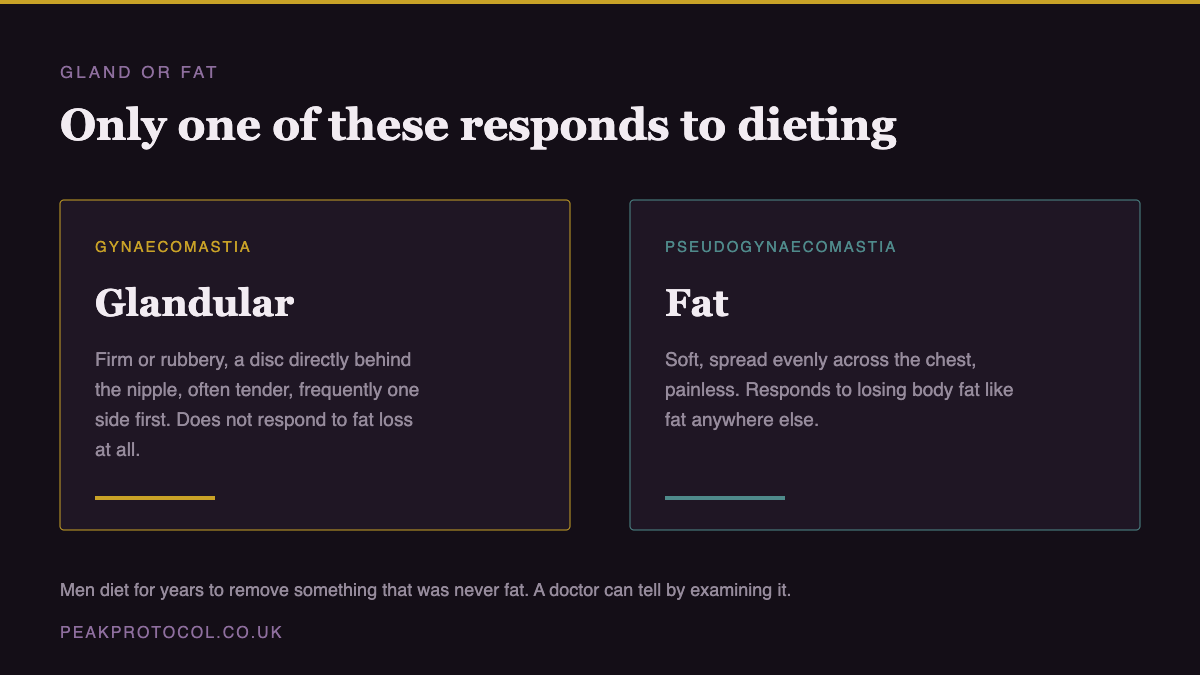
Not every man unhappy with his chest has gynaecomastia. Pseudogynaecomastia is fat rather than gland, and it is far more common.
The practical distinction is texture and location. Glandular tissue feels firm or rubbery, is concentrated in a disc directly behind the nipple, and is frequently tender, particularly early on. Fat is softer, spread more evenly across the chest, and painless.
The difference is not academic. Fat responds to losing body fat. Gland does not, at all, regardless of how lean you get. A man dieting for years to remove something that was never fat is a common and avoidable story.
If you are unsure, a doctor can tell by examining it, and an ultrasound settles it definitively.
The early warning most people ignore
Gynaecomastia announces itself before it becomes visible, and the announcement is easy to dismiss.
The first sign is usually tenderness, itching or a sensitivity behind the nipple, sometimes with a small firm lump that can be felt but not seen. It often affects one side before the other.
That stage is the window. Tissue that is actively growing can respond to intervention. Tissue that has been established for months generally cannot, and by then it is visible, which is when most people first take it seriously.
If you notice tenderness behind a nipple while using, that is the point to act rather than to wait and see.
Why it becomes permanent
Early growth involves proliferation of glandular tissue and is potentially reversible. Over months, that tissue undergoes fibrosis, meaning it is replaced by dense fibrous tissue with a different structure.
Fibrotic tissue does not shrink in response to hormonal change. Stopping the compound removes the driver, which prevents further growth, and it does not undo what has already formed.
The commonly cited window before changes become largely irreversible is around a year, and shorter is better. Nobody can tell you precisely where your own line is, which is an argument for acting early rather than for calculating how long you have.
Who is most at risk
Susceptibility varies considerably and is not entirely predictable. The identifiable risk factors are higher body fat, since fat tissue contains aromatase and converts more, using compounds that aromatise heavily, higher doses, longer duration, and a personal history of gynaecomastia during puberty, which is common and usually resolves but appears to mark susceptibility.
Adolescent use carries particular risk because the hormonal environment is already in flux.
What actually prevents it
Not using compounds that aromatise heavily is the only complete answer, and it is not the one most people want.
Beyond that: lower body fat means less aromatase activity, monitoring oestradiol on bloodwork gives you warning before symptoms appear, and acting immediately on nipple tenderness rather than waiting is the single most useful behavioural change available.
Testing oestradiol matters because it turns this from something you notice into something you can see coming.
On the drugs people use for it
The medicines used to manage this, aromatase inhibitors such as anastrozole and selective oestrogen receptor modulators such as tamoxifen, are prescription only medicines in the UK.
We are not publishing protocols or doses. What is worth stating is that these are real drugs with real effects. Aromatase inhibitors suppress oestrogen systemically, and men with too little oestrogen develop joint problems, poor lipid profiles, low libido and bone density loss. Crashing oestrogen to avoid gynaecomastia creates a different problem, and it is a common one.
They are also used legitimately for exactly this indication, under supervision, with bloods. That version involves a doctor rather than a website, and a doctor can prescribe for it. Be straightforward about your history, because it is the relevant part.
If you already have it
See a doctor and get it examined. Not because there is a non surgical fix for established tissue, but because a breast lump in a man should be assessed properly. Male breast cancer is rare and it exists, and a firm unilateral lump is exactly how it presents.
That is worth stating plainly. Assuming a lump is gynaecomastia because you have been using is an assumption, not a diagnosis.
If it is established gynaecomastia, the honest position is that surgery is the only route back, and no supplement, topical product or training approach changes that.
Surgery
The procedure removes the glandular tissue, usually through a small incision at the edge of the areola, often combined with liposuction where there is a fat component as well.
It is a day case under general or local anaesthetic, with a recovery measured in weeks and a compression garment for a period afterwards. Results are generally good and permanent, since the gland does not regrow, though it can if someone resumes the same compounds afterwards.
Scarring at the areolar edge is usually discreet. Asymmetry and contour irregularity are the more common complaints, which is an argument for choosing a surgeon on experience rather than price.
NHS or private
NHS treatment is available in limited circumstances, generally where there is significant physical or psychological impact and where the cause has been addressed, and thresholds vary between areas. It is worth asking your GP rather than assuming it is unavailable.
Privately it is a common procedure. Check the surgeon is on the GMC specialist register for plastic surgery, ask to see their own before and after photographs rather than stock imagery, and be wary of anywhere quoting a price before examining you.
The part nobody writes about
Gynaecomastia affects men psychologically out of all proportion to its medical seriousness, and pretending otherwise helps nobody.
It is medically benign in almost every case. It is also, for a lot of men, the thing that stops them taking their shirt off for years, changes how they dress, and quietly withdraws them from swimming, beaches and gyms. Research into men presenting for correction consistently finds meaningful impact on self esteem and social functioning, and that impact does not track with the physical size of the tissue.
Two things follow. If it is affecting you that much, that is a legitimate reason to seek treatment rather than something to feel embarrassed about raising, and it is also relevant to whether NHS treatment is considered.
And if you are currently weighing up whether to use compounds that carry this risk, this is the effect most likely to be dismissed in advance and most regretted afterwards, precisely because the cost is not medical.
Other causes worth ruling out
Steroids are not the only cause, and a doctor will consider others before assuming.
Puberty related gynaecomastia is very common and usually resolves on its own within a couple of years. Some prescription medicines cause it, including certain antipsychotics, some blood pressure drugs, finasteride and cimetidine. Liver disease, kidney disease, thyroid disorders and testicular tumours all can. So can heavy cannabis or alcohol use.
Mentioning this is not deflection. If you develop breast tissue and have been using, the obvious explanation is probably correct, and it is still worth a clinician checking the others, because a couple of them matter considerably.
What does not work
Losing body fat, which helps only if what you have is fat. Chest training, which builds the muscle underneath and can make glandular tissue more prominent rather than less. Topical creams and gels sold for it. Supplements marketed as oestrogen blockers, which are food supplements and do not remove established tissue.
We sell natural estrogen support supplements in our shop and we will say the same thing on those product pages that we say here: they hold no authorised health claims in Great Britain, and nothing in that category removes glandular tissue that has already formed.
A realistic timeline
Putting the stages together, because the sequence is what determines your options.
Weeks one to four of exposure. Nothing visible. Oestradiol rising on bloods if you are testing, which is the only warning available at this point.
First signs. Tenderness or itching behind a nipple, often one side, sometimes a small lump you can feel. This is the window, and it is the stage most people wait through.
Weeks to months. Tissue becomes palpable then visible. Still potentially responsive to intervention early in this stage, decreasingly so as it continues.
Beyond several months. Fibrosis sets in and the tissue stops responding to hormonal change. From here it is surgical or it stays.
The practical lesson is that the useful decisions all happen in the first two stages, when there is least to see and least apparent urgency.
Frequently asked questions
Does gynaecomastia go away if I stop taking steroids?
Stopping prevents further growth. It does not remove glandular tissue that has already formed and fibrosed. Only surgery does that.
How do I know if it is gyno or just fat?
Glandular tissue is firm, sits in a disc directly behind the nipple, and is often tender. Fat is soft, evenly spread and painless. A doctor can tell by examination and an ultrasound is definitive.
What is the first sign of gyno?
Tenderness, itching or sensitivity behind the nipple, often on one side, sometimes with a small firm lump that can be felt before it can be seen. That stage is the window for doing anything about it.
Can I get gyno surgery on the NHS?
In limited circumstances, generally where there is significant physical or psychological impact. Thresholds vary by area, so ask your GP rather than assuming.
Do oestrogen blocker supplements help?
No. They are food supplements with no authorised health claims in Great Britain, and nothing in that category removes established glandular tissue.