

About Peak Protocol. This page sets out who writes this site, what we sell, and the rules we hold ourselves to. If you want the short version: legal food supplements only, claims kept inside the authorised list, and no dosing advice about anything controlled.
What this page is about, first. Peak Protocol exists because the information around steroids and testosterone in the UK is split between two kinds of website, and neither is any use to you.
The first kind sells the compounds. Those sites are committed to a criminal offence carrying up to fourteen years, and everything they publish exists to move stock, so nothing on them can be trusted. The second kind is written to frighten. It treats anyone asking a question as already lost, which means the people who most need accurate information close the tab and go back to a forum.
On this page
- What we do instead
- What we will not do
- How the site is written
- What we actually sell
- How the money works, and what it costs us
- Who writes this, and what is missing
- The rules we work inside
- How to read a product page here
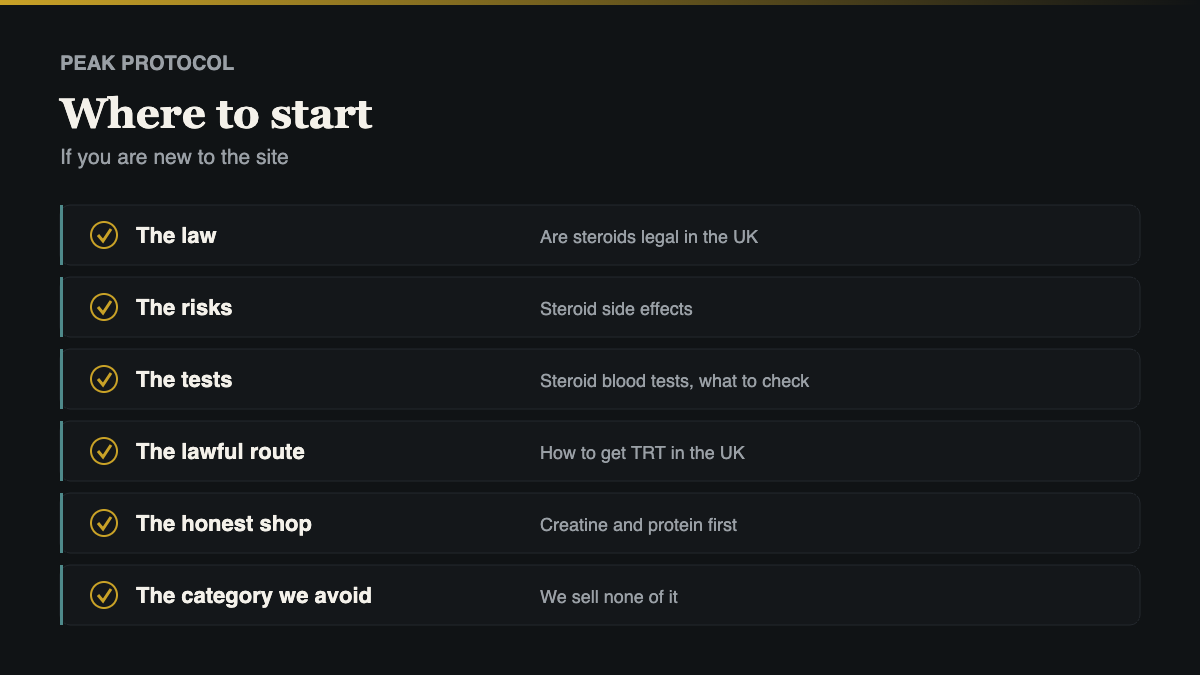
- Where the shop and the guides meet
- What has changed, and what has not
- What we get wrong, and how to tell us
- How to judge a site like this one
- Questions about Peak Protocol

What we do instead
We explain what the law actually says, including the parts people get wrong, such as the fact that possession for personal use and supply are treated completely differently under the Misuse of Drugs Act 1971. We cover side effects using the evidence rather than the anecdotes. We publish harm reduction material because people make these decisions with or without accurate information, and the version with accurate information goes better.
Then we sell legal supplements, with the doses printed and the claims kept inside what is authorised in Great Britain. Where an ingredient has no authorised claim behind it, the product page says so rather than implying one.
That combination is unusual and it is the entire point. A shop that only sells cannot be trusted about what works. A publisher that only publishes has no reason to be careful about the products it recommends. Doing both, in public, with the trade offs written down, is harder and more useful.
What we will not do
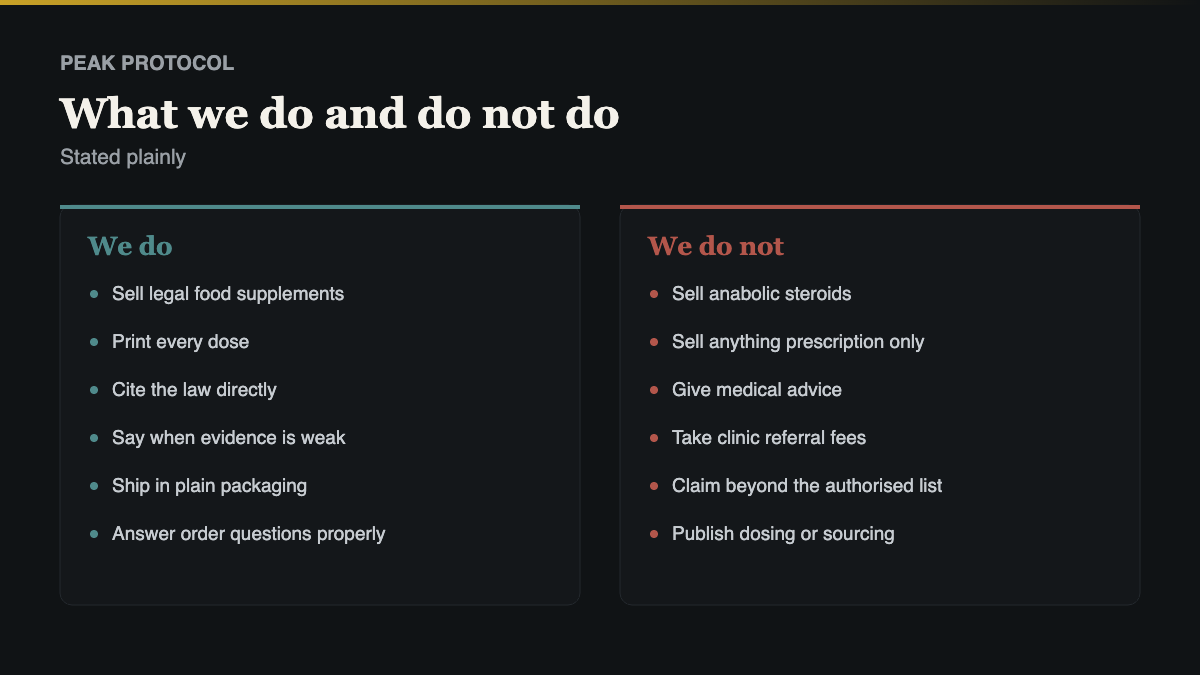
We do not sell anabolic steroids, prescription only medicines or SARMs, and we never will. We do not describe supplements as legal steroids or steroid alternatives, because that phrasing is both misleading and against UK advertising rules that the Advertising Standards Authority enforces. We do not publish before and after photographs implying a supplement caused a transformation.
We do not publish dosing protocols for controlled compounds. The guides explain what a substance does and what the risks are; they stop before the part that tells you how to take it. That line is deliberate and it is not negotiable, whatever the search demand looks like.
We do not run a fat burner category, because a legal food supplement cannot produce meaningful fat loss and stocking one implies otherwise. We do not use proprietary blends in our own label, because a blend exists to hide how little of each ingredient is present.
How the site is written
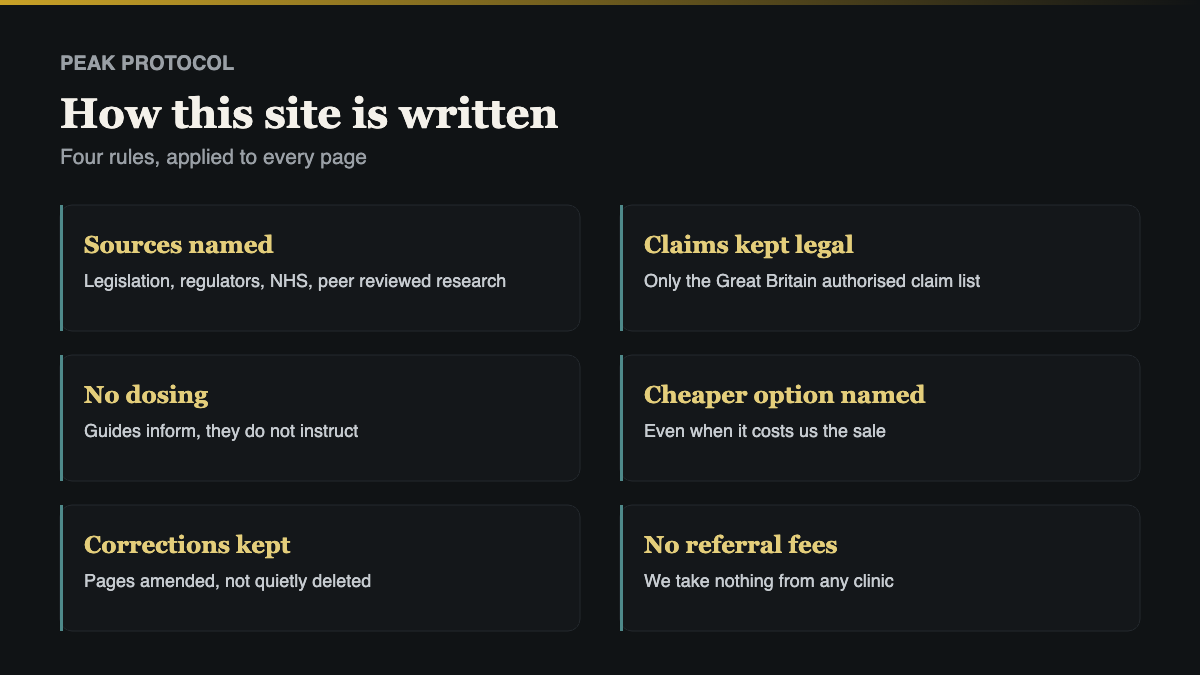
Every guide starts from primary sources. Legislation comes from legislation.gov.uk rather than from somebody else’s summary of it. Health information comes from the NHS and from peer reviewed research. Drug information comes from Talk to Frank. Claim wording comes from the Great Britain nutrition and health claims register rather than from what a competitor has got away with saying.
Where the evidence is genuinely thin, the page says the evidence is thin. Several product pages on this site tell you the product will do very little for you. That is not modesty, it is the only way the pages where we say something works are worth anything.
Where a number cannot be verified, we do not repeat it. Manufacturers publish figures that are sometimes marketing rather than measurement, and a retailer passing those on without a caveat is laundering them. Our editorial policy sets out the sourcing rules in full, and our experts covers who does the work.
What we actually sell
One hundred and five products across thirteen categories, every one of them a food supplement. Thirty eight are our own label and sixty seven come from twenty two other companies. The brand index covers who makes what and where each brand is genuinely the best answer.
| What we stock | Why it is here |
|---|---|
| Protein and creatine | The two categories with authorised claims and the largest, least disputed effects |
| Vitamins and minerals | Correction of real shortfalls, principally vitamin D through a British winter |
| Amino acids and pre workout | Stocked because people ask for them, sold with the evidence stated honestly |
| Testosterone support | Vitamin D, zinc, magnesium and two botanicals, framed as correction rather than enhancement |
| Anabolic steroids, SARMs, prescription medicines | Never. Not now and not later, whatever the margin looks like |
How the money works, and what it costs us
We also lose sales on purpose, and it is worth being explicit about how. A product page that says the category has weak evidence sells less than one that does not. A guide that ends by telling you a blood test matters more than a supplement sells nothing at all. Roughly half of what we publish covers compounds we will never stock.
The commercial logic is longer term than a single order. People who work out that every answer on a site leads to the house product stop believing the site. People who find one page telling them not to buy something come back. That is the whole business model and it is slower than the alternative.
Prices are set the same way. Own label products skip licensing and marketing costs so you pay for the ingredient. Imported brands carry a premium that buys a track record. Every product page compares cost per serving rather than cost per tub, which is the comparison that favours us least often and informs you most.
Who writes this, and what is still missing
Content is researched and written by the Peak Protocol editorial team, working from the sources listed above. There is one gap and we are not going to bury it: no named medical reviewer is in place yet.
We are appointing a qualified reviewer registered with the General Medical Council or the General Pharmaceutical Council, to check every health page before publication. Until that appointment is made and named, health articles carry a notice saying they are awaiting medical review. We could have invented a plausible advisor with a stock photograph, which a great deal of this industry does. An incomplete page is better than a fabricated credential, because if we lie there you have no reason to believe anything else.
The rules we work inside
Everything sold here is a food supplement rather than a medicine, which places it under food law rather than under the MHRA. That sets what may be said: only claims on the GB register, only where the product delivers the required amount of the nutrient, with the Food Standards Agency overseeing the sector.
Distance selling adds a second layer. Unopened supplements can be returned within fourteen days under the Consumer Contracts Regulations 2013, and faulty goods are covered by the Consumer Rights Act regardless of what any policy page says. Shipping and returns sets out how that works in practice.
For anyone competing under anti doping rules there is a third layer that no retailer can solve for you: a clean formulation is not the same as a clean batch. UK Anti-Doping publishes guidance, and the honest advice is to check the batch rather than trust any brand, including ours.
How to read a product page here
Product pages on this site are laid out the same way every time, and knowing the shape saves you reading all two thousand words of one.
The panel at the top states the format, the price and who the product is for, and then states what it is not. That second line is the one worth reading: it is where a page tells you the thing you are about to buy does not do what the category is usually sold on.
Below that, the specification table prints the pack size, the price, the cost per hundred grams and the brand. Cost per hundred grams is the number that makes two products comparable, and it is the one the industry least likes to publish.
Then the sections: what the active does, why this particular product, what may lawfully be claimed about it, who it suits, how to take it, what to expect and by when. Near the bottom there is always a comparison table putting the product against the alternatives on our own shelves, including the ones that beat it. If you read nothing else, read that table.
Where the shop and the guides meet
The most common question we get about the structure of this site is why a shop carries twenty four long guides about compounds it refuses to stock. The answer is that the two halves are solving the same problem from different ends.
Somebody researching anabolic steroids is trying to work out what a compound does, what it costs them physically, and whether the legal position is what they assumed. Those are answerable questions and the answers are not on the sites selling the compounds. Somebody buying creatine is trying to work out whether the expensive tub is better than the cheap one. Also answerable, also not answered honestly in most of the places selling it.
Both readers are asking to be told the truth about something that costs them money or health. The guides and the product pages are written by the same people to the same standard, and the only real difference is that one half has something to sell at the end and the other does not.
In practice the guides send far more people away than they convert. A reader who arrives worried about low testosterone and leaves with a link to the blood test guide rather than a product is the normal outcome, and it is the right one.
What has changed, and what has not
Two things about this site have changed since it launched and are worth stating plainly, because both are visible if you look.
The range has grown from a short own label list to one hundred and five products, which brought in imported brands we do not control. That raised a question about how to review a product we did not formulate, and the answer we settled on was to review it exactly as harshly as our own. The brand pages say where a competitor beats us and where a famous name is charging for the logo.
Prices have moved, in one direction. When we found seventeen products carrying an import placeholder price rather than a real one, every correction reduced the price. That is the sort of thing a shop can fix quietly, and saying it here is cheaper than being asked about it later.
What has not changed is the refusal list. No anabolic steroids, no SARMs, no prescription medicines, no dosing protocols, no proprietary blends in our own label, no before and after photographs, and no describing a supplement as a legal steroid. Those were the rules on day one and there is no version of the business where they become negotiable.
What we get wrong, and how to tell us
This site carries a lot of numbers, a lot of law and a lot of study interpretation, and some of it will be wrong. Law changes, evidence moves, and a figure that was accurate at publication drifts.
When something is corrected, the page changes and the correction is not hidden. We would rather republish a page with an awkward admission in it than leave a confident error standing. If you find one, tell us with the page and what you think is wrong, and it gets looked at by a person rather than filed.
How to judge a site like this one
Everything written above is a claim about ourselves, which is the least reliable kind of evidence there is. Nobody should believe a page about a company written by that company. So here are four checks you can run on this site, or on any competitor, without taking anyone’s word for it.
Look for a page that argues against a sale. Search the site for a product page that tells you the product does very little. If there is not one anywhere, the reviews are marketing about marketing.
Check whether the claims match the register. Take any health claim on a product page and look for it on the GB nutrition and health claims register. A shop making claims that are not on that list is telling you something about how it treats everything else.
See whether the sources are primary. Links to legislation, the NHS and published research can be checked. Links to other blogs cannot. This matters more than anything a site says about its own standards.
Find the part they admit to. Every honest site has a gap in it. Ours is on this page and on our experts: there is no named medical reviewer yet. A site with nothing to admit is either perfect or not telling you about the parts that are not.
Questions about Peak Protocol
Is Peak Protocol a UK company?
Yes. We are a UK based retailer of legal food supplements and a publisher of health information, and everything ships from UK stock. Our terms are governed by the laws of England and Wales.
Do you sell anabolic steroids?
No, and we never will. Every product on this site is a legal food supplement. The guides about controlled substances exist because people search for accurate information about them, not because there is anything to sell at the end.
Why does a supplement shop publish harm reduction material?
Because people make these decisions either way, and the version with accurate information goes better. Withholding it does not prevent use, it just moves the reader to a worse source.
Who checks the health content?
The editorial team, against primary sources. A named medical reviewer is being appointed and until that is in place the health pages say so. We are not going to claim a review that has not happened.
How do I contact you about an order?
Email Contact@peakprotocol.co.uk and a person replies, usually within one working day. The contact page sets out what we can and cannot help with.
Can I trust a shop that reviews its own products?
Judge it on whether the reviews ever go against the sale. Several product pages here tell you the category has weak evidence, and the brand pages name competitors that beat us on price or format. That is the test worth applying to any retailer.
That is everything worth knowing about how this site operates. If you are new here, start with what legal supplements actually do, or browse the guide library. If you already know what you want, the shop prints every dose.