
Information and harm reduction only, never medical advice. Sourced from the NHS, TALK TO FRANK, the MHRA and peer reviewed research, and written to say plainly where the evidence runs out rather than filling the gap. Always speak to a qualified clinician before changing anything. See our editorial policy.
A testosterone blood test is the single most useful thing you can do before making any decision in this area, and it is also the step most people skip. This page explains what to ask for, when to take it, which route to use, and how to read what comes back.
We do not sell blood tests and we are not a clinic. This is written so you arrive at a GP or a private provider knowing what you need rather than accepting whatever is offered.
Why get tested at all
Because a very large number of men who are certain their testosterone is low turn out to be in range, and a smaller number who assume they are fine turn out not to be.
The symptoms of low testosterone, fatigue, low libido, low mood, poor concentration, lost muscle and gained fat, are also the symptoms of poor sleep, excess body fat, heavy drinking, chronic stress, thyroid problems, depression and iron deficiency. Every one of those is more common than hypogonadism. Guessing gets you the wrong treatment for the wrong problem.
A test settles it. If you are considering TRT, no responsible clinician will treat you without one anyway.
What to ask for on the panel
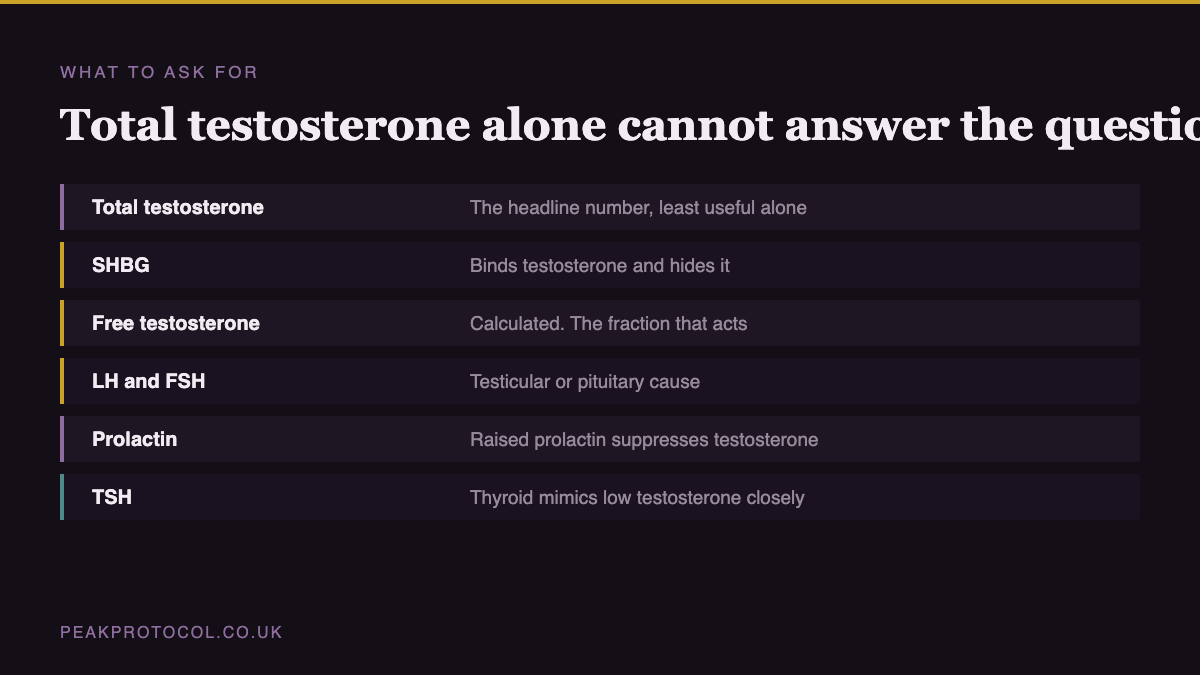
Asking for a testosterone test usually gets you total testosterone alone, which is not enough to interpret. A useful panel includes:
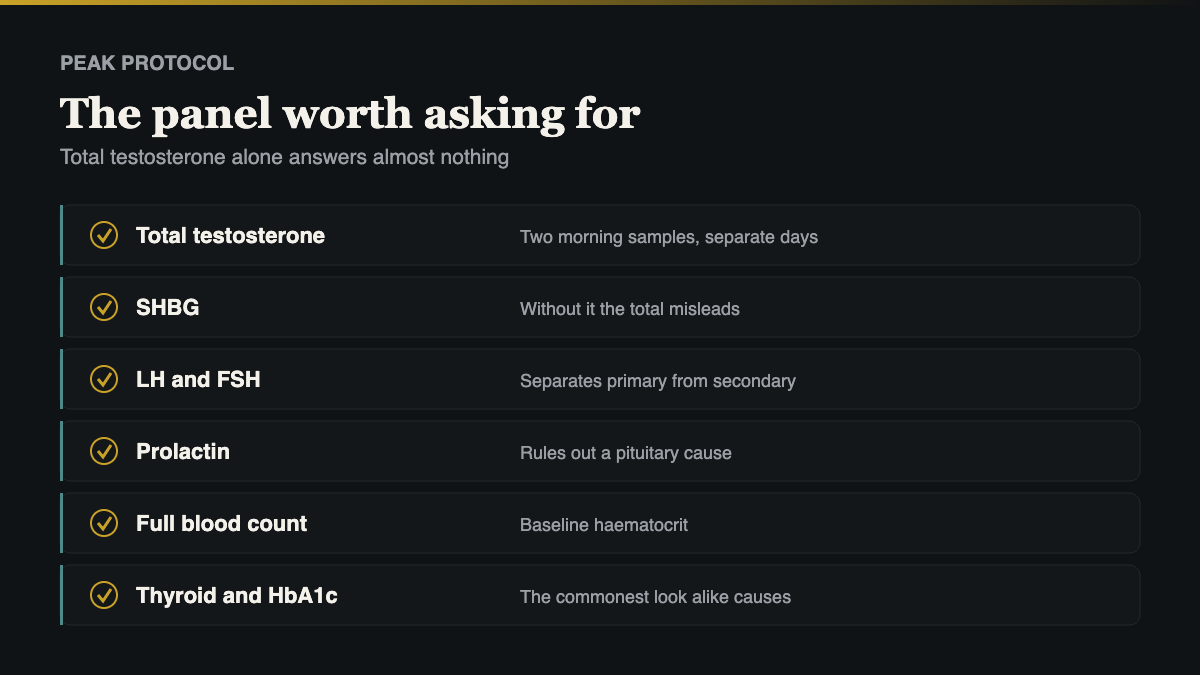
- Total testosterone. The headline number, and the least informative on its own.
- SHBG. Sex hormone binding globulin, which binds testosterone and makes it unavailable to tissue.
- Free testosterone, calculated from total and SHBG. The fraction that actually does anything.
- LH and FSH. These distinguish whether the problem sits in the testes or the pituitary, which changes the diagnosis entirely.
- Oestradiol. Relevant to symptoms and to monitoring.
- Prolactin. Raised prolactin suppresses testosterone and occasionally points to a pituitary issue needing investigation in its own right.
- Full blood count, liver, kidney and lipids. Baseline general health, and essential if treatment follows.
- TSH. Thyroid problems mimic low testosterone closely.
If a provider will not run LH, FSH and SHBG, they are giving you a number rather than an answer.
Timing, and why it decides the result
Testosterone follows a daily rhythm, peaking early and falling through the day. The difference between an eight in the morning sample and a three in the afternoon sample can be the difference between a normal result and an apparently low one, in the same man on the same day.
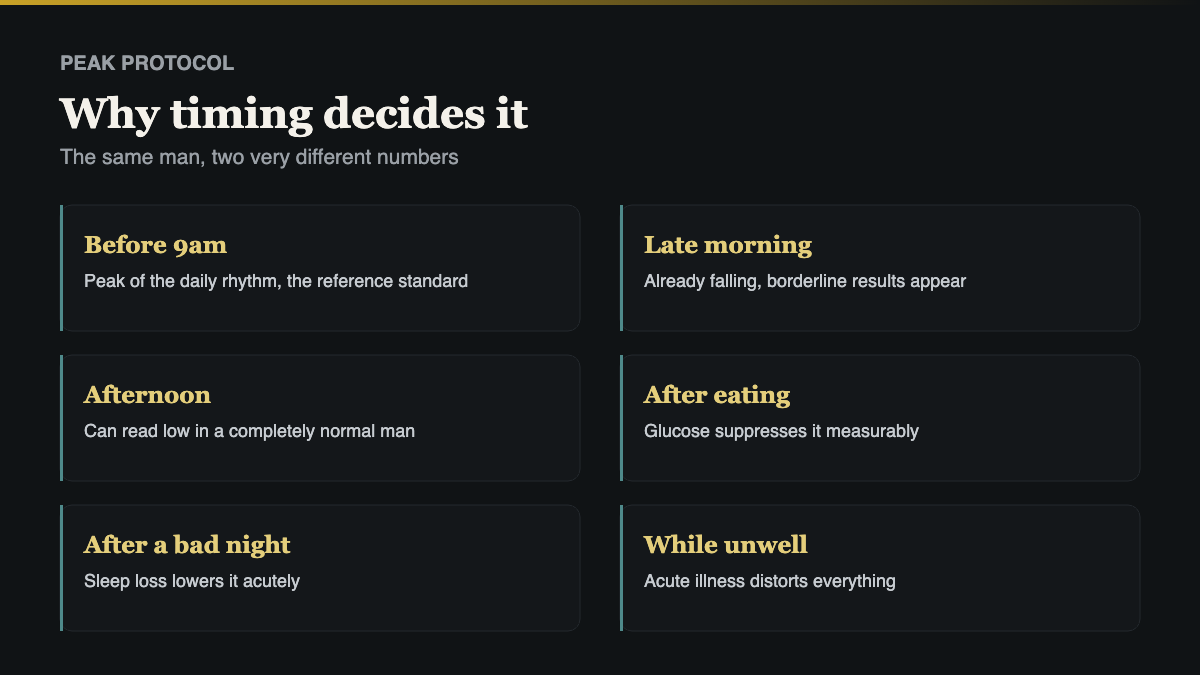
UK guidance is consistent: test in the morning, ideally before 11am, fasted, and repeat on a second separate day before drawing conclusions. Two morning samples is the standard because a single reading misleads in both directions.
Other things that shift a reading are acute illness, a bad night of sleep, heavy training in the previous 24 hours, and significant alcohol the night before. If any applies, reschedule rather than collecting a number you will then have to argue about.
GP, clinic or home kit
Your GP. Free, and the right first stop. Describe symptoms plainly and ask specifically for a morning total testosterone with SHBG, LH and FSH. Some practices run the full panel without argument. Others run total testosterone alone, or decline, particularly with younger men.
Where a low result leads next is covered in NHS vs private TRT.
A private clinic. Faster and more thorough, and it costs. The advantage is a panel designed for this question. The disadvantage is that a clinic which also sells the treatment has an interest in the answer, which is worth holding in mind rather than assuming bad faith.
A home finger prick kit. The middle option, and increasingly the most practical.
How home kits work
The kit arrives with a lancet, a collection tube and a prepaid return envelope. You prick a finger, usually first thing, fill the tube and post it the same day. Results come back within a few days through an online portal.
Two things matter when choosing one: the laboratory and the panel. The lab should be UKAS accredited, the UK standard for testing competence. The panel should include SHBG, LH and FSH rather than total testosterone alone. A cheap kit reporting one number is not a saving.
Two practical points that catch people out. Warm your hands thoroughly first, because a cold finger produces a slow bleed and an underfilled tube gets rejected. And post it the same day, since sample degradation affects the result.
Interpretation should come from a clinician, not from a forum and not from us. A good provider includes a doctor comment with the result.
Why total testosterone alone misleads
This is the most useful thing on this page.
Most testosterone in your blood is bound to SHBG and albumin, and while bound it is unavailable to tissue. Only the free fraction does anything. If your SHBG is high, total testosterone can sit comfortably in range while free testosterone is genuinely low, and you will have every symptom of low testosterone alongside a result somebody has told you is normal.
That scenario is common, it causes a great deal of frustration, and it is invisible on a total testosterone test. It is the single strongest argument for insisting on SHBG.
What the numbers mean
UK laboratories report total testosterone in nanomoles per litre. Clinical guidance works with threshold bands: clearly below the lower threshold in a symptomatic man supports treatment, comfortably in range argues against it, and a band in between depends on free testosterone, symptoms and judgement.
We are deliberately not printing specific cut offs. Thresholds differ between guidelines, laboratories differ in assay and reference range, and a number quoted out of context is exactly how people talk themselves into or out of treatment incorrectly. Your report carries its own reference range and that is the one that applies to your sample.
What matters is the structure: clearly low, clearly normal, and a grey zone that needs a conversation.
Reading the reference range
Laboratories report a reference range alongside your figure, and it is wider than most people expect. That range represents the spread found across a reference population. It is not a target, it is not personalised, and it is not adjusted for age in the way people assume.
Two men can both sit inside the same range and feel completely different, because the range is broad enough to contain both. That is why a result described as normal does not settle the question on its own, and equally why a result marginally under the line does not automatically mean treatment.
Reference ranges also differ between laboratories, because they depend on the assay used. A figure from one lab is not directly comparable to a figure from another, which matters if you are tracking over time. Where you can, retest with the same provider.
What it costs
Through your GP it is free. Privately, the price spread is wide and it tracks the panel rather than the quality of the laboratory, since most private providers use the same handful of accredited labs.
What you are paying for is the number of markers, the speed of the result, and whether a clinician comments on it. A single total testosterone is the cheapest and the least useful. A full male hormone panel with SHBG, LH, FSH, prolactin and thyroid costs several times more and actually answers the question.
We are not printing specific prices, because they change and a stale figure is worse than none. Compare on the marker list rather than the headline price, and check the laboratory is UKAS accredited before anything else.
Five mistakes when getting tested
Testing in the afternoon. The most common, and it produces a low reading in a man with normal testosterone.
Testing once. A single result is a snapshot of a fluctuating value.
Ordering total testosterone alone. Without SHBG you cannot calculate the free fraction, which is the part that matters.
Testing the day after a heavy session or a heavy night. Both distort the result, in opposite directions.
Interpreting it yourself. Reference ranges are broad, assays differ, and the internet will confidently tell you that anything under the top of the range is a crisis. Get a clinician to read it.
If your result is low, what causes that
Low testosterone is a finding, not a diagnosis, and the useful question is why.
Clinicians divide the causes by where the fault sits. Primary means the testes are not producing despite being told to, and LH and FSH come back high because the pituitary is signalling harder to compensate. Causes include injury, infection, undescended testes, chemotherapy and Klinefelter syndrome. Secondary means the signal itself is weak, and LH and FSH come back low or inappropriately normal. Causes include pituitary problems, raised prolactin, significant obesity, opioid use, chronic illness and prior anabolic steroid use.
That is exactly why LH and FSH belong on the panel. Without them you know the level is low and nothing about the reason, and the reason determines the treatment. A prolactin secreting pituitary tumour presents as low testosterone and needs treating in its own right rather than being papered over with replacement.
It is also why a doctor investigating rather than immediately prescribing is doing their job properly, even when it feels like being fobbed off.
What to do with the result
Clearly low. Take it to a doctor. Low testosterone has causes, and some of them, a pituitary problem for instance, matter considerably more than the symptom that brought you in. Treating the number without investigating the cause is poor medicine.
Grey zone. Ask for free testosterone and a repeat morning test, and address sleep, body fat and alcohol properly for three months first. A meaningful number of men resolve their symptoms that way at no cost.
Normal. The answer was never testosterone. That is genuinely good news even though it rarely feels like it, because the actual cause is still findable. No supplement raises testosterone in a man whose level is already normal, and our product pages say so rather than implying otherwise.
The panel if you already use steroids
Different purpose, same tests, plus several more.
A baseline taken before you started is worth more than anything measured afterwards, and if you did not take one, take the earliest you can. Beyond hormones, the markers that matter are haematocrit, because raised red cell volume is a clotting risk, liver function particularly on oral compounds, kidney function, lipids, and blood pressure at home.
Detail is in steroid blood tests, what to check. Be honest with whoever reads the results. They are interpreting numbers, not reporting you, and a clinician who does not know what you have taken cannot help you properly.
Five mistakes that waste the money
Most of the money wasted on this is wasted in five predictable ways, and all five are avoidable before you book anything.
One, testing at the wrong time of day. Testosterone follows a daily rhythm and peaks in the morning. An afternoon testosterone blood test UK wide can read low in a man whose morning level is entirely normal, and this single error produces more wrong answers than everything else combined.
Two, testing once. A diagnosis requires two morning samples on separate days, because day to day variation is large. Anyone offering to diagnose from one result is not following the standard that NHS endocrinology uses.
Three, ordering total testosterone alone. Without SHBG the total figure can mislead badly in both directions, and a testosterone blood test UK panel that omits it is giving you half the picture for most of the price.
Four, testing while something else is going on. Acute illness, a run of bad sleep, a heavy training block or a crash diet all suppress testosterone temporarily. The result will be real and it will not mean what you think.
Five, buying the cheapest kit. A finger prick testosterone blood test UK kit that measures total only, at a time of your choosing, with no clinical interpretation, produces a number rather than an answer.
Next steps after a borderline result
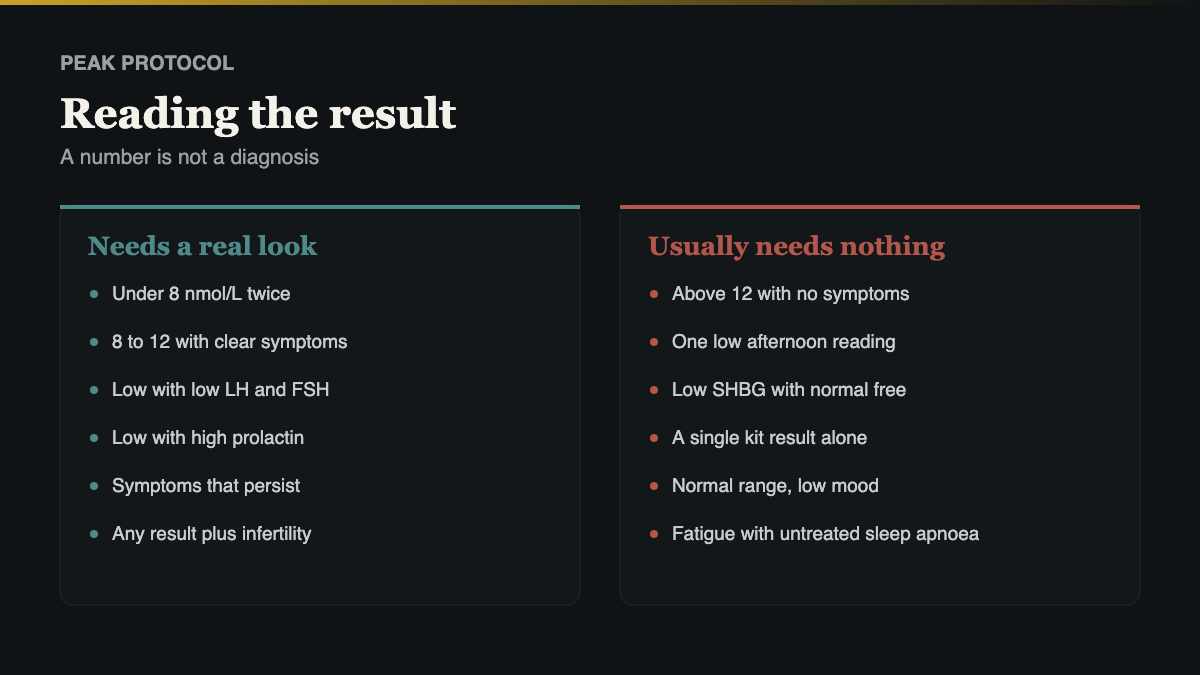
A number on its own changes nothing. What matters is what you do with it, and there are only three sensible paths.
If it is clearly low, go to a GP with the paperwork. Two morning results under the reference range, with symptoms, is a reasonable basis for a referral. Bring the printouts. How to get TRT in the UK covers the conversation and what to say, and a testosterone blood test UK result you already hold makes it considerably shorter.
If it is borderline, look at the reversible causes first. Sleep apnoea, excess weight, alcohol and overtraining all suppress testosterone, and all of them respond. Low testosterone symptoms covers what genuinely discriminates and what is just tiredness.
If it is normal and you still feel awful, the answer is elsewhere. That is worth saying plainly, because a normal testosterone blood test UK result is often treated as a dead end when it is actually useful information. Thyroid disease, depression, iron deficiency and poor sleep all produce the same symptom list.
And if you are already using anything, test anyway. The panel changes: you are looking at the full steroid blood test set rather than a diagnostic one, and the numbers that matter most are lipids and haematocrit rather than testosterone itself.
Testosterone blood test: common questions
Can I get a testosterone test on the NHS?
Yes. Ask your GP for a morning total testosterone, and specifically ask for SHBG, LH and FSH alongside it.
What time of day should I take a testosterone test?
Morning, ideally before 11am and fasted. Levels fall through the day, so an afternoon sample can read low in a man with entirely normal testosterone.
Are home testosterone tests accurate?
A finger prick sample analysed by a UKAS accredited laboratory is reliable. What varies is the panel. A kit reporting total testosterone alone cannot answer the question properly.
Why do I have symptoms if my testosterone is normal?
Either the cause is something else, which is common, or your SHBG is high enough that free testosterone is low while total reads normal. Ask for SHBG and calculated free testosterone.
How many times should I test before starting treatment?
At least twice, on separate mornings. Standard UK practice does not treat on a single reading.
What should a testosterone blood test UK panel include?
Total testosterone taken before 11am on two separate days, plus SHBG, LH, FSH and prolactin. A full blood count and thyroid function are worth adding, because thyroid disease produces almost the same symptom list and is far more common.
Are home testosterone blood test UK kits accurate?
The better ones are analysed in accredited laboratories and are reasonably reliable for total testosterone, but they depend entirely on you taking the sample at the right time. They are a screening tool, not a diagnosis, and most do not include LH, FSH or SHBG.
What testosterone level is considered low in the UK?
Below about 8 nmol/L on two morning samples is generally accepted as low and warrants treatment if symptoms fit. Between 8 and 12 is a grey zone where clinicians genuinely disagree, and above 12 is usually considered normal.