Vitamins and Minerals
Most people training hard do not need most of a multivitamin. What a fair number of people in Britain do need is vitamin D through the winter, and possibly iron or B12 depending on how they eat. This category exists to cover the gaps a normal UK diet actually leaves, not to sell you thirty nutrients on the off chance.
Everything below carries a GB authorised health claim, which is a meaningful filter. If a nutrient has a claim it is because the evidence cleared a regulatory bar. What follows is which gaps are real, at what dose, and which forms are worth paying for.
On this page
- Vitamin D, the one that matters here
- Iron, and who is actually short
- B12 and folate
- Omega 3
- Magnesium and zinc
- Multivitamins, and when they make sense
- Forms worth paying for
- Should you get tested first
- Food first, and what that means
- How to choose from this range
- Absorption and timing
- Upper limits and interactions
- Common questions
Vitamin D, the one that matters here
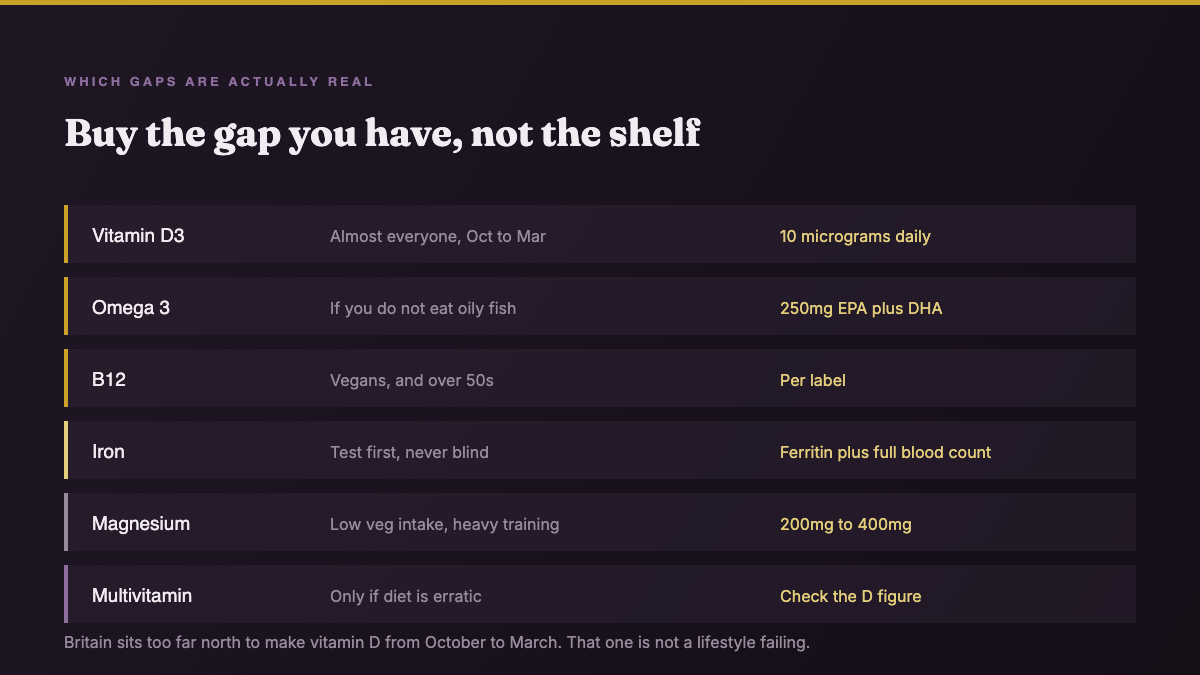
Britain sits too far north for the skin to make vitamin D between roughly October and March. The sun does not get high enough in the sky, regardless of how much time you spend outside. That is a geographical fact rather than a lifestyle failing, and it is why UK guidance is unusual in recommending a supplement to the whole population.
The NHS advises everyone to consider 10 micrograms, which is 400 international units, daily through autumn and winter, and advises some groups to take it year round. Those groups include people who are rarely outdoors, people who cover most of their skin, and people with darker skin, in whom higher melanin reduces synthesis.
Vitamin D has authorised claims for the maintenance of normal bones, teeth and muscle function, and for the normal function of the immune system. D3 is the form to buy, since it raises and maintains blood levels more effectively than D2. Take it with a meal containing fat.
Iron, and who is actually short
Iron is the nutrient most often needed and most often taken unnecessarily. Deficiency is common in menstruating women, in endurance athletes, and in people eating little or no red meat. It is uncommon in men eating a mixed diet, and men should not supplement iron without a blood test, because the body has no route to excrete a surplus.
Iron has authorised claims for normal oxygen transport, normal red blood cell formation and the reduction of tiredness and fatigue. Plant sources contain non haem iron, which absorbs less readily, and vitamin C taken alongside improves that substantially. Tea and coffee within an hour of the dose reduce it.
B12 and folate
B12 is found almost exclusively in animal foods, so anyone eating a vegan diet needs a supplement or reliably fortified foods. This is not optional and it is not a preference, because a prolonged shortfall causes neurological damage that is not always reversible.
Absorption also declines with age as stomach acid production falls, so people over about fifty benefit from a supplement even on a mixed diet. B12 has authorised claims for normal red blood cell formation, normal nervous system function and the reduction of tiredness and fatigue.
Folate matters most before and during early pregnancy, where 400 micrograms daily before conception and through the first twelve weeks reduces the risk of neural tube defects. That is a specific, well established recommendation rather than a general wellbeing claim.
Omega 3
The authorised claims sit with EPA and DHA, which contribute to normal heart function at 250mg a day, with further claims for brain and vision at that intake. Those numbers are the ones to compare, and they are not the same as the fish oil content on the front of the bottle.
A 1000mg capsule of standard fish oil typically contains around 180mg EPA and 120mg DHA, so one capsule roughly meets the 250mg combined threshold. Concentrated products deliver the same in a smaller capsule. Read the EPA and DHA figures on the back, not the oil weight on the front.
If you eat two portions of oily fish a week, one of them oily, you are already there. Algal oil gives vegans the same EPA and DHA without fish.
Magnesium and zinc
Both are covered in more depth in the testosterone support range, where the same products appear with a different framing. In short, magnesium has authorised claims for normal muscle function, normal protein synthesis and reduced tiredness, and bisglycinate is the form worth buying. Zinc has claims covering normal immune function and the maintenance of normal serum testosterone concentrations, and 15mg to 25mg is the usual supplemental range.
| Nutrient | Who is usually short | Typical dose |
|---|---|---|
| Vitamin D3 | Almost everyone, October to March | 10 micrograms (400 IU) daily |
| B12 | Vegans, and adults over about 50 | Per label, higher doses are poorly absorbed but harmless |
| Iron | Menstruating women, endurance athletes, low red meat diets | Test before supplementing |
| Omega 3 (EPA and DHA) | Anyone not eating oily fish | 250mg EPA plus DHA daily |
| Magnesium | Low vegetable intake, heavy training | 200mg to 400mg elemental |
| Zinc | Vegetarians, heavy sweaters | 15mg to 25mg |
Multivitamins, and when they make sense
A multivitamin is insurance rather than treatment. It provides small amounts of many nutrients, which suits someone whose diet is genuinely erratic and suits nobody who has one specific deficiency, because the dose of any single nutrient is usually too low to correct a real shortfall.
The trap is believing a multivitamin covers vitamin D through a British winter. Many contain 5 micrograms or less, half the recommended amount, so people taking one every day still fall short. Check the D figure on the label and top it up separately if needed.
If your diet is decent, buying the two or three things you are actually short of costs less and works better than a thirty ingredient tablet.
Forms worth paying for
Most of the time the cheap form is fine and the premium form is marketing. There are a few exceptions where the difference is real.
Magnesium oxide is poorly absorbed and is what fills cheap multivitamins, so bisglycinate or citrate is worth the difference. Vitamin D3 outperforms D2. Iron bisglycinate causes less constipation than ferrous sulphate at equivalent doses, which matters if the sulphate form has already put you off. For B12, cyanocobalamin is well studied and inexpensive, and methylcobalamin is not clearly better for most people despite costing more.
Everywhere else, buy on price per daily dose.
Absorption and timing
Fat soluble vitamins, A, D, E and K, need dietary fat to absorb properly, so take them with a meal rather than with water first thing. Iron absorbs best on an empty stomach but causes nausea that way for many people, and taking it with vitamin C and without tea or coffee is the usual compromise.
Calcium and iron compete, so do not take them together. Zinc and copper compete over time, which is why sustained high zinc intakes are a bad idea. Most water soluble vitamins are unaffected by timing, and the expensive urine joke is true, because excess B vitamins and vitamin C are simply excreted.
Upper limits and interactions
More is not better and a few nutrients are genuinely risky in excess. Vitamin A in the retinol form accumulates and is harmful in high doses, particularly in pregnancy, where liver and high dose retinol supplements should be avoided. Iron overdose is dangerous and is a leading cause of poisoning in young children, so keep it out of reach.
Vitamin D is fat soluble and accumulates, though ordinary supplemental doses are well within safe limits. Selenium has a narrow window between adequate and excessive. Very high vitamin C causes diarrhoea and nothing worse in healthy people.
On interactions, ask a pharmacist if you take prescribed medication. The common ones are vitamin K with warfarin, calcium and magnesium with certain antibiotics and thyroid medication, and St John’s wort with a long list of drugs.
Should you get tested first
For most of this category testing is unnecessary, because the doses are modest and the nutrients are ones a normal diet supplies in some quantity anyway. Two are worth testing before you buy.
Iron is the clearest case. Ferritin plus a full blood count tells you whether stores are genuinely low, and supplementing without knowing is either pointless or, in men, potentially harmful. Vitamin D is the second, though here the calculation is different, because the standard winter dose is low enough that most people can simply take it without testing. Test if you have symptoms, if you are in a higher risk group, or if you want to know before taking a higher dose.
B12 is worth testing in vegans who have gone years without supplementing, and in older adults with unexplained fatigue or neurological symptoms. Beyond those, routine micronutrient panels sold direct to consumers tend to generate more anxiety than useful action.
Food first, and what that actually means
Every nutrient here except vitamin D in winter is obtainable from food, and food brings fibre, protein and the compounds that do not fit neatly into a capsule. Oily fish twice a week covers omega 3. Red meat, shellfish and dairy cover zinc and iron. Leafy greens, nuts and wholegrains cover magnesium and folate.
Food first is not an argument against supplements, it is an argument for knowing which gap you are filling. Someone who eats none of the above has several real gaps. Someone who eats all of it has one, and it is vitamin D between October and March.
How to choose from this range
Start from your actual diet rather than from the shelf. If you eat a mixed diet in Britain, vitamin D through autumn and winter is the one purchase almost everyone can justify. Add omega 3 if you do not eat oily fish. Add B12 if you are vegan or over fifty. Get iron tested before buying it.
That is usually three products or fewer, and it is a far better use of the money than a thirty ingredient tablet bought on the assumption that more must be better. Every product below prints the amount per serving and the percentage of the nutrient reference value, so the comparison takes seconds.
If you are training hard, the ranges that move performance are protein and creatine rather than this one. This category keeps the foundation in order so the training works, which is a different job. The full shop lists everything we carry.
Common questions
Do I need to take vitamin D in the UK?
Between October and March, almost certainly. The sun does not get high enough at this latitude for the skin to make any, so the NHS advises everyone to consider 10 micrograms a day through autumn and winter, and some groups all year.
Is a multivitamin worth taking?
It is insurance rather than treatment. It suits someone whose diet is genuinely erratic. It will not correct a specific deficiency, because the dose of any single nutrient is usually too low, and many contain only half the recommended vitamin D.
Should men take iron supplements?
Not without a blood test. Deficiency is uncommon in men eating a mixed diet, and the body has no route to excrete a surplus, so unnecessary supplementation carries real risk.
What is the best form of magnesium?
Bisglycinate for daily use because it absorbs well and is gentle on the stomach. Citrate is also well absorbed. Oxide is cheap, common in multivitamins and poorly absorbed.
How much omega 3 do I need?
The authorised claim for normal heart function sits at 250mg of EPA plus DHA daily. Check those two figures on the back of the pack rather than the total fish oil weight on the front.
Do vegans need B12?
Yes. B12 is found almost exclusively in animal foods, and a prolonged shortfall causes neurological damage that is not always reversible. A supplement or reliably fortified foods are essential.
Can you take too many vitamins?
Yes. Retinol form vitamin A accumulates and is harmful in excess, particularly in pregnancy. Iron overdose is dangerous, especially to children. Selenium has a narrow safe window. Water soluble vitamins are mostly excreted.
Where this comes from
Dose guidance follows the NHS vitamins and minerals guidance, and permitted wording comes from the GB nutrition and health claims register.
Food supplements are not a substitute for a varied diet and a healthy lifestyle. Nothing here is medical advice. If you are pregnant, taking prescribed medication, or considering iron, speak to a healthcare professional first.
Showing all 8 results