
Information and harm reduction only, never medical advice. Sourced from the NHS, TALK TO FRANK, the MHRA and peer reviewed research, and written to say plainly where the evidence runs out rather than filling the gap. Always speak to a qualified clinician before changing anything. See our editorial policy.
If you are injecting anything, the risks that put people in hospital are usually not the compound. They are infection, contaminated product and poor practice, and all three are substantially reducible.
This page covers those risks and how to reduce them. It is harm reduction in the same sense that NHS needle and syringe programmes are harm reduction: it exists because people are doing this regardless, and the difference between doing it carefully and carelessly is measured in abscesses and hospital admissions.
What this page does and does not cover
It does not contain injection technique instructions, site selection guidance, or anything amounting to teaching someone to inject. That is a line we hold deliberately, and it is not squeamishness. Instruction is a different thing from information about risk, and we sit on the information side of it.
If you want that guidance, the place to get it is a needle and syringe programme, where trained staff give it in person, free, without judgement, and can look at what you are actually doing rather than guessing.
What this page covers is the risks, how to recognise them, and what to do about them.
Rule one: never share equipment
Needles, syringes, vials, ampoules, swabs, anything. Not with a training partner, not with a friend, not once.
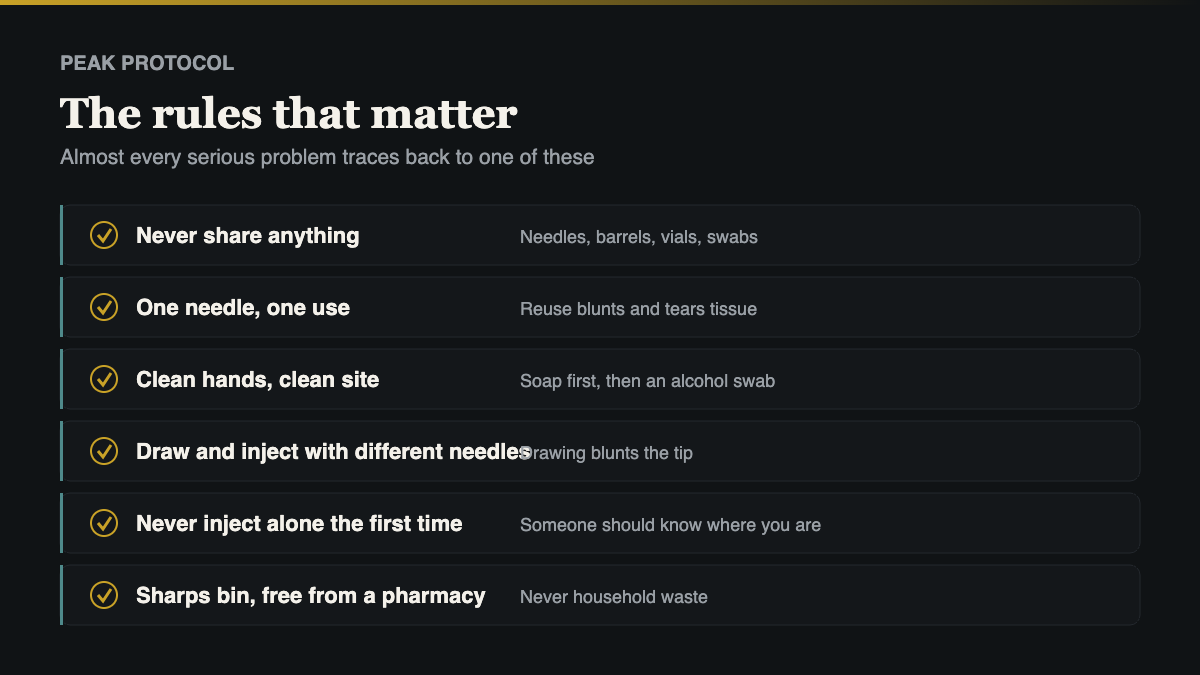
Sharing transmits hepatitis B, hepatitis C and HIV. Hepatitis C in particular survives outside the body far longer than most people assume, which means equipment that looks clean is not.
This is the highest consequence rule on the page and also the easiest to follow, because clean equipment is free.
Where to get clean equipment free
NHS needle and syringe programmes supply sterile equipment free and anonymously across the UK, through pharmacies and drug services. You do not need to be registered with anything, most do not require your name, and you will not be reported.
Many services now see more people using image and performance enhancing drugs than any other group, so staff are experienced with this population specifically. They also provide sharps bins, and they will look at an injection site you are worried about.
Find your nearest through TALK TO FRANK or by asking any pharmacy. Reusing equipment to save money makes no sense when clean equipment costs nothing.
Single use, every time
A needle is blunted by its first use, and a blunted needle causes more tissue damage on the second. Reuse also introduces contamination however carefully it was stored.
The same applies to anything touching a sterile surface. Swabs are single use. Once a vial has been entered repeatedly, its sterility is no longer what the label implies.
The problem with underground vials
This is the risk specific to an illegal market, and the one people discount most heavily.
What testing typically finds inside those vials is set out in counterfeit steroids.
Licensed injectable medicines are manufactured under sterile conditions in controlled facilities and tested before release. Underground product is frequently made in domestic settings, filtered rather than genuinely sterilised, and tested by nobody.
UK emergency departments see abscesses, cellulitis and blood poisoning arising from underground injectables. That is not theoretical, it is a recurring presentation, and no amount of careful practice on your part compensates for a vial that was not sterile when it was filled.
It is also the argument that lands when others do not. You can control your own practice completely and still be injecting something contaminated before you bought it.
Recognising infection early
Some soreness at a site for a day or two is common. Infection looks different, and it progresses rather than settling.
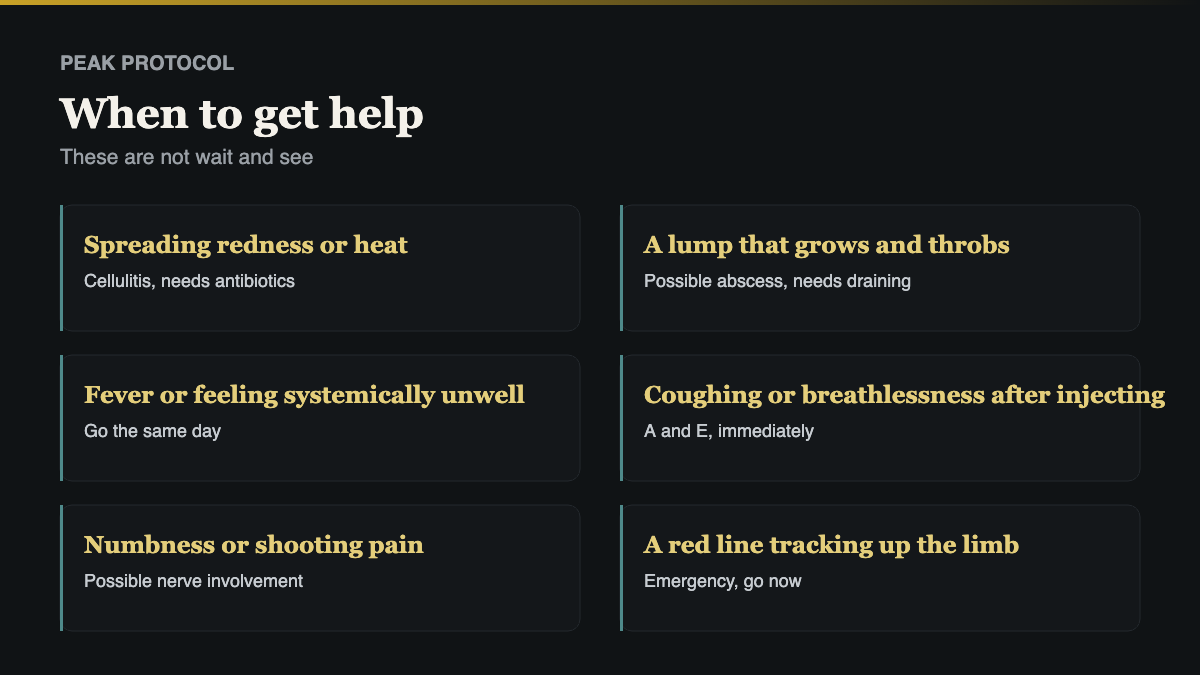
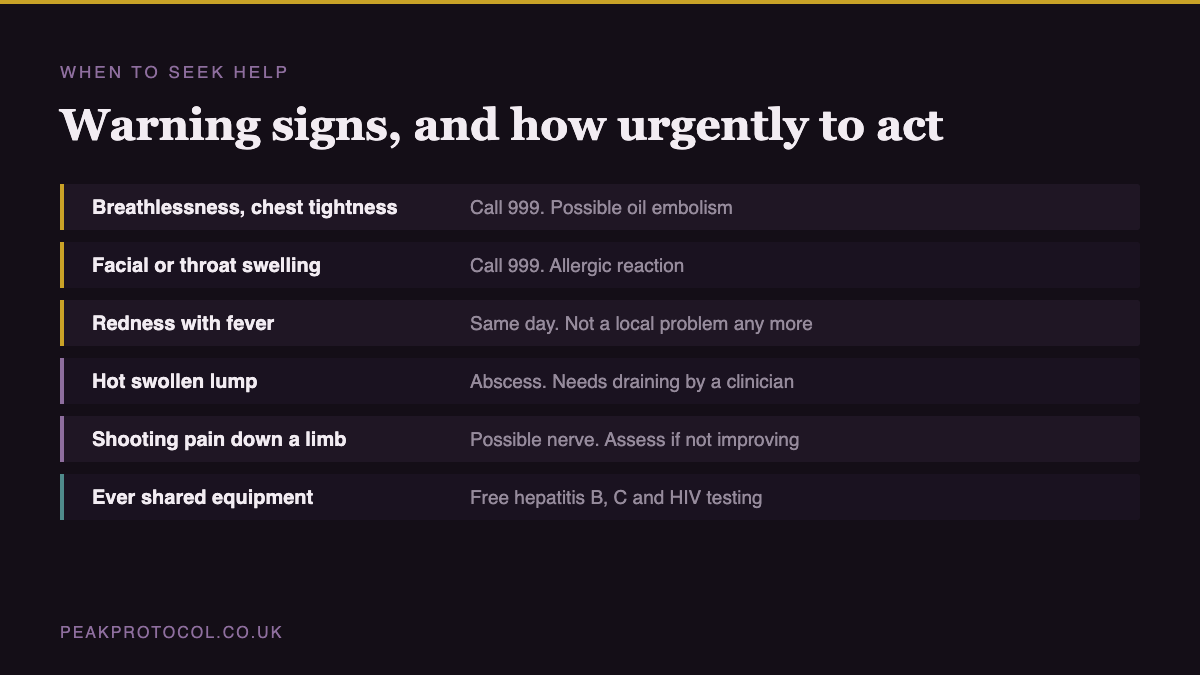
Warning signs are spreading redness, increasing rather than decreasing pain, heat, swelling that grows, any discharge, a red line tracking away from the site, and fever, chills or feeling generally unwell.
That last combination matters most. Local redness with a fever is not a local problem any more. Same day medical attention, not tomorrow.
Abscesses, the commonest complication
An abscess is a walled off collection of pus, typically a painful, hot, swollen lump that may feel fluid filled.
Antibiotics alone frequently do not resolve one, because the antibiotic cannot reach the centre. Most need draining by a clinician.
Do not attempt to drain it yourself. That is how a contained infection becomes a spreading one, and it is a common route into a considerably worse outcome. Go to a GP, an urgent care centre or A and E.
Nerve damage
Injecting into or near a nerve produces immediate sharp, shooting or burning pain, often travelling down a limb, sometimes with numbness, tingling or weakness afterwards.
Most cases settle over weeks. Some do not, and persistent weakness or numbness needs assessing rather than waiting out. If symptoms have not clearly improved within a couple of weeks, see someone.
The rare emergencies
Two things are uncommon and warrant immediate action.
Oil entering the bloodstream can cause a pulmonary oil embolism, typically presenting within minutes as coughing, chest tightness, breathlessness or a metallic taste. Call 999.
Severe allergic reaction presents as swelling of the face, lips or throat, difficulty breathing, or widespread rash. Call 999.
In both cases tell the paramedics exactly what was injected. They are treating you, not reporting you, and the information changes what they do.
Site damage over time
Repeated injection into the same area causes fibrosis, scar tissue that becomes progressively harder, more painful to inject and less able to absorb properly.
Once established it does not fully resolve. It is among the more common long term complaints from people who have injected for years, and it is largely a consequence of not varying sites, which is exactly the sort of thing a needle exchange worker will talk through with you.
Storing what you have
Storage gets almost no attention and causes a reasonable share of avoidable problems.
Keep everything in original packaging until use, out of direct sunlight and away from heat. A bathroom cabinet is one of the worst places in a house for anything sterile, because of the humidity and temperature swings.
Keep it where children and pets cannot reach it, which is a more common near miss than people expect, and keep sharps separate from everything else so nobody reaches into a bag and finds a needle.
Check expiry dates and discard anything past them. Also discard anything that looks wrong: cloudiness, visible particles, a colour change, a damaged seal or a vial that has been frozen. That judgement is worth applying even though it means throwing away something you paid for, because the alternative risk is considerably more expensive.
Hygiene basics
Three things reduce infection risk more than anything else and cost nothing.
Wash your hands properly with soap and water first, for longer than feels necessary. Most contamination arrives on hands rather than through the air.
Prepare on a clean, hard, non porous surface that you have wiped down. Not a bed, not a carpeted floor, not a gym bag.
Do not do any of this while drunk. It sounds obvious and it is a genuine factor in a meaningful proportion of injection injuries, because impaired coordination and a sharp object are a poor combination.
Sharps disposal
Never in household waste. A used needle in a bin bag injures refuse workers, and it happens.
Sharps bins are free from needle and syringe programmes and most pharmacies, and full bins are taken back for safe disposal. Some councils collect them. Nobody asks what was in them.
Blood borne virus testing
If you have ever shared equipment, even once, even years ago, get tested for hepatitis B, hepatitis C and HIV.
All three are testable free through sexual health services, drug services and GPs, and home postal kits exist. Hepatitis C is now curable in most cases with a short course of tablets, and both HIV and hepatitis B are highly manageable when known about.
Hepatitis B vaccination is free for people who inject, and it is worth asking for regardless of whether you have shared.
Do not do it alone
Two of the emergencies on this page, oil embolism and severe allergic reaction, develop within minutes and can leave someone unable to call for help themselves.
Having another person in the house is a straightforward mitigation, and it costs nothing. So does telling one person what you are taking, so that if you are found unwell somebody can tell paramedics what is in you. That single piece of information changes what treatment you receive in the first ten minutes.
People resist this because it means admitting to someone. Weigh that against the alternative, which is a clinician guessing while you cannot speak.
The false economy of cutting corners
Almost every serious injection problem traces back to a decision made to save a small amount of money or a small amount of effort.
Reusing a needle rather than opening a new one, when clean ones are free. Buying from a cheaper source with no idea how it was made. Skipping the trip to a needle exchange and improvising. Injecting the same site because it is the convenient one.
Set against that, an abscess is a hospital visit, a course of antibiotics, a drainage procedure, time off training and sometimes time off work. Cellulitis can be an admission. Hepatitis C is a lifelong diagnosis, curable now but not trivially.
The economics are not close. Every genuinely protective step on this page is either free or nearly free, which is unusual in harm reduction and worth taking advantage of.
Getting help without judgement
The biggest barrier to people getting seen for injection problems is expecting to be lectured or reported. Neither happens.
Possession of anabolic steroids for personal use is not a criminal offence in the UK, medical confidentiality applies regardless, and NHS drug services exist to help people who are using rather than to persuade them to stop.
Go earlier rather than later. An infection caught at the redness stage is a course of antibiotics. The same infection two days later can be an admission.
See also what to check on bloodwork and steroid side effects.
A note for women
Almost everything written about injecting in this context assumes a male reader, and women using image and performance enhancing drugs are a real and largely unserved group.
Every risk on this page applies identically. Needle and syringe programmes serve women and some run women only sessions, which is worth asking about if a mixed service feels unapproachable.
The additional consideration is that several effects of androgens on women are permanent rather than reversible, including voice deepening and clitoral enlargement, which is a different risk calculus to the one described elsewhere on this site. If that is relevant to you, it is worth a conversation with a clinician who will not be shocked, and drug services genuinely will not be.
Five errors that put people in hospital
Five errors account for nearly every injecting problem that ends in a hospital, and every one of them is avoidable at no cost.
One, sharing anything. Hepatitis B, hepatitis C and HIV all transmit through shared equipment, and this group is the least likely to see itself as at risk, which is precisely why the gap exists. Steroid injection safety starts and ends with equipment that only you have touched.
Two, reusing needles. A needle blunts on first use. The second injection tears tissue rather than piercing it, which hurts more, scars more and raises infection risk substantially.
Three, assuming an underground vial is sterile. It has not been tested and nobody has inspected the process. Aqueous suspensions are worse than oils in this respect. This is the part of steroid injection safety you genuinely cannot control, which is why everything you can control matters more.
Four, ignoring the early signs. Spreading redness, heat and a growing lump are not bruising. Cellulitis needs antibiotics and an abscess needs draining, and both get considerably worse with a fortnight of waiting to see.
Five, hiding it from whoever treats you. Nobody is going to report you. A doctor who knows what was injected, where and when can treat it properly, and one who does not is guessing.
A safety routine that takes two minutes
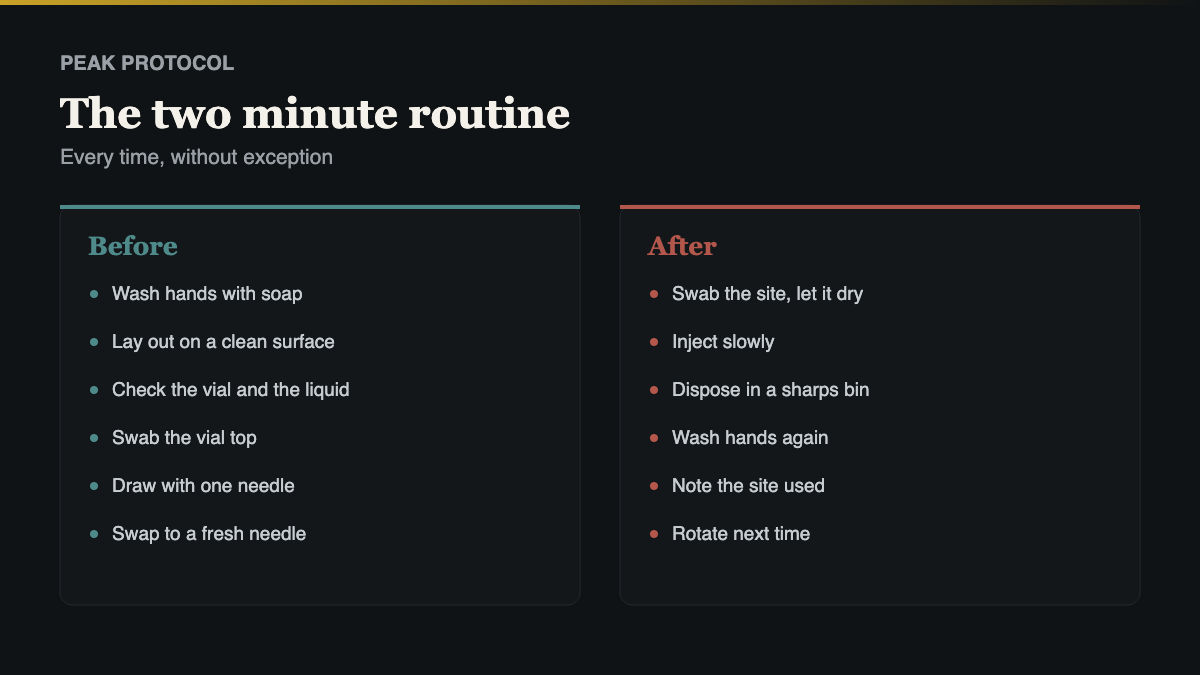
Good steroid injection safety is not complicated and it does not cost anything. It is the same short routine every time.
Get free equipment properly. Needle and syringe programmes across the UK are free, open to anyone injecting anything, and carry no expectation that you stop or explain yourself. Community pharmacies run them and staff have seen it all. This is the single highest value item on the page and most people never use it.
Separate drawing from injecting. Drawing through a rubber stopper blunts the needle tip. Swapping to a fresh needle before injecting is a two second habit that removes a large share of the pain and tissue damage people accept as normal.
Take the free blood borne virus screen. It takes minutes, it is confidential, it carries no obligation to change anything, and hepatitis C in particular is curable when it is found. Local drug services offer it and TALK TO FRANK will find one near you.
And know the emergency signs cold. Coughing or breathlessness immediately after injecting means Accident and Emergency, not a forum. A red line tracking up a limb means the same. Everything else in steroid injection safety is prevention; these two are the ones where minutes matter. Steroid side effects covers the wider picture and steroid blood tests covers monitoring.
Steroid injection safety: common questions
Where can I get clean needles in the UK?
Free from NHS needle and syringe programmes through pharmacies and drug services, anonymously and without being reported. Ask any pharmacy or contact TALK TO FRANK.
How do I know if an injection site is infected?
Spreading redness, increasing pain, heat, growing swelling, discharge, a red line tracking away, or fever. Redness with a fever needs same day medical attention.
Can I drain an abscess myself?
No. Most need draining by a clinician, and attempting it yourself is a common route from a contained infection to a spreading one.
Will a doctor report me for injecting steroids?
No. Possession for personal use is not an offence and confidentiality applies. Being honest about what you injected changes the treatment you receive.
How do I dispose of used needles?
In a sharps bin, free from needle exchanges and most pharmacies, which take full bins back. Never in household waste.
What are the most important steroid injection safety rules?
Never share any equipment, use each needle once, swap to a fresh needle between drawing and injecting, clean hands and site, and dispose of sharps in a proper bin. Free needle and syringe programmes across the UK supply everything you need at no cost.
How do I know if an injection site is infected?
Spreading redness, heat, swelling that grows rather than settles, throbbing pain, or feeling generally unwell with a fever. Any of those needs medical attention rather than waiting. A red line tracking up the limb or breathlessness after injecting is an emergency.
Can I get clean needles free in the UK?
Yes. Needle and syringe programmes run through community pharmacies and drug services are free, confidential and open to anyone who injects anything, including steroids. They also provide sharps bins and free blood borne virus screening.