Harm reduction
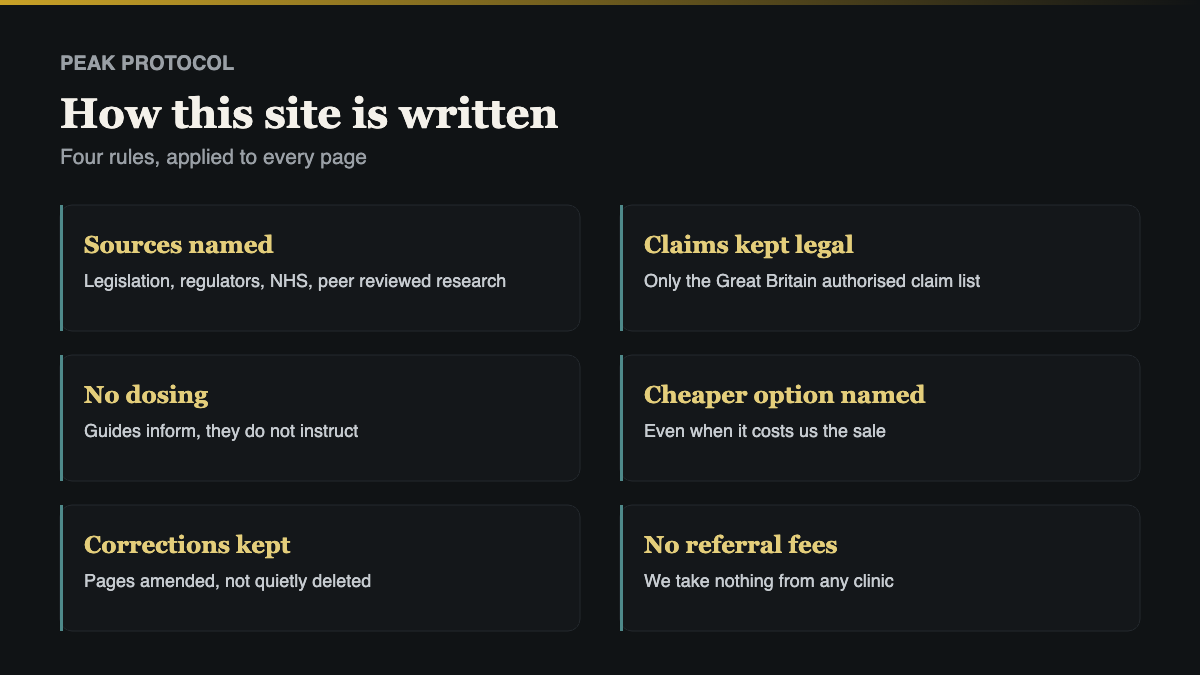
Harm reduction starts from an uncomfortable premise: people make these decisions with or without accurate information, and the version with accurate information goes better. That is the whole basis for this category.
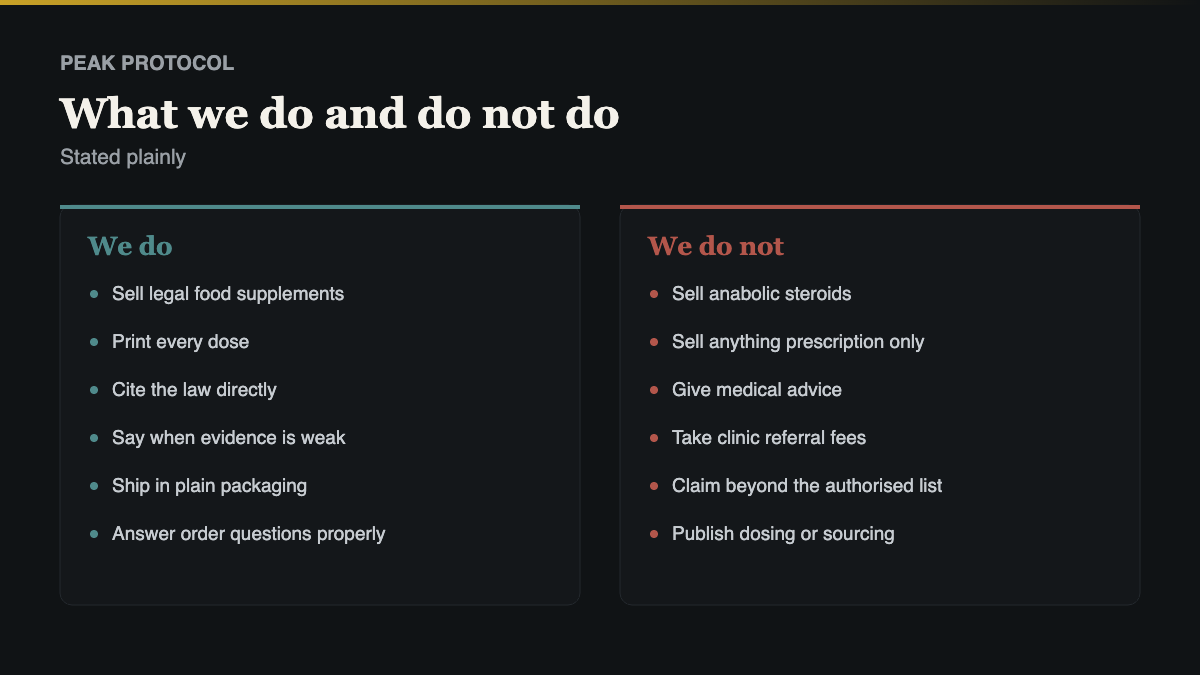
Nothing here encourages anyone to use anything, and nothing here tells anyone how. There are no doses, no protocols and no cycle plans on this site and there never will be. What these guides cover is the part that reduces damage for people who have already decided.

Why a shop publishes this
It is a fair question, and the answer is not marketing. Roughly half of what we publish covers compounds we will never sell, and that half brings no commercial benefit whatsoever.
The reason is that the alternative to accurate harm reduction information is not abstinence. It is the same decision made with worse information, taken from a forum with a commercial interest or from whoever is supplying. Silence is not neutral in this area; it just hands the question to people less inclined to answer it honestly.
The guides in this category
Four guides sit here. Steroid injection safety covers sterile technique, sites, and the infection signs that mean hospital rather than hope. Steroid blood tests sets out exactly which markers to ask for and how often.
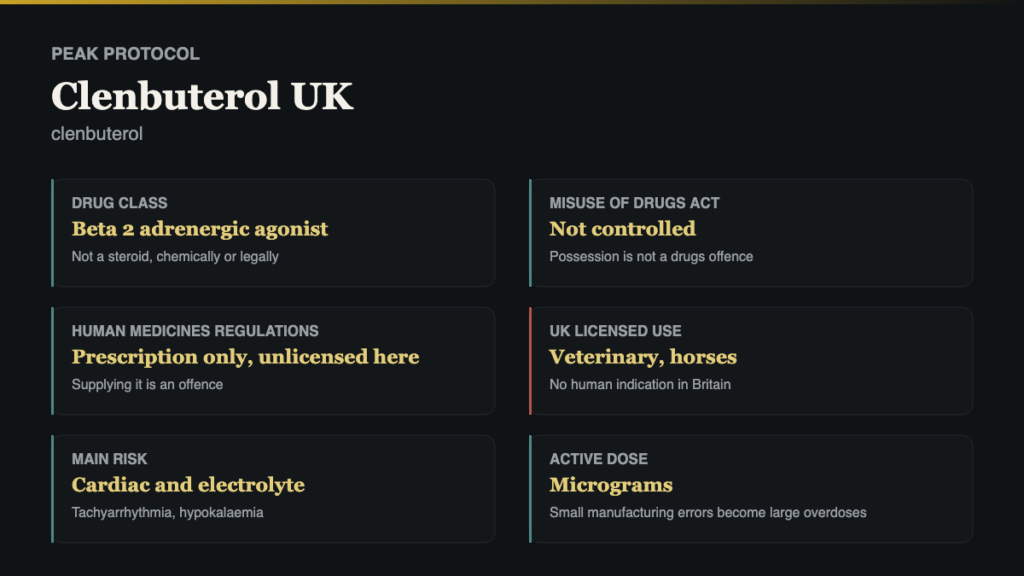
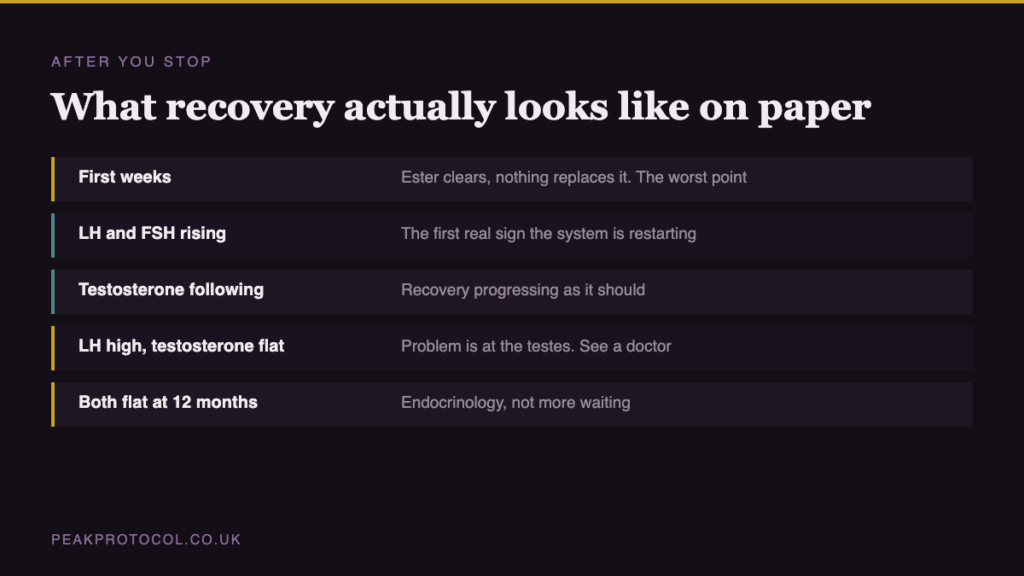
Coming off steroids covers what actually happens when you stop, which is the least discussed and most mishandled part of the whole subject. Clenbuterol sits here rather than with the steroids because it is not one, and because its risk profile is cardiac and immediate rather than gradual.
The line these guides do not cross
Harm reduction is often used as cover for publishing protocols. It is not used that way here, and the limit is worth stating precisely so you can hold us to it.
| What these guides do |
What they will not do |
| Explain what a compound does to the body |
Tell you how much to take |
| Name the risks and which are permanent |
Provide cycle or post cycle plans |
| Say which markers can be monitored |
Interpret your results for you |
| Describe sterile technique for anyone already injecting |
Suggest that injecting is advisable |
| Explain what happens when you stop |
Recommend a recovery protocol |
| Point to NHS and Frank services |
Point to a supplier, ever |
That limit costs us search traffic, because dosing queries are the high volume ones. It is not negotiable whatever the demand looks like.
Injection safety
If someone is injecting, the infection risk is the most immediately dangerous thing in this whole category, and it is also the most reducible.
Needle exchanges in the UK serve people using image and performance enhancing drugs, not only people who use heroin, and they are free, confidential and staffed by people who will not lecture you. That is the single highest value harm reduction step available: sterile equipment, every time, never shared, disposed of in a sharps bin.
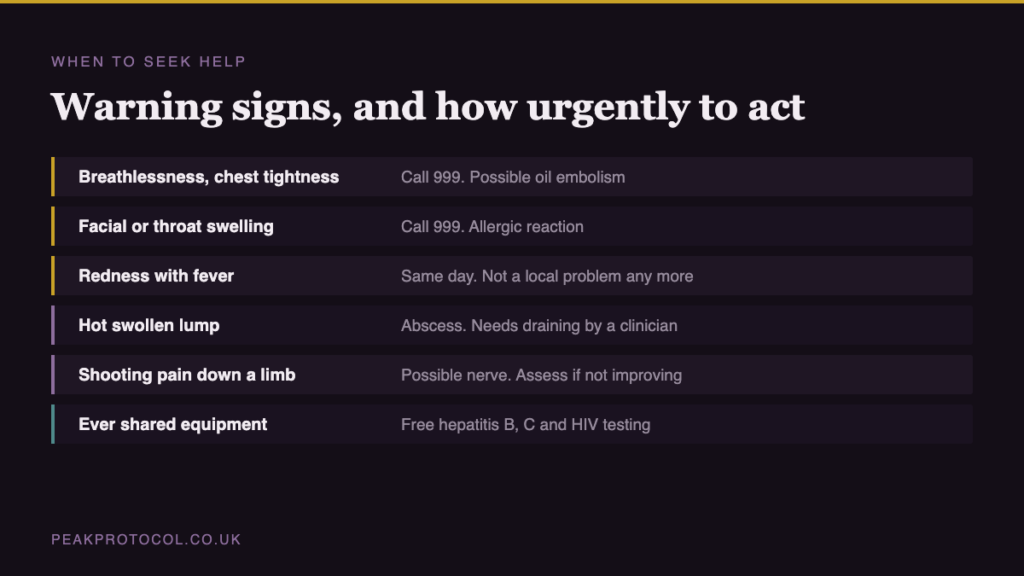
Abscesses, cellulitis and, rarely, sepsis are the outcomes when that goes wrong. Redness spreading from a site, heat, swelling, fever or a hard lump that keeps growing are all reasons to be seen the same day. Our injection safety guide covers the detail.
What to monitor, and how often
Measurement is the core of harm reduction here, because most of what goes wrong produces no sensation until it is advanced.
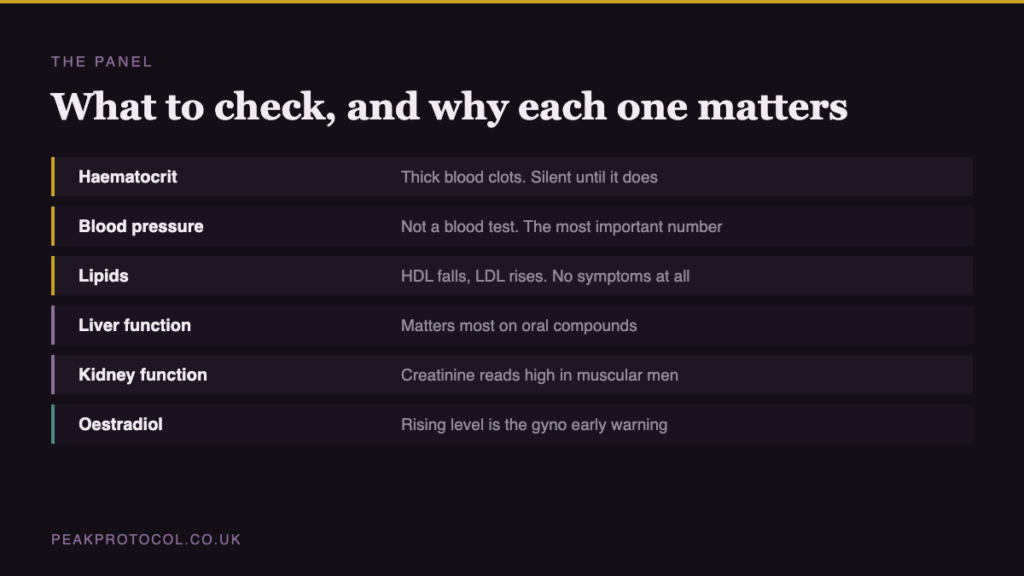
Blood pressure at home is the cheapest and most useful measurement available, and a monitor costs about twenty pounds. Beyond that, a lipid panel, a liver panel, a full blood count for haematocrit, and a hormone panel covering testosterone, LH, FSH, oestradiol and prolactin capture most of what is visible.
Haematocrit deserves a specific mention because it rises quietly, thickens the blood and carries a genuine clot risk, and because it is trivially easy to check.
Coming off, and why it is the hardest part
Stopping is where most of the damage in this area actually happens, and it is the part the marketing around these compounds never covers.
Natural production is suppressed and takes months to return. In the meantime people feel flat, lose strength and size, sleep badly and feel low. That period is precisely when starting again feels like the obvious solution, which is how intermittent use becomes continuous use.
Knowing that arc in advance is itself harm reduction. Our guide on coming off sets out what the months look like and what a GP can actually do, which is more than most people expect.
The supply problem nobody can solve for you
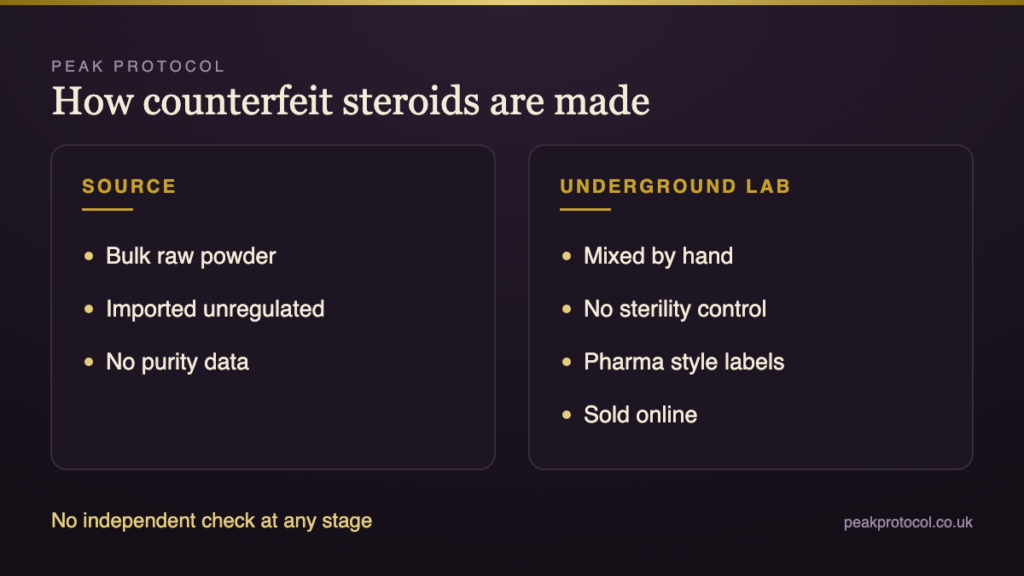
Underground products are not tested, not standardised and not accountable. Analyses of seized and submitted samples repeatedly find the wrong compound, the wrong dose, or contamination.
That is the risk no harm reduction advice can remove, because it is upstream of everything you control. You can use sterile technique, monitor properly and still be injecting something other than what the label claims.
We will not point anyone towards a supplier, tested or otherwise, and any message asking us to gets a refusal. That is a fixed position rather than a policy we are willing to discuss.
When to stop and seek help
A short list overrides everything else in this category. Chest pain, breathlessness at rest, a sudden severe headache, one sided calf swelling, yellowing of the eyes or skin, fainting or vision changes all mean 999 or 111 today.
Tell them what you have taken. Nobody is arrested for that, possession for personal use is not an offence, and the clinician cannot treat you properly without it. Concealing it is the most common and most dangerous mistake made in an emergency here.
Talking to a GP without fear
The most common objection we hear is that a GP will report it. They will not, and there is nothing to report: possessing these substances for your own use is not a criminal offence in the United Kingdom.
What a GP can do is order the blood work, treat the blood pressure, refer for the fertility question and manage the recovery period. None of that is available to somebody managing it alone from a forum, and all of it is free.
If a conversation with your own practice feels difficult, sexual health clinics and some drug services see this population routinely and without judgement.
Where to get support
Talk to Frank covers drugs including steroids, is anonymous and is free. The NHS is the route to blood work and to treatment for anything that has already gone wrong. Local needle exchanges provide equipment with no questions attached.
For anyone competing, UK Anti-Doping publishes the rules that actually apply to you, which are stricter than the law.
The five things that matter most
If harm reduction came down to a short list, this would be it, ordered by how much difference each one makes rather than by how often it gets discussed.
| Action |
Why it matters |
| Measure blood pressure at home |
The most common serious effect, and it has no symptoms |
| Use sterile equipment every time |
Infection is the fastest route to hospital in this group |
| Get a blood panel through a GP |
Haematocrit and lipids move quietly and are cheap to check |
| Keep the list short |
Most harm involves several substances rather than one |
| Tell a clinician what you have taken |
Concealing it is the most dangerous thing in an emergency |
| Plan for stopping before starting |
The post cycle period is where people get trapped |
None of that requires anyone to change their mind about anything, which is the point of harm reduction as a method. It is available to you regardless of what you decide.
Harm reduction for women
Almost everything written about this subject assumes a male reader, which leaves a group with different and in some respects larger risks with almost nothing accurate to read.
The virilising effects, meaning voice deepening, facial and body hair, and clitoral enlargement, are the ones that do not reverse. Voice change in particular is permanent and is the effect most often minimised by whoever is supplying. Menstrual disruption and fertility effects are common, and the cardiovascular picture is no better than it is in men.
The honest harm reduction position is that the irreversible threshold arrives sooner and with less warning, and that anyone weighing this should know that before rather than after.
Why stigma makes this worse
The single biggest obstacle to harm reduction in this area is not ignorance. It is the expectation of being judged, which keeps people away from the services that would help them.
People delay seeing a GP because they expect a lecture. They conceal what they have taken in A and E because they expect the police. They get their information from a supplier because the supplier does not moralise. Every one of those decisions is rational given the expectation, and every one of them increases the risk.
That is why these guides are written without moral commentary. It is not approval. It is the recognition that a page which starts by telling somebody they are foolish will not be read to the end by the person who most needs it.
Testing what you actually have
One harm reduction option gets almost no coverage in this country: some drug checking services will analyse a substance and tell you what is in it, without involving the police.
Coverage is patchy and largely festival based rather than year round, so it is not a reliable route for most people. It is worth knowing it exists, because the alternative is trusting a label printed by someone with every incentive to exaggerate.
What is consistently available instead is measurement of the effect rather than the substance. Blood work does not tell you what was in the vial, but it does tell you what it is doing to you, and that is the more actionable number of the two.
Common questions about harm reduction
Is publishing this encouraging use?
No. These guides carry no doses and no protocols, and they say plainly what the risks are. The alternative is the same decision made on worse information.
Will my GP report me to the police?
No, and there is nothing to report. Possession for personal use is not an offence in the UK, and your GP is bound by confidentiality regardless.
Can I get sterile needles legally?
Yes. Needle exchanges are free, confidential, and serve people using image and performance enhancing drugs as well as other groups.
Will you tell me a safe dose?
No. There is no dosing information anywhere on this site and that will not change, whatever the search demand is.
What is the single most useful thing I can do?
Buy a blood pressure monitor and use it, then get a blood panel through your GP. Most of what goes wrong is silent and both of those make it visible.
Do you know a trustworthy supplier?
No, and we would not say if we did. We do not point anyone towards a source under any circumstances.
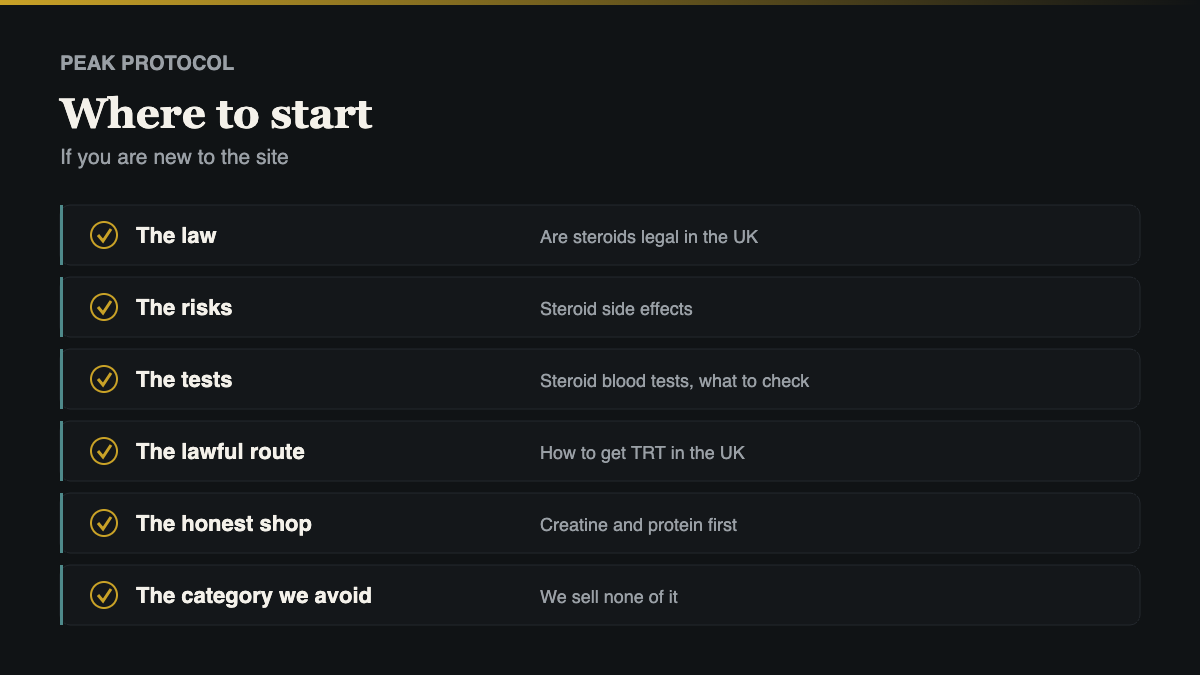
Our editorial policy explains why this category exists and where the line sits. For anything clinical, the NHS comes before this site.