
Information and harm reduction only, never medical advice. Sourced from the NHS, TALK TO FRANK, the MHRA and peer reviewed research, and written to say plainly where the evidence runs out rather than filling the gap. Always speak to a qualified clinician before changing anything. See our editorial policy.
This is the practical version. Our main TRT guide covers what the treatment is and who it suits. This page covers the mechanics of actually obtaining it in the UK, step by step, on both the NHS and privately, including what to say and what to do when you hit the obstacles most people hit.
We are not a clinic, we do not sell testosterone, and prescription only medicines cannot be advertised to the public in the UK. This explains a pathway so you can navigate it competently.
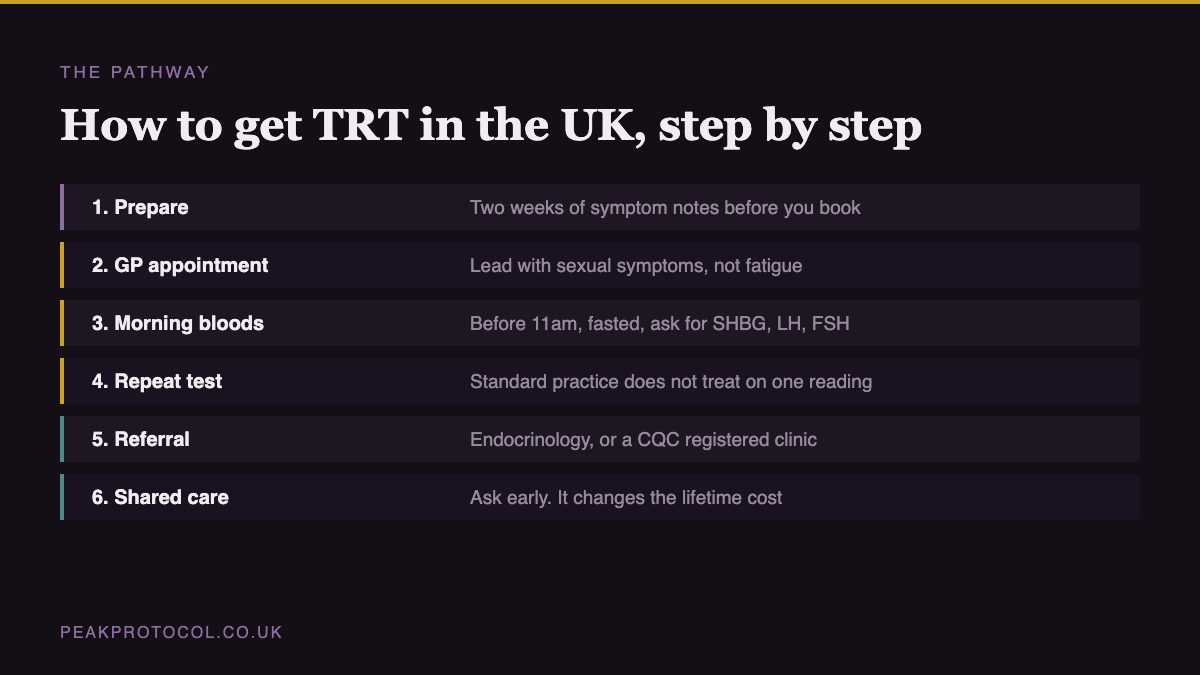
Before you book anything
Two weeks of preparation makes the difference between being taken seriously and being sent away.
Keep a short symptom record: morning erections present or absent, sleep hours, energy, mood, libido. Note your alcohol units per week honestly, every medication including anything over the counter, and any previous anabolic steroid use. That last one is uncomfortable to disclose and it changes the entire clinical picture, so it has to be said.
If you can, address the obvious first. Three months of consistent sleep, less alcohol and some fat loss resolves this for a meaningful number of men, and if it does not, you arrive having already excluded the things a doctor will otherwise send you away to try.
Step one: the GP appointment
This is the correct starting point even if you intend to go private, because an NHS blood test costs you nothing and gives you a result from a source with no commercial interest in the answer.
Book a standard appointment and say at the outset that you want to discuss possible low testosterone and would like a blood test. Being direct saves the first half of a ten minute appointment.
What to actually say
Lead with the sexual symptoms rather than tiredness. Not because tiredness does not matter, but because fatigue alone points at a dozen things and a GP will reasonably investigate the more likely ones first.
Something close to this works: “I have had reduced morning erections and low sex drive for several months, along with fatigue and low mood. I would like a morning testosterone test, and I have read that SHBG, LH and FSH are needed to interpret it properly.”
Two things are happening in that sentence. You are leading with the symptoms that actually discriminate, and you are naming the specific tests, which signals you have read something and makes a total testosterone only test less likely.
Ask for the appointment slot to be a morning one for the blood draw itself, before 11am, and fasted.
Step two: the blood tests
Expect total testosterone at minimum. Push for SHBG, LH, FSH, prolactin, TSH and a full blood count. If the first result is low, a repeat on a second morning is standard before anything follows, so do not be discouraged by being asked back.
Ask for a copy of your results with the reference ranges. You are entitled to them, and you will want them if you later see anyone else. Full detail on interpretation is in testosterone blood tests.
If your GP refuses
This happens, particularly with younger men, and it is worth knowing the options rather than giving up or going straight to a private prescription.
Ask for the refusal and the reasoning to be recorded in your notes. That single request frequently changes the conversation, because it moves the decision from informal to documented.
Ask whether the objection is to testing or to treating. Those are different, and a GP reluctant to prescribe may be perfectly willing to test.
You can see a different GP at the same practice. You can ask for a referral to endocrinology directly. And you can obtain private bloods independently and return with them, which is often the most efficient route: a private panel is not expensive, and a documented low result from an accredited lab is harder to dismiss than a description of symptoms.
Step three: referral
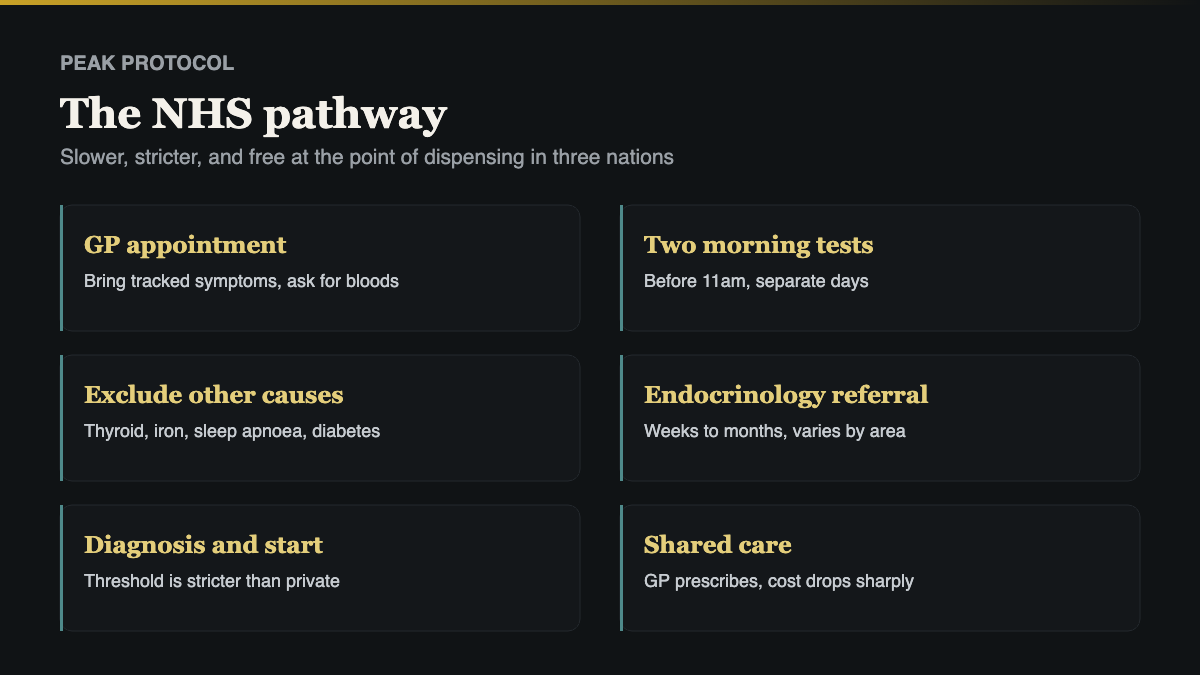
If bloods confirm low testosterone, the NHS pathway is usually referral to an endocrinologist, who confirms the diagnosis, looks for the cause and decides on treatment.
Waiting times vary enormously by area, from a few weeks to many months. Ask the practice what the local wait is, since knowing it is what lets you decide sensibly whether to go private in the interim.
The endocrinologist may order further investigation, including imaging if a pituitary cause is suspected. That is not delay for its own sake. Finding a treatable cause is a materially better outcome than replacing the hormone and leaving the cause in place.
The private route, step by step
The sequence is consistent across providers. An initial consultation, usually remote. A blood panel, either at a clinic or by post. A follow up to discuss results. If treatment is indicated, a prescription and a monitoring schedule, then repeat bloods at intervals, typically at six weeks, three months, then twice yearly.
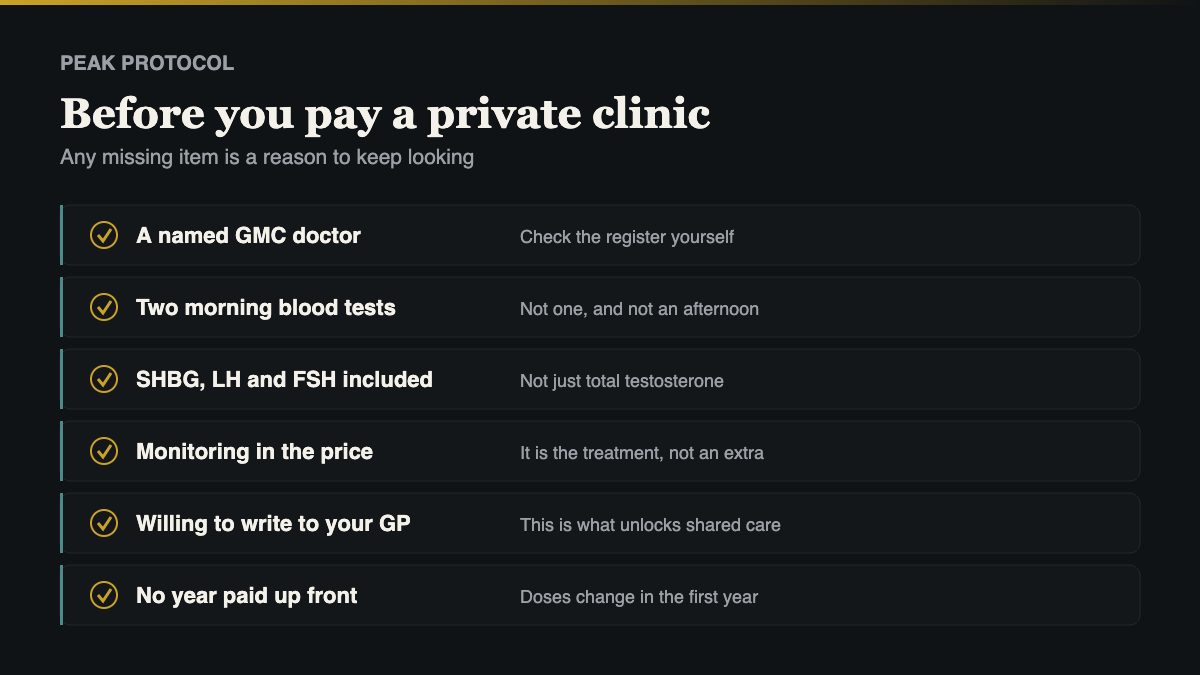
A provider that skips the second blood test, or that treats the follow up as optional, is not running the pathway properly.
Choosing a private clinic
Check three things before you pay anything, and all three take minutes.
Our comparison of NHS and private TRT lists the red flags to check first.
CQC registration. In England, clinics providing this service must be registered with the Care Quality Commission, and the register is public and searchable. Scotland, Wales and Northern Ireland have their equivalents.
The prescriber. Doctors appear on the GMC register, pharmacist prescribers on the GPhC register. Both are public. If you cannot find the person prescribing to you, stop.
What happens if your bloods are normal. Ask directly. A clinic that would decline to treat is a clinic. One that is vague, or suggests treating anyway, is a supply arrangement with a consultation attached.
More on this in our TRT guide, including the warning signs worth walking away from.
Shared care
Shared care is an arrangement where a private specialist diagnoses and initiates treatment, and your NHS GP takes over prescribing and monitoring afterwards under an agreed protocol.
It matters because it is far cheaper long term and it keeps your treatment in your main medical record rather than in a private silo.
It is also entirely discretionary. Your GP is not obliged to accept it, and many practices decline for TRT specifically. Ask early rather than assuming, because the answer changes the long term cost considerably. If the answer is no, budget for private monitoring indefinitely rather than for a few months.
What happens when you start
You will be shown how to inject, or how to apply gel, and for injections most people self administer at home after the first one.
Bloods at around six weeks check the response and haematocrit. Expect the dose or the frequency to be adjusted, since the first prescription is a starting point rather than a final answer, and levels that swing between doses are usually a frequency problem rather than a dose problem.
Raise fertility before you start, not after. Exogenous testosterone suppresses sperm production, and there are approaches used specifically to preserve it. A clinician who does not ask you about this unprompted is not being thorough.
How long it takes
Privately, from first contact to a prescription is commonly two to four weeks, most of it waiting for bloods.
On the NHS, expect a few weeks for the first test, a repeat, then the endocrinology wait, which is the variable part and is measured in months in much of the country. Six months from first appointment to treatment is not unusual.
That gap is why many people use private bloods to establish the picture quickly, then decide whether to wait for NHS treatment or pay for it.
What each route costs
The comparison people make is NHS free against private paid, and it is more complicated than that in both directions.
On the NHS, treatment and monitoring are free and prescription charges apply in England. The real cost is time: waiting lists, repeat appointments, and the possibility of being turned down at the first step and having to work through the options above.
Privately, the cost is structured as an initial consultation, an initial panel, then ongoing fees covering prescription, medication and monitoring bloods. The mistake people make is comparing headline monthly rates, because the difference between providers usually sits in how much monitoring is included and how much is charged as an extra.
Ask every provider for the total first year cost including all bloods, and the annual cost thereafter. That single question makes providers comparable in a way their pricing pages deliberately do not.
And ask about shared care before you commit, because a practice willing to take over prescribing changes the long term figure more than any difference between clinics.
Keep your own records
Whichever route you take, keep a folder of every blood result with its date, its reference ranges and the laboratory that produced it.
Three reasons this matters more here than in most areas of medicine. Assays and reference ranges differ between laboratories, so a result only means something alongside the range it came with. Treatment is usually lifelong, so a decade from now the baseline you took at the start will be the most useful number you own. And if you move between providers, which people commonly do, the receiving clinician wants a history rather than a single recent figure.
A GP practice will give you printed results on request. Private providers usually make them downloadable. Save them as you go rather than trying to reconstruct the sequence later.
Where people go wrong
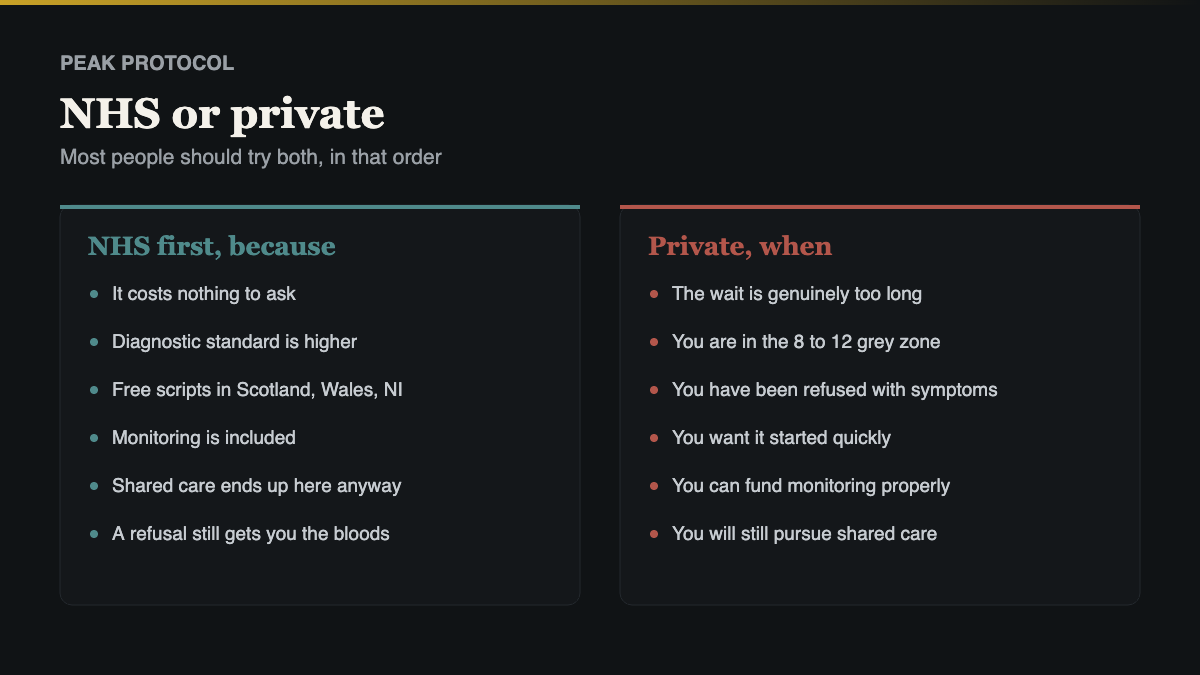
Going private first. An NHS blood test is free and comes from a party with no interest in the result. Get it, then decide.
Testing in the afternoon. The most common self inflicted problem, and it produces a normal looking result in a man who is not.
Not disclosing previous steroid use. It is the single most relevant part of the history and withholding it produces a wrong diagnosis.
Accepting a prescription without a blood test. If a provider will do that, they will do it to anyone.
Buying online instead. It is unmonitored, the seller is committing a supply offence, and it makes the underlying question permanently harder to answer.
What to expect emotionally
One last thing, because it catches people out and nobody mentions it.
If treatment works, the change is usually gradual rather than dramatic. Libido and morning erections tend to respond within weeks, energy and mood over a couple of months, body composition over considerably longer. People expecting a switch to flip are frequently disappointed at week three and conclude it has failed when it has not.
Equally, if you have spent a year convinced testosterone was the explanation for everything and treatment does not resolve all of it, that is common too. Low testosterone can be real and still not be the whole story, and the remaining piece is worth pursuing rather than treating as a dosing problem.
Five mistakes that cost the most
Five mistakes account for most of the money wasted and most of the frustration on the way in.
One, going private first. The commonest error in how to get TRT in the UK is starting with a clinic that sells the treatment. It costs nothing to ask a GP, the diagnostic standard is higher, and even a refusal usually gets you the blood tests you need for everything that follows.
Two, arriving with feelings instead of data. A ten minute appointment goes very differently when you bring a month of dated symptom notes and, better still, two morning blood results. Describing tiredness gets you a thyroid test. Showing a pattern gets you a conversation.
Three, accepting one afternoon blood test. Testosterone peaks in the morning. If a single afternoon sample comes back normal, that is not an answer, and if it comes back low, that is not a diagnosis either.
Four, not pursuing shared care. This is the single biggest lever on lifetime cost and most people never ask. Once you are stable, a GP can take over prescribing while the specialist oversees, which is the difference between paying privately forever and paying a prescription charge.
Five, choosing on the consultation price. The consultation is not the cost. Monitoring is. A clinic that looks cheap up front and bills separately for every blood test usually costs more within the first year.
Your next three steps
If you have read this far, the useful version of how to get TRT in the UK comes down to three things, in order.
First, get the bloods, from anywhere. Two morning samples on separate days, with SHBG, LH and FSH alongside total testosterone. Testosterone blood test UK covers exactly what to ask for. You can do this before you have decided anything, and it makes every later conversation shorter.
Second, rule out the things that look identical. Sleep apnoea, thyroid disease, iron deficiency and depression all produce the same symptom list, and all are commoner. Low testosterone symptoms sets out what actually discriminates. This is not a delaying tactic; it is what a good clinician will do anyway, and doing it yourself speeds everything up.
Third, ask the NHS before you pay anyone. Then, if you go private, compare properly on the whole year rather than the first appointment. TRT cost and clinics in the UK breaks that down, TRT UK covers what treatment actually involves, and the city guides cover what changes locally, from London to everywhere else.
Peak Protocol sells legal supplements. We cannot prescribe, we take no referral fees, and we have nothing to gain from which route you pick.
How to get TRT in the UK: common questions
Can I get TRT on the NHS?
Yes, with symptoms and blood tests confirming low testosterone. Start with a morning test through your GP, expect a repeat, then a referral to endocrinology.
How do I ask my GP for a testosterone test?
Lead with reduced morning erections and low libido rather than tiredness, and ask specifically for a morning total testosterone with SHBG, LH and FSH.
What do I do if my GP will not test me?
Ask for the refusal to be recorded, see a different GP, request an endocrinology referral, or obtain private bloods and return with a documented result.
How long does it take to get TRT in the UK?
Two to four weeks privately. On the NHS it depends on local endocrinology waiting times, and six months from first appointment is not unusual.
Will my GP take over prescribing after a private diagnosis?
Sometimes, under a shared care agreement. It is discretionary and many practices decline for TRT, so ask early because it changes the long term cost.
Can I just ask my GP for TRT?
Yes, and that is the right first step. Ask for symptoms to be investigated and for morning blood tests rather than asking for the treatment by name, because the diagnosis has to come first and a request for a specific drug tends to shorten the conversation.
What if my GP refuses to test me?
Ask for the reason to be recorded, and ask specifically for a morning total testosterone with SHBG, LH and FSH. If that fails you can pay for the same panel privately for well under a hundred pounds and return with the results, which usually changes the response.
How long does getting TRT in the UK take?
On the NHS, typically two to six months depending on local endocrinology waits. Privately it can be days to a few weeks. The bloods are the rate limiting step in both cases, because two morning samples on separate days are needed before anyone can decide anything.