
Information and harm reduction only, never medical advice. Sourced from the NHS, TALK TO FRANK, the MHRA and peer reviewed research, and written to say plainly where the evidence runs out rather than filling the gap. Always speak to a qualified clinician before changing anything. See our editorial policy.
Testosterone replacement therapy is legal in the UK on prescription, and it is a genuinely different proposition from buying testosterone online. This page explains what it is, who it is for, how the diagnosis actually works, and both routes to getting it.
We are not a clinic and we do not sell testosterone. Prescription only medicines cannot be advertised to the public in the UK, and this page is not attempting to. It explains a treatment pathway so you can have a better conversation with a doctor than you would otherwise have.
What TRT actually is
TRT is prescribed testosterone for men whose own production is clinically low, a condition called hypogonadism. The aim is to restore levels into the normal physiological range and keep them there, under monitoring, indefinitely.
The word replacement is doing real work in that sentence. The intent is to replace what the body is no longer making enough of, not to exceed it. That is the entire distinction between TRT and anabolic steroid use, and it is a distinction of dose and supervision rather than of substance.
What TRT is not
It is not a performance enhancer at replacement doses. Restoring a genuinely low level to the middle of the normal range will make someone feel considerably better if they were symptomatic, and it will not turn an average man into a competitive physique athlete.
It is not a treatment for tiredness in someone with normal testosterone. A great many men who feel exhausted and assume their testosterone is the cause turn out to be in range, and the actual cause is sleep, bodyfat, alcohol, stress or an unrelated condition. Treating a normal level does not fix any of those.
It is also not a short course. Starting TRT suppresses your own production further, and for most people it is a lifelong commitment. That is a bigger decision than it is usually presented as, and it is the thing worth being certain about before starting.
Who TRT is actually for
Men with symptoms of low testosterone alongside blood tests confirming a low level. The symptoms most commonly reported are persistent fatigue, low libido, erectile difficulty, low mood, loss of muscle mass, increased body fat and poor concentration.
The difficulty is that every one of those symptoms has other, more common causes. That is why diagnosis rests on symptoms plus bloodwork rather than either alone, and why a clinic willing to prescribe on symptoms without confirming levels is not doing you a favour.
See low testosterone symptoms for the fuller picture.
How diagnosis works
The standard approach is at least two separate morning blood tests measuring total testosterone. Morning matters because levels follow a daily rhythm and peak early, so an afternoon test can read low in someone perfectly normal. Two tests matter because a single reading can be misleading.
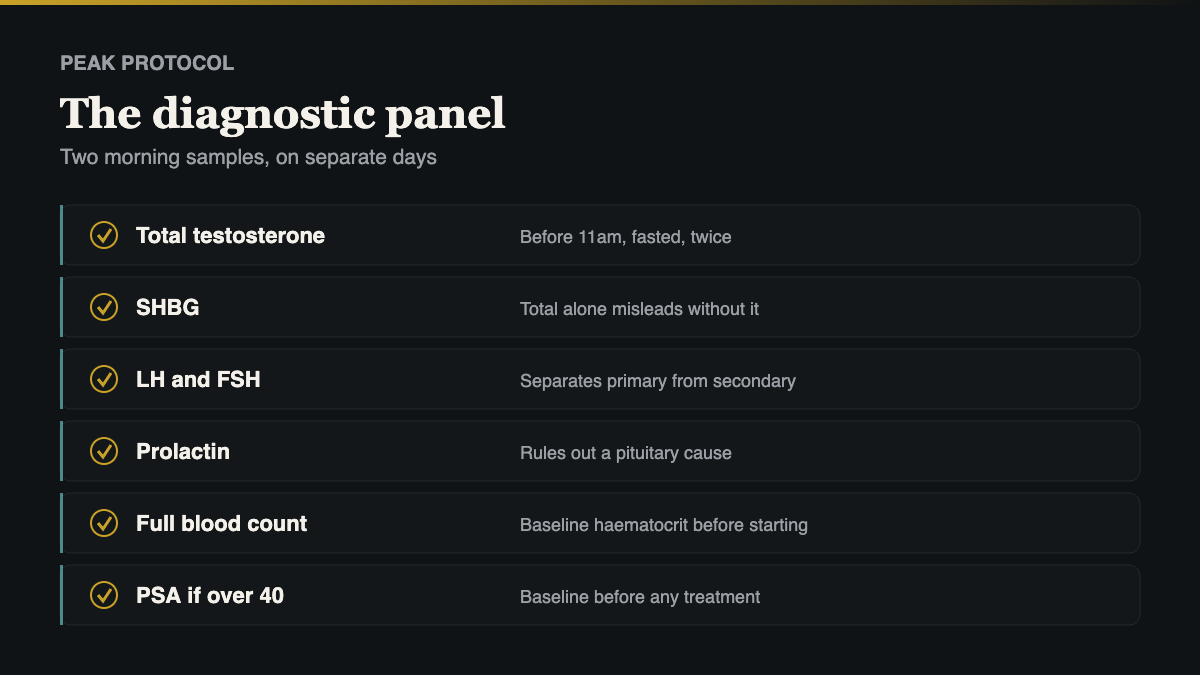
Alongside total testosterone, a proper workup usually includes SHBG and calculated free testosterone, LH and FSH to distinguish whether the problem originates in the testes or the pituitary, prolactin, and often oestradiol, a full blood count and a lipid panel.
UK clinical guidance from the British Society for Sexual Medicine sets out threshold ranges for total testosterone at which treatment is considered, with clearer indications at the lower end and a grey zone above it where the decision depends on symptoms, free testosterone and clinical judgement. Your reading falling in that grey zone is common and is where most of the disagreement between clinicians happens.
See testosterone blood tests for what to ask for.
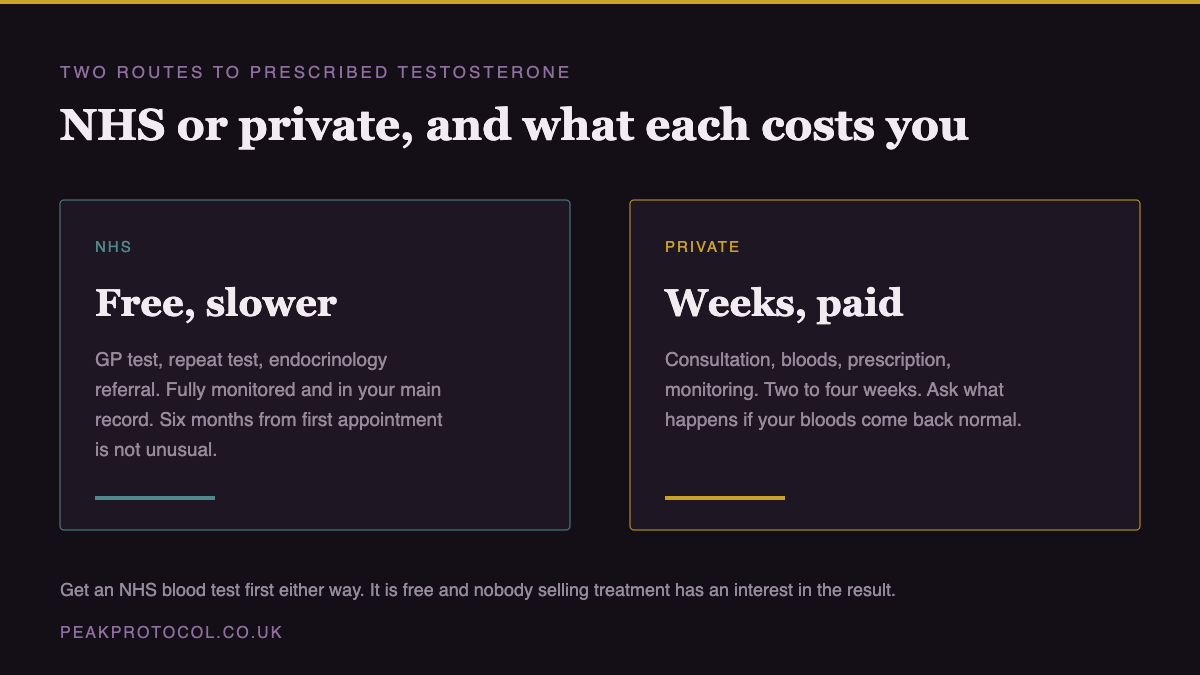
The NHS route
Start with your GP. Describe the symptoms plainly and ask for a morning total testosterone test. If it comes back low, expect a repeat test to confirm, and then a likely referral to endocrinology.
The honest picture is that this route is free, properly monitored and often slow, and that experience varies considerably between practices. Some GPs investigate thoroughly. Others are dismissive, particularly with younger men, and particularly where the reading is in the grey zone rather than clearly low.
If you are dismissed and you believe the symptoms are real, asking for the specific tests above, or for a referral, is reasonable and you are entitled to do it.
The private route
Private men’s health clinics offer a faster path: consultation, bloods, and if indicated, a prescription with ongoing monitoring. In England these clinics must be registered with the Care Quality Commission, and prescribers must be on the GMC or GPhC register. Both registers are public and searchable, and checking takes two minutes.
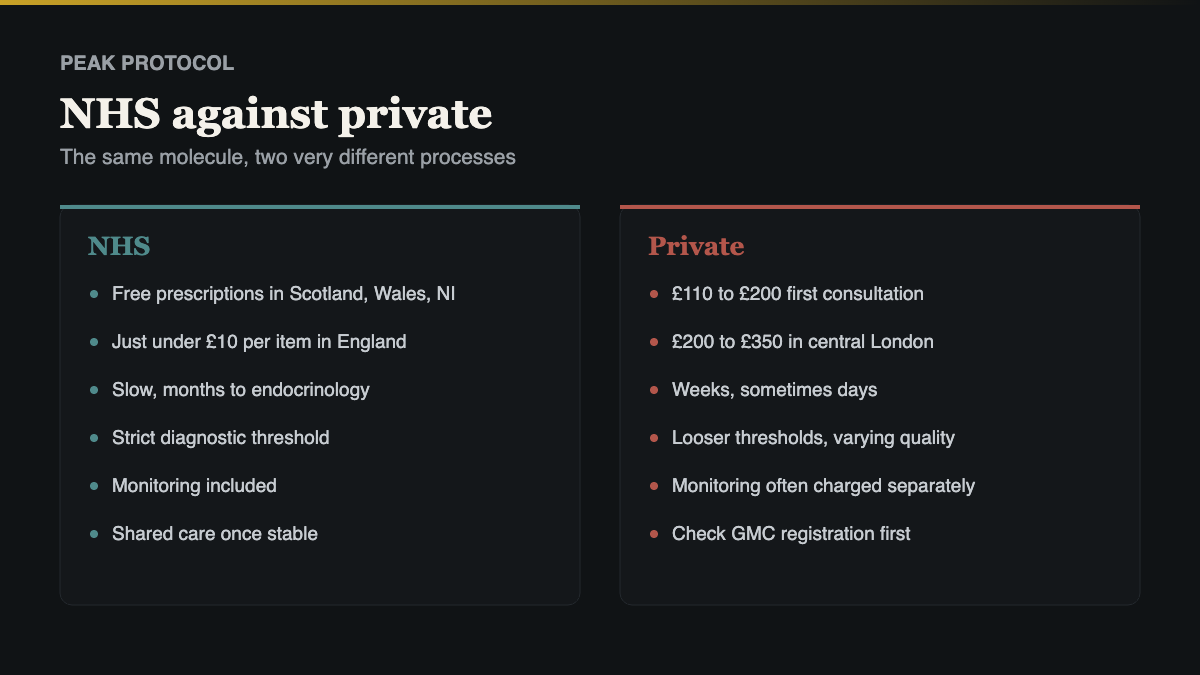
For a side by side comparison of the two routes, see NHS vs private TRT.
That check matters because the standard varies. A good private clinic diagnoses properly, monitors on a schedule and will decline to treat someone who does not need treatment. A bad one prescribes to anyone who pays, which is closer to a supply arrangement with a consultation attached.
The single most useful test of a clinic: ask what happens if your bloods come back normal. If the answer is that they would not prescribe, that is a clinic. If the answer is vague, or they suggest treating anyway, walk away.
What TRT costs
Private TRT is usually structured as an initial consultation, an initial blood panel, then an ongoing monthly or quarterly fee covering the prescription, the medication and periodic monitoring bloods.
We are not going to publish specific prices, because they vary between providers and change, and a figure copied from somewhere and left to go stale is worse than no figure. Ask each clinic for the full annual cost including monitoring rather than the headline monthly rate, since the monitoring is where the difference between providers usually sits.
On the NHS, treatment and monitoring are free, and prescription charges apply in England.
The forms TRT comes in
Injections. The most common route. Shorter acting esters are injected more frequently and give steadier levels. Longer acting preparations are given far less often, which suits some people and produces more of a peak and trough for others.
Gels. Applied daily to the skin. They avoid needles entirely and give very stable levels, and they carry one specific caution: transfer to other people through skin contact, which matters if you have young children or share a bed.
Which suits you is a clinical decision and a lifestyle one, and it is worth raising rather than accepting the default.
Monitoring, and why it is the point
Monitoring is not administrative overhead. It is the thing that makes prescribed testosterone different from the alternative.
The measures that matter most are haematocrit, because testosterone raises red blood cell production and an excessive rise thickens the blood and raises clot risk, PSA and prostate health in older men, oestradiol, lipids and blood pressure, and testosterone levels themselves to confirm the dose is doing what it should.
A clinic that prescribes and then does not test you again is not providing TRT in any meaningful sense. It is selling you testosterone.
Fertility
This is the consideration most often skipped in the initial conversation and most regretted later.
Exogenous testosterone suppresses the signals that drive sperm production, and for many men on TRT sperm counts fall substantially, in some cases to zero. It is frequently reversible after stopping, and it is not always, and there is no reliable way to know in advance which you will be.
If you want children in the future, raise it at the first appointment. There are approaches used specifically to preserve fertility alongside or instead of standard TRT, and sperm banking beforehand is straightforward. A clinician who does not ask you about this unprompted is not being thorough.
TRT risks and side effects
At properly monitored replacement doses the risk profile is very different from anabolic steroid use, but it is not nothing.
The documented issues include raised haematocrit, acne and oily skin, fluid retention, breast tenderness or gynaecomastia in some men, worsening of sleep apnoea, suppression of fertility as above, and accelerated hair loss in anyone genetically predisposed.
Almost all of those are manageable when someone is watching for them, which is the argument for monitoring rather than an argument against treatment.
Before you go anywhere
Get tested first. A morning total testosterone, ideally twice, before you speak to any private clinic, gives you a baseline nobody has a commercial interest in.
Then look at the boring explanations honestly. Sleep under six hours, significant excess body fat, heavy alcohol use and chronic stress all lower testosterone, and all of them are reversible without a prescription. Fixing those is not a fobbing off, it is the first line of treatment, and for a meaningful number of men it resolves the problem entirely.
If levels are genuinely low after that, the legal route exists and it works. If they are not, the answer was never testosterone, and no supplement replaces it either. Our shop sells legal supplements and none of them raise testosterone in a man whose level is already normal, which is why our product pages say so.
The grey zone, and why two clinicians disagree
Most of the frustration people describe with TRT in the UK comes from one place: a reading that is low enough to explain the symptoms but not low enough to be unarguable.
Below a clear threshold, treatment is straightforward and most clinicians agree. Above the normal range, nobody treats. In between sits a band where the same set of results can reasonably produce two different answers, and which answer you get depends on the clinician rather than on you.
Two things make that band navigable. The first is free testosterone: total testosterone can read acceptable while SHBG is high enough that the free fraction, the part actually available to tissue, is not. Asking for SHBG and calculated free testosterone rather than total alone frequently changes the picture, and it is not always ordered by default.
The second is symptom documentation. Turning up with a list of symptoms and dates is more persuasive than describing them from memory in a ten minute appointment, and it costs nothing.
How to tell a good clinic from a bad one
The private market ranges from genuinely excellent to something closer to a supply operation with a consultation attached. The differences are visible before you pay.
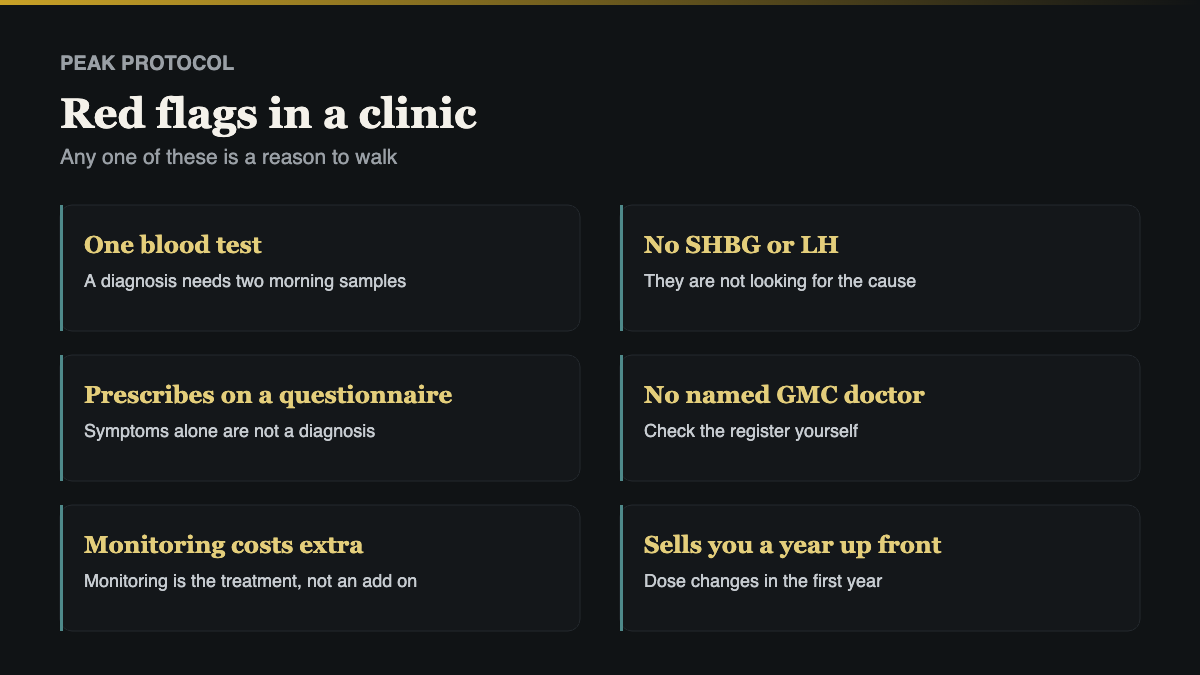
Good signs. They insist on their own bloods before prescribing. They require two morning tests. They ask about fertility, sleep apnoea and family history unprompted. They set a monitoring schedule and hold you to it. They are registered with the CQC and their prescriber is findable on the GMC or GPhC register. They will tell you when you do not need treatment.
Warning signs. A prescription offered after a questionnaire and no blood test. Monitoring described as optional or charged as an expensive extra. Doses that climb quickly. Anything else being sold alongside, particularly compounds that are not testosterone. Marketing that leans on physique rather than on symptoms.
That last one is a reliable indicator. A clinic treating a medical condition talks about fatigue, libido and mood. A clinic selling something else talks about muscle.
Five mistakes that cost people the most
Five mistakes account for most of the money wasted and most of the harm done on the way into treatment.
One, treating symptoms as a diagnosis. Fatigue, low mood and low libido are real, but they are also the symptoms of poor sleep, depression, thyroid disease and simply being overweight. TRT UK clinics that prescribe on a questionnaire alone are selling, not treating.
Two, testing at the wrong time. Testosterone follows a daily rhythm and is highest in the morning. An afternoon sample can read low in a man whose morning level is entirely normal, and it is the single commonest reason for a wrong answer.
Three, reading total testosterone alone. Without SHBG the total figure can mislead badly in both directions. Any TRT UK service that does not measure it is working with half the picture.
Four, underestimating the commitment. This is usually for life. Starting suppresses your own production, and stopping after a long period leaves you worse than when you began. That is not a reason to avoid it, but it is a reason to be certain first.
Five, choosing a TRT UK clinic on price. The consultation is not the cost, the monitoring is, and a service that charges little up front and bills for every blood test afterwards usually costs more within a year.
What to do next
If the symptoms are real and you want to do this properly, the order of operations matters more than the destination.
Get the bloods before you get an opinion. Two morning samples on separate days, with SHBG, LH and FSH alongside total testosterone. Testosterone blood test UK covers exactly what to ask for and why the timing decides the result. Walking into any TRT UK consultation holding your own numbers changes the conversation entirely.
Rule out the reversible causes. Sleep apnoea, obesity, alcohol and overtraining all suppress testosterone, and all of them respond to being addressed. Low testosterone symptoms covers what actually discriminates and what does not.
Try the NHS first, even if you expect to go private. It costs nothing to ask, the diagnostic standard is higher, and prescriptions are free in Scotland, Wales and Northern Ireland. How to get TRT in the UK sets out the steps and what to say.
Then compare properly. TRT cost and clinics in the UK breaks down what each route costs over a year rather than at the first appointment, and the city guides cover what changes locally, including London, Manchester and the rest. Peak Protocol is a supplement retailer and cannot prescribe, so there is nothing here we gain from your answer.
TRT UK: common questions
Is TRT legal in the UK?
Yes, on prescription from a registered doctor, through the NHS or a private clinic. Buying testosterone without a prescription is a different matter entirely, covered in are steroids legal in the UK.
Can I get TRT on the NHS?
Yes, if you have symptoms and blood tests confirming low testosterone. Start with a morning blood test through your GP.
Is TRT the same as taking steroids?
The substance can be the same. The dose and the supervision are not. TRT aims to restore a normal level and keep it there under monitoring. Anabolic steroid use aims to exceed it, usually without either.
Will TRT make me build muscle?
Restoring a genuinely low level to normal typically improves body composition and training capacity. It is not a performance enhancer at replacement doses.
Do I have to stay on TRT for life?
Usually, yes. Starting suppresses your own production further, so stopping generally means returning to symptoms or worse. Treat it as a long term decision.
Does TRT cause infertility?
It substantially suppresses sperm production in most men. That is frequently reversible and not always. Raise fertility at your first appointment if children are a possibility.
Can I get TRT UK wide on the NHS?
Yes, if you meet the diagnostic criteria: consistently low morning testosterone on two separate samples plus symptoms, with other causes excluded. The threshold is stricter than most private clinics apply and the wait for endocrinology can run to months.
How much does TRT UK cost privately?
A first consultation is typically £110 to £200, and £200 to £350 in central London. Ongoing costs including medication and monitoring usually run between £80 and £200 a month, and services that look cheap up front often charge separately for every blood test.
Is TRT UK treatment for life?
Usually. Treatment suppresses your own production, so stopping after a long period leaves you lower than you started until natural production recovers, which takes months and is sometimes incomplete. That is why the diagnosis matters so much before you begin.