
Steroids UK searches usually come down to three questions: what these drugs are, whether they are legal here, and what they do to the body. This page answers all three in plain English and then points you to the detailed guide for each part of the subject. It covers anabolic steroids specifically, the testosterone based drugs used to build muscle, rather than the corticosteroids a GP prescribes for asthma or eczema. Peak Protocol does not sell anabolic steroids, SARMs or prescription medicines. We sell legal sports supplements and publish this guide because the people searching deserve straight, sourced answers rather than a sales page.
Steroids UK: the short version
- Anabolic steroids are Class C drugs under the Misuse of Drugs Act 1971 and sit in Schedule 4 Part II of the Misuse of Drugs Regulations 2001.
- Possessing them for your own use, in the form of a medicinal product, is not an offence. Supplying them, even to a friend for free, can carry up to 14 years in prison.
- Bringing them into the country by post, courier or freight has been an offence since 2012. Carrying them in person for personal use is treated differently.
- The main harms are to the heart, blood, liver, hormones, fertility and mood, and most produce no symptoms until they are advanced, which is why blood tests matter.
- In sport they are banned at all times, in and out of competition, and a positive test can mean a four year ban.
- Testosterone replacement therapy (TRT) is a prescribed medical treatment for diagnosed deficiency. It is not the same thing as using steroids to build muscle.
What people mean by steroids
The word steroid covers two very different families of drug, and mixing them up causes most of the confusion in search results.
Corticosteroids are anti inflammatory medicines. Prednisolone tablets, hydrocortisone cream and the brown preventer inhaler are all corticosteroids. They are prescribed every day on the NHS, they do not build muscle, and nothing on this page is about them. If a doctor has put you on a corticosteroid, keep taking it as prescribed and ask them before changing anything.
Anabolic androgenic steroids, usually shortened to anabolic steroids or AAS, are synthetic versions and derivatives of testosterone. Anabolic refers to tissue building, principally muscle. Androgenic refers to the male characteristics testosterone drives, such as body hair, a deeper voice and the growth of the prostate. No anabolic steroid is purely anabolic, which is why the side effects follow the muscle gain so reliably.
Two other groups often get called steroids even though they are not. SARMs (selective androgen receptor modulators) are experimental drugs that act on the same receptor but have a different structure, and clenbuterol is an asthma drug for horses that is used for fat loss. Neither is a steroid, and different laws apply to each. Our guide to what anabolic steroids are and how they work goes into the drugs themselves in more depth.
Types of anabolic steroids
Anabolic steroids are usually grouped by how they are taken, because the route changes the risk profile more than the brand name on the box does.
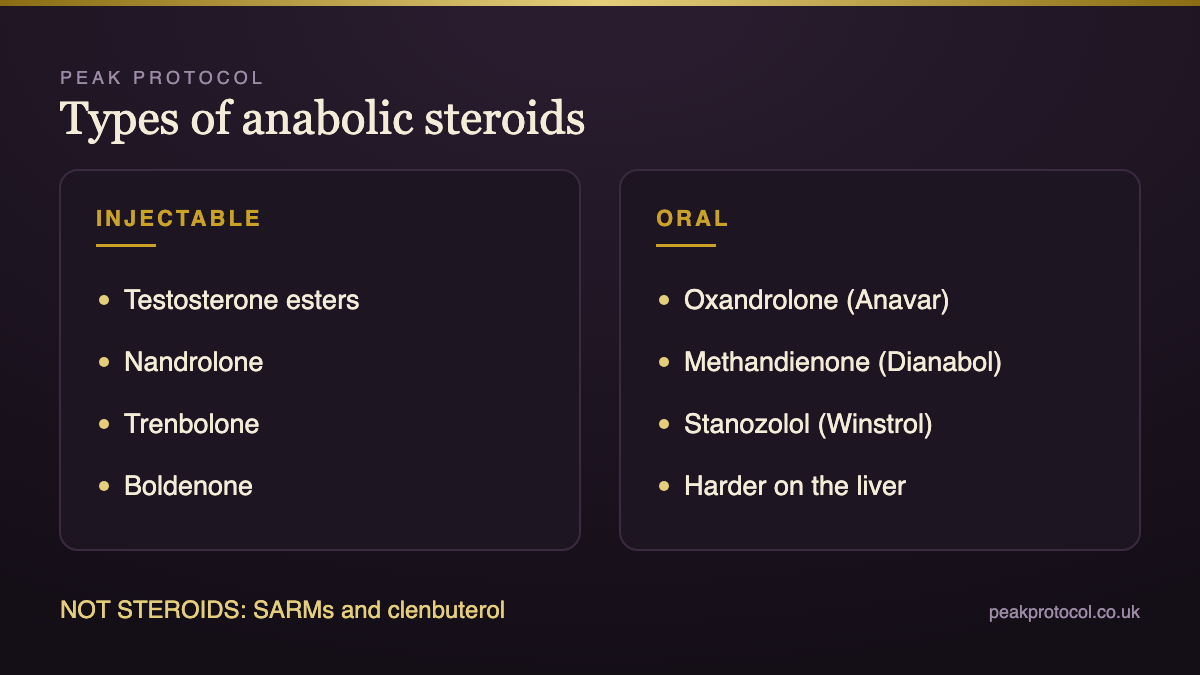
Injectable steroids are oil based solutions injected into muscle. Testosterone itself is the most common, attached to an ester such as enanthate or cypionate that controls how quickly it is released. Nandrolone, trenbolone, boldenone and drostanolone are other injectables. Injecting adds its own risks, from abscesses to blood borne viruses, which we cover in steroid injection safety.
Oral steroids are tablets. Most are chemically altered at a position known as 17 alpha so that they survive the liver, and that same alteration is what makes them harder on the liver. Oxandrolone (sold as Anavar), methandienone (Dianabol) and stanozolol (Winstrol) are the best known.
The table below links to our individual guides. Each one explains the legal position, the evidence and the harms for that compound. None of them gives doses, cycles or sources, and none ever will.
| Compound | Substance | Legal position in the UK | Taken as | Main concern |
|---|---|---|---|---|
| Anavar | Oxandrolone | Class C | Tablet | Sharp fall in HDL cholesterol |
| Dianabol | Methandienone | Class C | Tablet | Blood pressure and liver strain |
| Winstrol | Stanozolol | Class C | Tablet or injection | Severe effect on cholesterol |
| Trenbolone | Trenbolone | Class C | Injection | Veterinary drug with no human safety data |
| Nandrolone | Nandrolone decanoate | Class C | Injection | Long hormonal suppression |
| Clenbuterol | Clenbuterol | Prescription only medicine, not a steroid | Tablet | Heart rhythm and low potassium |
| SARMs | Various | Unlicensed medicines, not steroids | Tablet or liquid | Liver injury and mislabelling |
Are steroids legal in the UK?
The short answer is that anabolic steroids are controlled but possession for personal use is not a crime, while supply is treated as seriously as dealing any other Class C drug. The detail matters, because the line between personal use and supply is easier to cross than most people think.
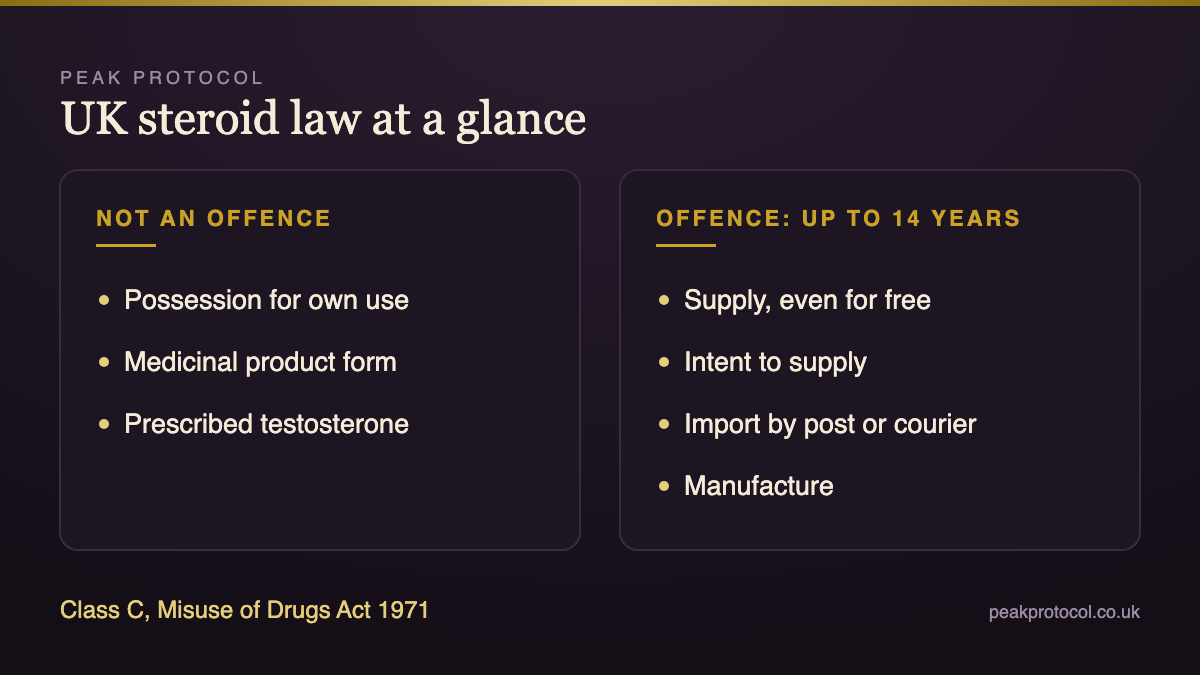
Anabolic steroids are listed as Class C under the Misuse of Drugs Act 1971. Their position in Schedule 4 Part II of the Misuse of Drugs Regulations 2001 is what creates the personal use exemption: possessing them in the form of a medicinal product, for your own use, is not an offence. That exemption does not stretch to anything else.
- Supply means passing them to anyone else, whether sold, swapped or given away. It carries up to 14 years in prison and an unlimited fine. Possession with intent to supply carries the same maximum, and large quantities or splitting a batch can be treated as evidence of intent.
- Importing by post, courier or freight forwarder has been an offence since a 2012 change to the regulations, even for personal use. Border Force routinely seizes parcels and the case can be passed to the police.
- Making or producing them is an offence with the same maximum penalty as supply.
- Prescription is the only lawful route for most people. Testosterone and a small number of related drugs are prescription only medicines under the Human Medicines Regulations 2012, prescribed for conditions such as testosterone deficiency.
Clenbuterol and SARMs sit outside this framework. They are not controlled drugs, but selling or supplying them is regulated under medicines law and enforced by the Medicines and Healthcare products Regulatory Agency.
We explain every part of this in UK steroid law: possession, supply and import, answer the common questions in are steroids legal in the UK?, and set out how the class system works in UK drug classification and Class C drugs UK. The official maximum penalties are published in the GOV.UK penalty tables. None of this is legal advice, and anyone facing a charge should speak to a solicitor.
| Activity | Legal position | Maximum penalty |
|---|---|---|
| Possessing for your own use (medicinal product form) | Not an offence | None |
| Giving or selling to anyone else | Supply offence | Up to 14 years and an unlimited fine |
| Possessing with intent to supply | Offence | Up to 14 years and an unlimited fine |
| Ordering by post, courier or freight | Importation offence since 2012 | Up to 14 years and an unlimited fine |
| Producing or manufacturing | Offence | Up to 14 years and an unlimited fine |
| Using testosterone on a doctor’s prescription | Lawful | None |
Steroid risks and side effects
The risks of anabolic steroids depend on the drug, the dose, how long it is used and the person using it, but the pattern is consistent enough that the NHS guidance on anabolic steroid misuse lists the same problems researchers keep finding. What makes them dangerous is that most produce no symptoms at all until they are well advanced.
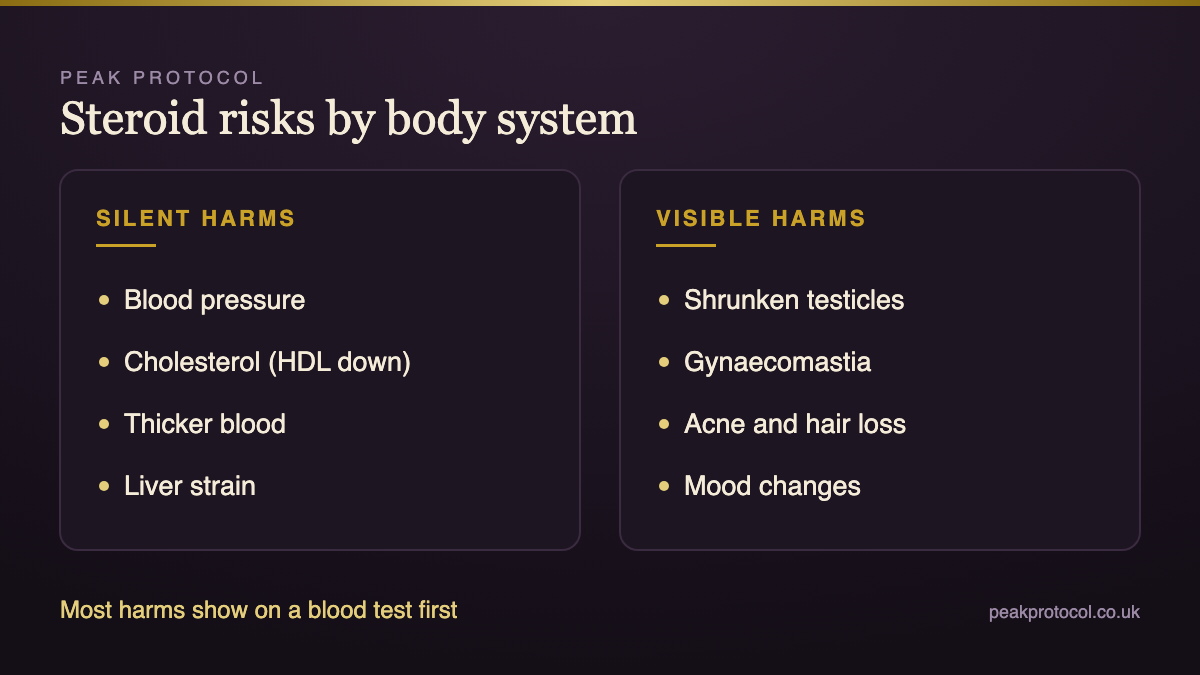
Heart and circulation. Steroids lower HDL, the protective cholesterol, and raise LDL. Blood pressure tends to rise. Over time the heart muscle can thicken and pump less efficiently. Our guide to steroids and heart health covers blood pressure, cholesterol and the heart in detail.
Blood. Androgens push the body to make more red blood cells. Thicker blood, shown as a raised haematocrit on a blood test, increases the risk of clots and stroke.
Liver. Oral steroids in particular strain the liver and can cause jaundice, and in rare cases blood filled cysts or tumours.
Hormones and fertility. Taking testosterone from outside tells the body to stop making its own. Testicles shrink, sperm production falls and many men become temporarily infertile. Some do not fully recover. We explain the mechanism in steroids and fertility.
Appearance. Acne, hair loss in men who are genetically prone to it, and gynaecomastia (breast tissue growth in men), which sometimes only surgery reverses.
Mood and mental health. Irritability, aggression and poor sleep are common during use. Low mood and depression are common after stopping, and some people develop a dependence on the drugs.
Women can develop a deeper voice, facial and body hair and changes to the menstrual cycle. A deepened voice is often permanent. Teenagers who use steroids risk stopping their growth early.
The full list, with what is reversible and what is not, is in steroid side effects and risks.
Injection risks
Most steroid users inject, and a large share of the harm is caused by the injecting rather than the drug. Shared vials and needles spread HIV and hepatitis B and C. Poor technique or a contaminated product can cause abscesses, and a needle in the wrong place can damage a nerve.
Needle and syringe programmes across the UK give out sterile equipment free and take back used sharps, with no requirement to stop using and no questions about where the drugs came from. Many pharmacies run one. Hepatitis B vaccination is available through GPs and sexual health clinics. Our steroid injection safety guide explains the risks, the warning signs of infection and where to find a service.
Counterfeit and contaminated products
Because anabolic steroids cannot be sold legally without a prescription, almost everything on the market is made in unregulated labs. Nobody checks what goes in the vial. Products are regularly found to be underdosed, to contain a different drug from the one on the label, or to be contaminated with bacteria or particles. A professional looking label and a batch number prove nothing.
The Medicines and Healthcare products Regulatory Agency seizes large quantities of illegal medicines every year, and the pattern it reports is consistent: the packaging is designed to look pharmaceutical and the contents frequently are not. In Wales, WEDINOS, run by Public Health Wales, will test a submitted sample anonymously and publish the result. We cover how to recognise the problem, and why it cannot be solved by choosing a better supplier, in counterfeit steroids.
Testosterone suppression and coming off steroids
The body controls testosterone through a feedback loop between the brain and the testicles. When testosterone arrives from outside, the brain stops sending the signal (luteinising hormone) that tells the testicles to make it. When the steroids stop, the outside supply disappears straight away but the natural signal takes weeks or months to return.
That gap is when people feel worst: low energy, low libido, erectile problems and low mood, sometimes severe. It is also the point at which many people start again simply to feel normal, which is how dependence develops. Recovery is usually possible but it is slower after long or repeated use, and in some men natural production never fully returns.
The drugs often used to restart production are themselves prescription only medicines and are not a safe do it yourself fix. A GP can arrange hormone tests and refer to an endocrinologist. Our guide to coming off steroids covers what the months after stopping look like and where to get support, and testosterone in the UK explains how the hormone works in the first place.
Steroid testing and blood tests
Steroid testing means two different things, and both are covered on this site.
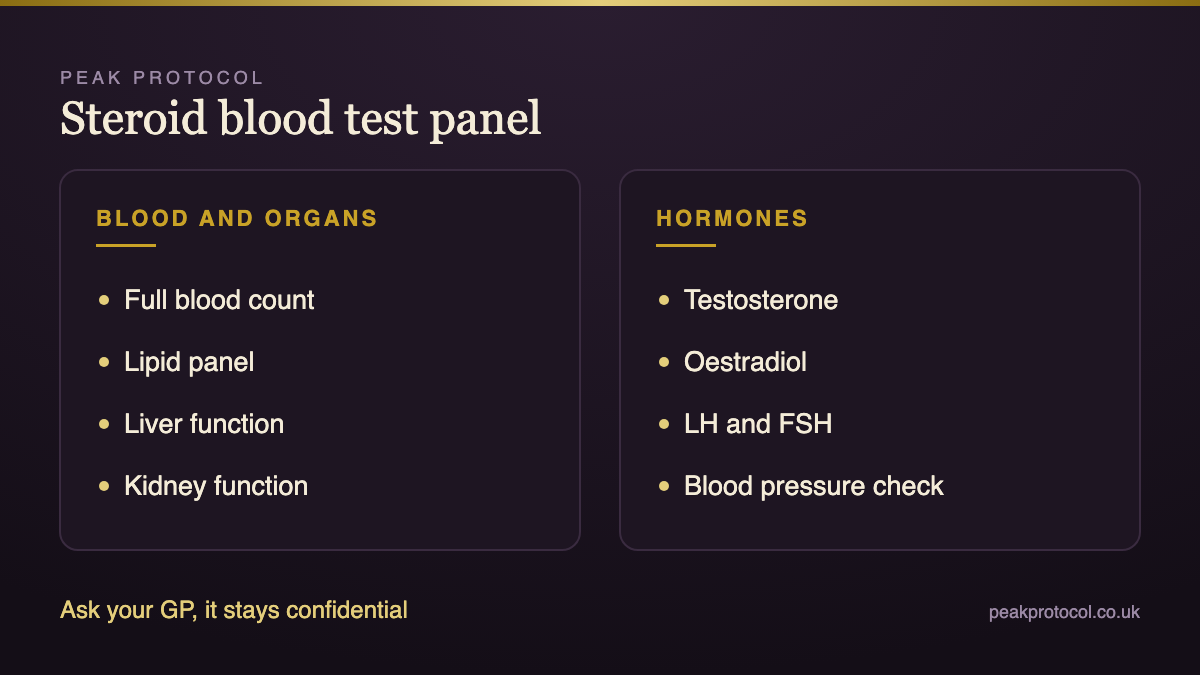
Health testing is a blood test to see what the drugs are doing to you. A useful panel covers a full blood count (for haematocrit), cholesterol and lipids, liver function, kidney function, testosterone, oestradiol, LH and FSH, plus a blood pressure reading. Many of these harms are silent, so a test is often the only way to find them before they become serious. Your GP can arrange the tests, and telling a doctor about steroid use will not get you reported to the police. Our guide to steroid blood tests explains each marker and what the results mean, and testosterone blood tests covers hormone testing specifically.
Drug testing is what sports bodies and some employers do to detect use. That is covered in the next section.
Steroids, sport and anti-doping
Anabolic agents are banned at all times, in and out of competition, under the World Anti-Doping Agency Prohibited List, which UK Anti-Doping enforces in Britain. The rule is strict liability: if a banned substance is in your sample, you are responsible, whether it came from a vial or a contaminated supplement. The standard ban for intentional use of an anabolic steroid is four years.
Testing is not limited to elite athletes. Anyone who competes under a sport’s national governing body can be tested, including amateur and university level competitors. A therapeutic use exemption is possible for a genuine, diagnosed medical need such as prescribed testosterone, but it has to be applied for and approved.
Contaminated supplements are a real risk for tested athletes, which is why batch tested products matter. Our anti-doping guide explains how testing works, what strict liability means in practice and how to reduce the risk from supplements.
TRT and anabolic steroid use are not the same thing
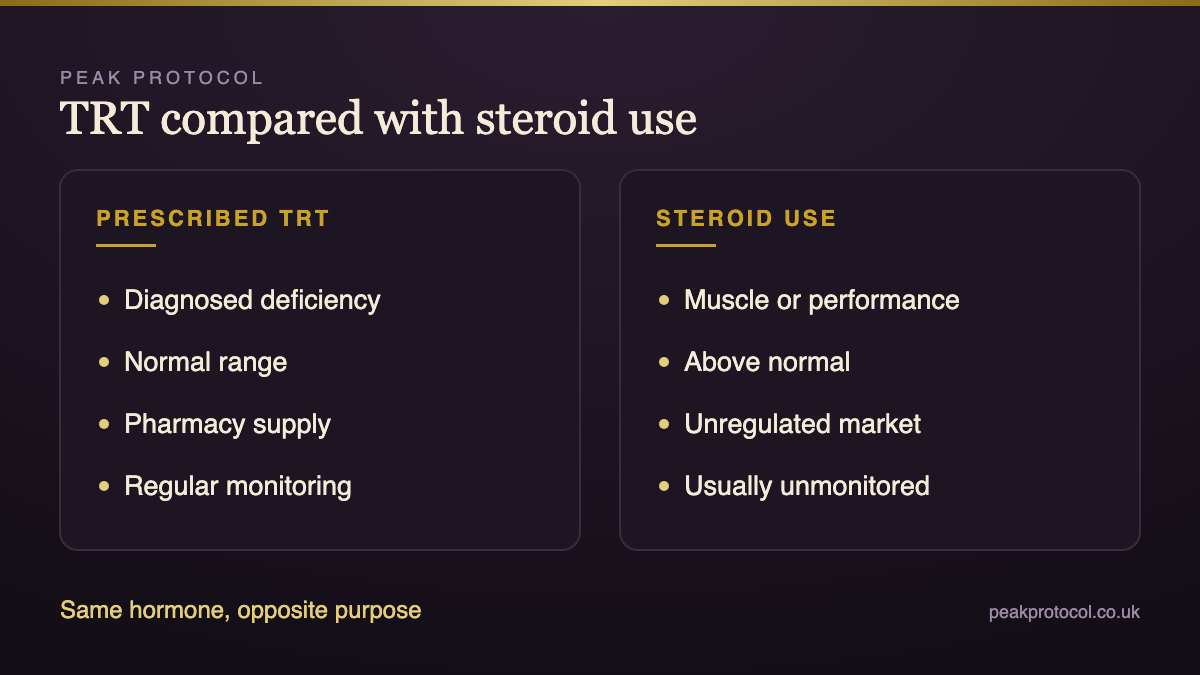
Testosterone replacement therapy and steroid use can involve the same drug, which is why they get confused, but they are opposite in purpose.
TRT is prescribed for men with testosterone deficiency, which is diagnosed from symptoms and at least two early morning blood tests. The aim is to bring testosterone back into the normal range, and treatment is monitored with regular blood tests. Anabolic steroid use aims to push hormone levels well above normal to build muscle, is usually unmonitored and often combines several drugs.
| Prescribed TRT | Anabolic steroid use | |
|---|---|---|
| Purpose | Treat diagnosed deficiency | Build muscle or improve performance |
| Target level | Normal range | Well above normal |
| Source | Pharmacy, on prescription | Unregulated market |
| Monitoring | Regular blood tests | Usually none |
| Legal position | Lawful | Supply and import are offences |
| Fertility | Can be suppressed, discussed before starting | Commonly suppressed |
If you think you may have low testosterone, start with low testosterone symptoms and our TRT UK guide, which covers how to get TRT and what it costs.
Legal alternatives that have evidence
Products sold as legal steroids mostly contain herbal extracts with little good evidence behind them, and some have been found to contain undeclared drugs. The legal steroids UK guide goes through the common ingredients and which ones have any support.
What does have strong evidence is less exciting. Creatine monohydrate is the most studied sports supplement there is and reliably improves strength and power in repeated high intensity exercise. Eating enough protein across the day supports muscle growth alongside resistance training. Zinc, vitamin D and magnesium matter when you are short of them. None of these will do what anabolic steroids do, and we will not pretend otherwise. They also will not suppress your hormones, fail a drugs test or put you on the wrong side of the law.
The two with the strongest evidence have their own guides, creatine and protein, and how we judge every ingredient we sell is set out on our supplement evidence page.
When to get medical advice
Talk to a GP if you are using or have used anabolic steroids and want a health check, if you have stopped and feel low, exhausted or unable to function, or if you are worried about your fertility. GPs deal with this regularly and it will stay confidential.
Call 999 or go to A&E for chest pain, sudden breathlessness, weakness on one side of the body, a severe headache, or a hot, red, swollen injection site with fever. If you are having thoughts of harming yourself, call Samaritans free on 116 123 at any time.
For confidential information about drugs and local services, TALK TO FRANK runs a free helpline on 0300 123 6600, or you can find local support.
All our steroid guides
Every page in this cluster links back here. Start with whichever question brought you to the site.
- The law: UK steroid law, are steroids legal in the UK?, UK drug classification, Class C drugs UK
- The drugs: anabolic steroids UK, Anavar, Dianabol, Winstrol, trenbolone, nandrolone, clenbuterol, SARMs
- Risks: side effects and risks, heart health, fertility, gynaecomastia, hair loss, counterfeit steroids
- Staying safer: injection safety, blood tests, coming off steroids
- Sport: anti-doping
- Testosterone and TRT: testosterone, TRT UK, low testosterone, testosterone blood test, NHS vs private TRT
- Alternatives: legal steroid alternatives, creatine, protein, how we grade the evidence
The full library, including supplement guides, is on the guides page.
Steroids UK: common questions
Are steroids legal in the UK?
Anabolic steroids are Class C controlled drugs. Possessing them in medicinal product form for your own use is not an offence, but supplying them to anyone, importing them by post or courier, and making them are all offences carrying up to 14 years in prison.
Can you get anabolic steroids on prescription in the UK?
Testosterone and a few related drugs are prescribed for specific medical conditions, most commonly testosterone deficiency in men. They are not prescribed to build muscle or improve appearance.
Is it illegal to buy steroids online in the UK?
Ordering anabolic steroids to be delivered by post, courier or freight has been an importation offence since 2012, even for personal use, and the seller is committing a supply offence. Products bought this way are also unregulated and often counterfeit.
What are the most serious risks of steroids?
The most serious are to the heart and circulation: raised blood pressure, harmful cholesterol changes, thicker blood and changes to the heart muscle. Hormonal suppression, infertility, liver damage and mental health effects are also common.
Will my GP report me if I tell them I use steroids?
No. Doctors have a duty of confidentiality and using steroids is not something they report to the police. Telling your GP means blood tests can be interpreted properly.
Do legal steroids work?
Most products sold as legal steroids have little evidence behind them. Creatine monohydrate and adequate protein intake have strong evidence for supporting strength and muscle alongside training, but they do not work like anabolic steroids.
Does Peak Protocol sell steroids?
No. Peak Protocol sells legal sports supplements only. We do not sell anabolic steroids, SARMs or prescription medicines, and we cannot help anyone obtain them.
Sources and review status
This guide draws on the Misuse of Drugs Act 1971, the Misuse of Drugs Regulations 2001, the Human Medicines Regulations 2012, the GOV.UK penalty tables, the NHS guidance on anabolic steroid misuse, the World Anti-Doping Agency Prohibited List and guidance from UK Anti-Doping and the Medicines and Healthcare products Regulatory Agency. It was written by the Peak Protocol editorial team and has not been reviewed by a medical professional. It is information, not medical or legal advice, and it is not an encouragement to use any drug. How we research and correct our content is explained in our editorial policy.