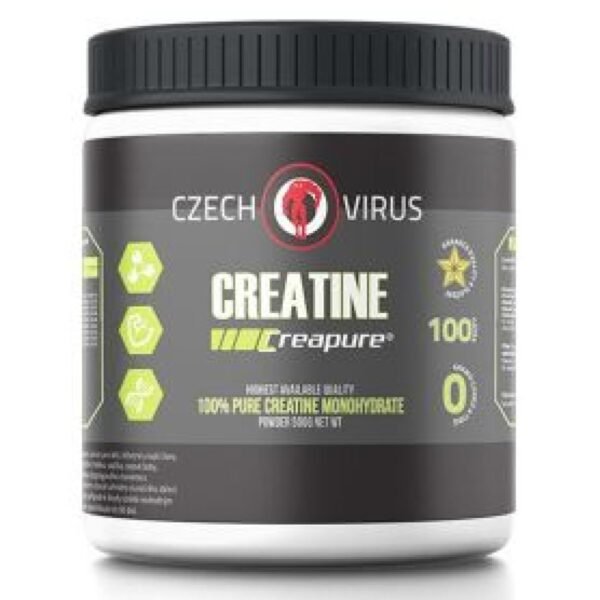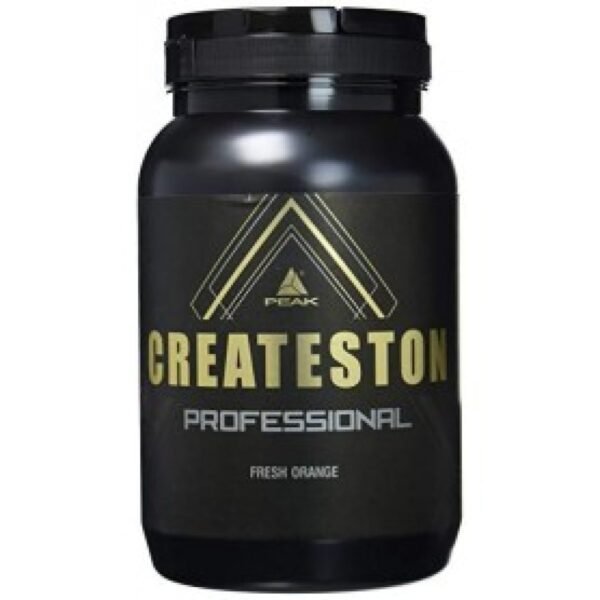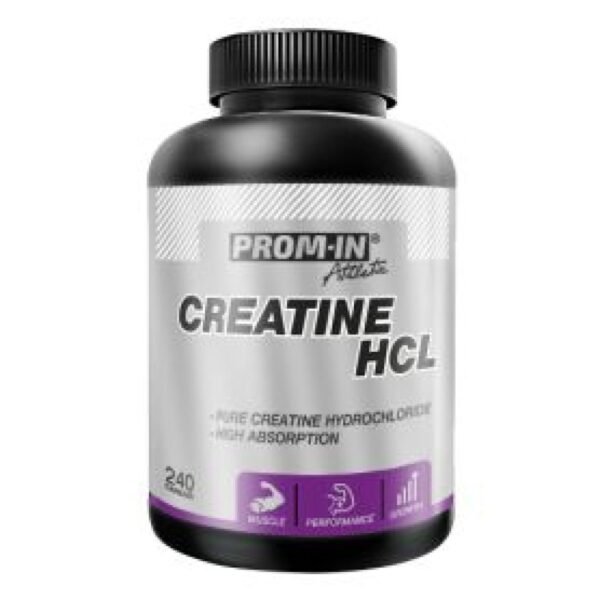
Creatine
Creatine is the most researched supplement in sports nutrition, and one of very few where the evidence is strong enough that we will say plainly it works. Several hundred controlled trials and a long run of position stands agree on a small, repeatable increase in strength, power output and training volume, alongside a few kilograms of extra body mass, most of it water held inside the muscle.
It is also one of the cheapest things on this site, which is why the marketing around it is so strange. The forms that cost the most have the least evidence behind them. What follows is what the research actually supports, what to ignore, and how to pick from the range below.
On this page
- What creatine actually does
- Monohydrate against every other form
- How to dose it, and whether to load
- Who it suits and who it does not
- Side effects, honestly
- The myths worth killing
- Creatine for women
- The non muscle research
- Quality, testing and storage
- How to choose from this range
- Common questions
What creatine actually does
Your muscles store creatine as phosphocreatine, which regenerates ATP during short, hard efforts. Supplementing raises those stores by roughly twenty to forty percent in most people, and the practical effect is an extra repetition or two at a given weight, or a slightly heavier weight for the same repetitions. Across weeks of training that compounds into more total work done, which is the actual driver of adaptation.
The effect size is real but modest. Meta analyses of resistance training studies typically show a few percent greater gain in strength and lean mass against placebo. Anyone promising a transformation from creatine alone is selling something. What it will do is make consistent training slightly more productive, indefinitely, for a few pence a day.
Around twenty to thirty percent of people are non responders, usually those who already carry high muscle creatine from a diet heavy in red meat and fish. If you eat that way and notice nothing after a month, that is the likely explanation rather than a bad batch.
Monohydrate against every other form
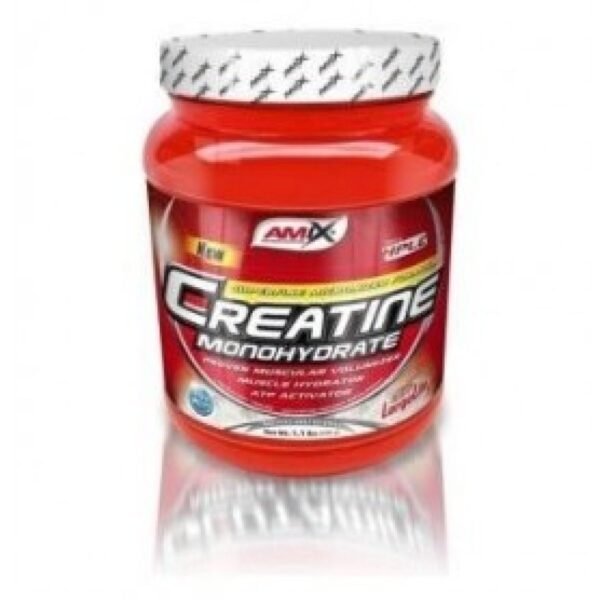
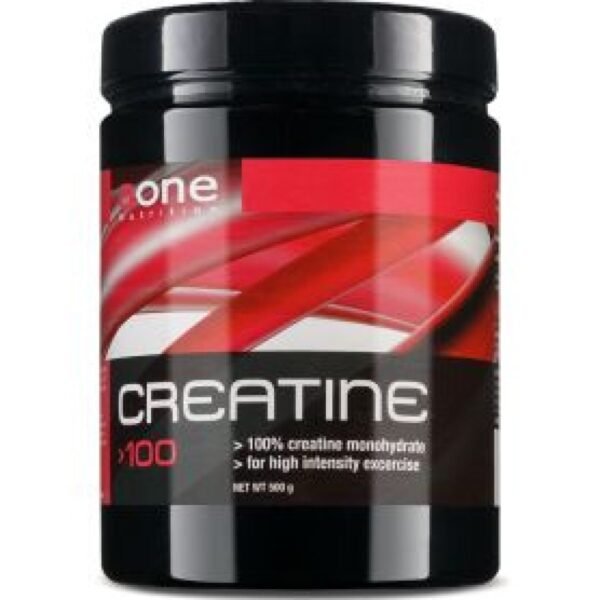
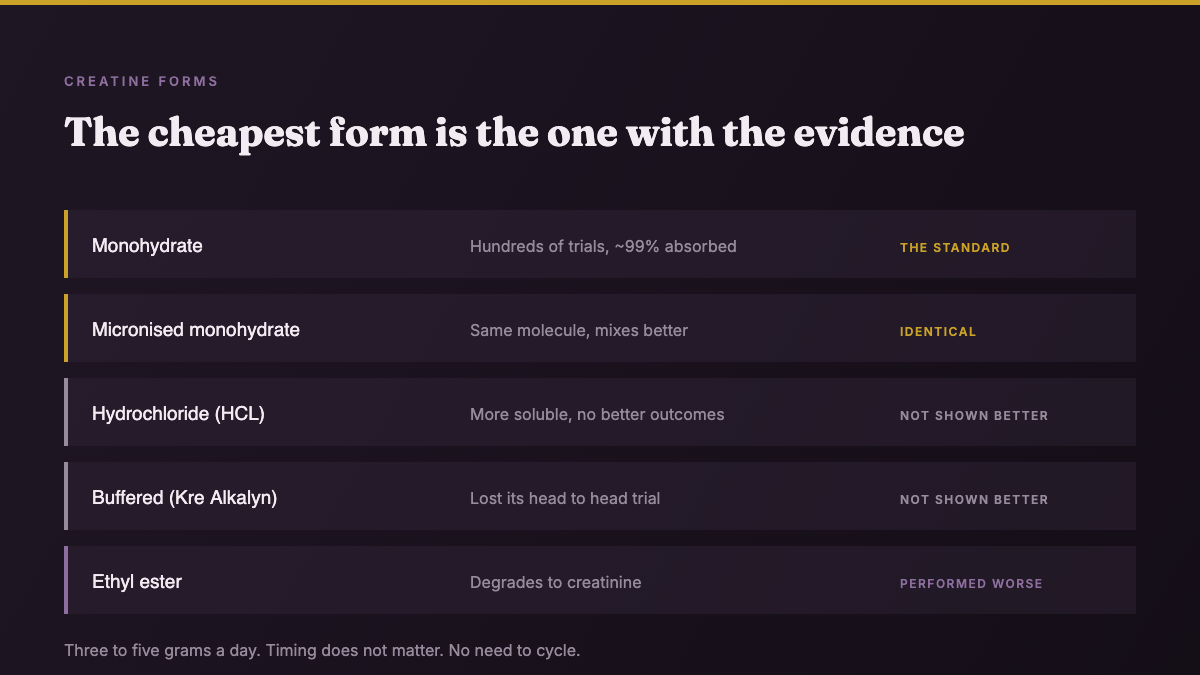
Creatine monohydrate is the form used in the overwhelming majority of the research, and no alternative form has beaten it in a fair head to head trial. The premium forms exist because monohydrate is unpatentable and cheap.
| Form | The claim | What the evidence shows |
|---|---|---|
| Monohydrate | None needed | The reference standard. Hundreds of trials, roughly 99 percent absorbed. |
| Micronised monohydrate | Mixes better | Same molecule, smaller particles. Genuinely mixes better, identical results. |
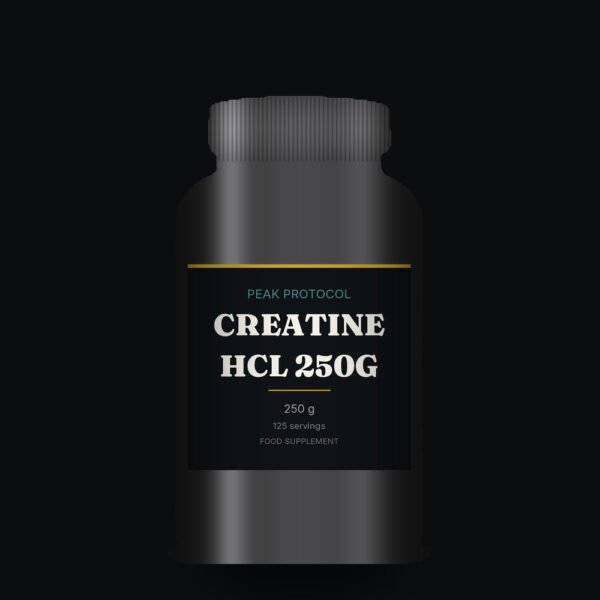
| Hydrochloride (HCL) | More soluble, lower dose | More soluble is true. No trial shows better strength or lean mass outcomes. |
| Buffered (Kre Alkalyn) | Survives stomach acid | Lost its head to head against monohydrate on both muscle creatine and performance. |
| Ethyl ester | Better uptake | Degrades to creatinine. Performed worse than monohydrate in trial. |
| Malate, nitrate, gluconate | Various | Thin evidence. Not shown to beat monohydrate. |
The pattern is consistent. Every alternative form is sold on a mechanism that sounds plausible in isolation, usually solubility or stomach stability, and then fails to translate into a better outcome when somebody measures muscle creatine or strength against plain monohydrate. Solubility is not the bottleneck, because monohydrate is already almost completely absorbed.
We stock several of these because people ask for them, and the product pages say the same thing this table says. If you want the form with the evidence, buy monohydrate and spend the difference on food.
How to dose it, and whether to load
Three to five grams a day, every day, is the maintenance dose. Bodyweight matters a little, so someone over about 90kg may do better at the top of that range or slightly above.
Loading means twenty grams a day split into four doses for five to seven days, then dropping to maintenance. It saturates the muscle in about a week rather than about a month. It is optional. The end point is identical either way, and loading is the phase where the stomach complaints happen.
Timing does not matter. Take it whenever you will remember, with or without food. Consistency is the only variable that changes the outcome, because the effect comes from saturated stores rather than from an acute dose. There is no need to cycle off.
Who it suits and who it does not
It suits anyone doing resistance training, sprinting, or any sport with repeated short maximal efforts. It suits older adults training for strength, where the evidence on preserving lean mass is arguably more valuable than it is for a twenty year old. Vegetarians and vegans tend to respond most strongly, because dietary creatine comes almost entirely from meat and fish.
It is close to useless for pure endurance performance. If you run marathons, creatine adds body water and body mass without adding anything to aerobic capacity, and that trade is against you.
If your training is inconsistent or your protein intake is not yet where it should be, fix those first. Creatine is a small multiplier on work you are already doing. Our protein range covers the intake question, and the guides cover the rest.
Side effects, honestly
The common one is water retention, two to four kilograms in the first weeks, held inside muscle cells rather than under the skin. Most people see this as a benefit. If you compete in a weight class, plan for it.
Stomach upset happens, almost always at loading doses or when a large dose is taken on an empty stomach with little water. Splitting the dose or skipping the loading phase resolves it.
Kidney function is the concern people raise most. In healthy adults, long term trials running several years have not shown kidney damage. Creatine does raise serum creatinine, which is a marker used to estimate kidney function, so a blood test can look alarming while nothing is wrong. Tell whoever ordered the test that you supplement. If you have existing kidney disease, speak to your doctor before starting.
The myths worth killing
It is a steroid. It is not, in any sense. Creatine is a compound found in ordinary food and it is legal, unscheduled and permitted in every tested sport. Anabolic steroids are Class C controlled drugs, an entirely different legal and pharmacological category.
It causes hair loss. This traces to one small 2009 study of rugby players showing a rise in DHT. It has never been replicated, and no trial has measured actual hair loss. Our guide on hair loss covers what genuinely does drive it.
You must cycle it. No trial supports cycling. Stores simply drop back over about a month when you stop.
It needs sugar to work. Insulin marginally improves uptake. Over weeks of consistent dosing the difference disappears.
Children and teenagers must never take it. Position stands from the International Society of Sports Nutrition consider it acceptable in supervised young athletes. That is a decision for a parent and a clinician, not a marketing page.
How to choose from this range
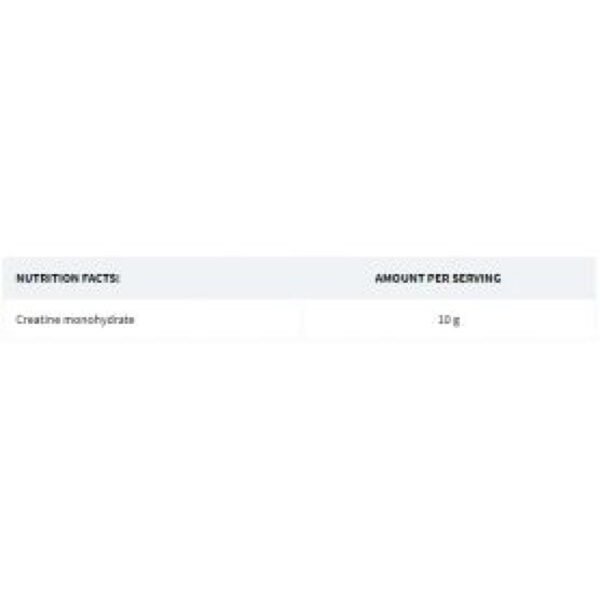
Every product below prints the dose per serving in full, and the servings per tub, so you can work out the cost per five gram serving before you buy. That number is the only one worth comparing.
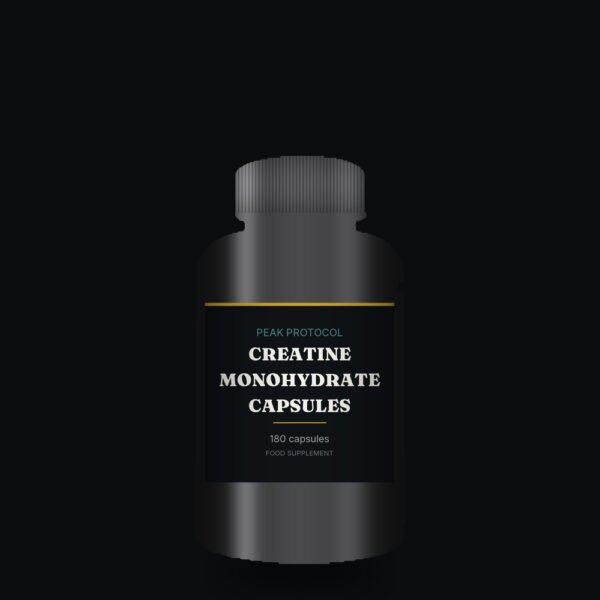
Powder is cheaper per serving than capsules by a wide margin, and unflavoured powder is cheaper than flavoured. Capsules exist for people who travel or who will not otherwise take it, and that is a legitimate reason to pay more. Flavoured powders are a convenience purchase, not a better product.
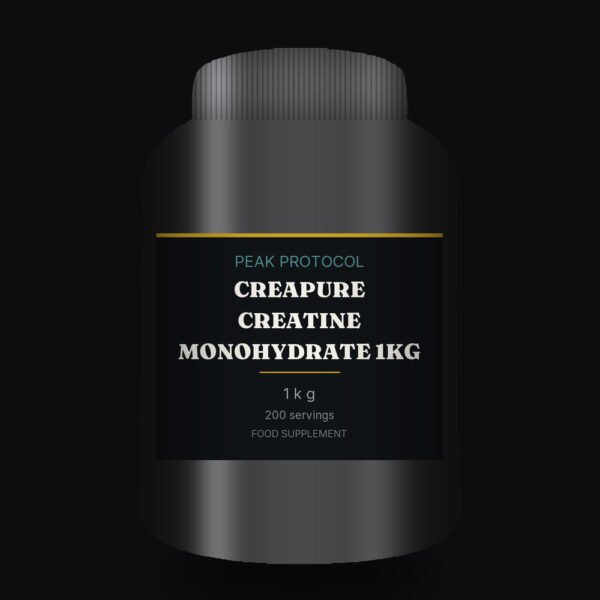
If you want the short version: buy plain micronised monohydrate in the largest tub you will finish, take five grams a day, and ignore everything else on the shelf. If you are building a full stack, our bundles pair it with protein and the basics, and the full shop lists everything we carry.
Creatine for women
The response in women is the same mechanism and roughly the same relative benefit, with the caveat that most published trials recruited men. The reluctance we hear most is about bloating, which conflates two different things. Creatine draws water into the muscle cell, not under the skin, so the visual effect is fuller muscle rather than a softer look. Scale weight does rise by a kilogram or two and that is water, not fat.
Interest has grown in creatine around the perimenopausal years, where the combination with resistance training is being studied for lean mass and bone. The research is early and we are not going to overstate it, but nothing about it argues against a woman using the same three to five grams a day as anyone else.
The non muscle research
Creatine is not only a muscle compound. The brain uses the same phosphocreatine system, and a body of research has looked at supplementation under conditions where brain energy is stressed, most consistently sleep deprivation. Results there are more promising than in well rested people, where effects on memory and reasoning are small or absent.
This is a live research area rather than a settled one, and none of it is an authorised health claim in Great Britain. We mention it because people ask, not because we are going to sell you creatine for your brain. Buy it for training and treat anything else as a possible bonus.
Quality, testing and storage
Creatine is a commodity and most of the world supply comes from a small number of plants. The meaningful quality question is contamination rather than potency, which matters most to anyone in tested sport, where a contaminated batch ends a career regardless of intent.
Look for a named third party testing programme and a batch number you can check, not a badge on a web page. Where a manufacturer publishes certificates we say so on the product page, and where a figure comes from the manufacturer rather than an independent laboratory we say that too.
Storage is simple. Keep it dry and sealed at room temperature. Creatine degrades to creatinine in solution, so mix it when you are going to drink it rather than leaving a bottle made up overnight. Clumping in a tub is moisture, not spoilage.
Common questions
How much creatine should I take a day?
Three to five grams daily is the maintenance dose for most people. Larger individuals may sit at the top of that range. Loading with twenty grams a day for five to seven days saturates stores faster but reaches the same end point.
Is creatine monohydrate the best form?
On the evidence, yes. It is the form used in the vast majority of trials and no alternative form has beaten it in a fair head to head comparison. Micronised monohydrate is the same molecule ground finer so it mixes more easily.
Do I need to cycle creatine?
No. No trial supports cycling. Taken daily it keeps muscle stores saturated, and stores fall back over roughly a month if you stop.
Does creatine damage your kidneys?
In healthy adults, long term trials have not shown kidney damage. It does raise serum creatinine, which can make a routine blood test look abnormal, so tell whoever ordered the test that you supplement. Anyone with existing kidney disease should speak to a doctor first.
Does creatine cause hair loss?
There is no good evidence that it does. The claim comes from a single small study showing a rise in DHT that has never been replicated, and no study has measured actual hair loss.
Is creatine a steroid?
No. Creatine is a compound found in ordinary food such as red meat and fish. It is legal, unscheduled and permitted in tested sport. Anabolic steroids are Class C controlled drugs and are a completely different category.
When is the best time to take creatine?
Timing does not meaningfully matter. The benefit comes from keeping muscle stores saturated, so take it whenever you will remember, with or without food.
Where this comes from
The position stand of the International Society of Sports Nutrition on creatine is the clearest summary of the evidence base. For general dietary context the NHS Eat Well guidance is the place to start.
Food supplements are not a substitute for a varied diet and a healthy lifestyle. Nothing here is medical advice.
Read before you buy creatine
We would rather you bought the right thing, or nothing. These guides cover the evidence, the law and the risks in plain terms.
- Creatine and your blood resultsCreatine raises serum creatinine without touching the kidney. Our blood testing guide explains which markers get misread this way.
- What actually has evidenceOur honest assessment of which legal supplements are worth buying and which are sold on marketing alone.
- Where the law sitsCreatine is a food supplement. Anabolic steroids are not, and the difference matters legally.
Every guide is in the Peak Protocol guide library.
Showing 1 to 12 of 19 results