
Information and harm reduction only, never medical advice. Sourced from the NHS, TALK TO FRANK, the MHRA and peer reviewed research, and written to say plainly where the evidence runs out rather than filling the gap. Always speak to a qualified clinician before changing anything. See our editorial policy.
Testosterone is the compound everything else in this category is measured against. It is the principal male sex hormone, a legitimate prescription medicine, and the base of almost every anabolic steroid protocol in existence.
This page covers what it is, how the different forms differ, where UK law sits, and what it does at medical against non medical doses. We do not sell testosterone, we could not lawfully do so, and prescription only medicines cannot be advertised to the public in the UK.
What testosterone prescriptions contain
Testosterone is produced mainly in the testes, under instruction from the pituitary through luteinising hormone. It drives male sexual development, muscle and bone mass, red blood cell production, libido, and has substantial effects on mood, energy and cognition.
Pharmaceutical testosterone is chemically identical to what your body produces. That is the source of a great deal of confusion, because the substance in a prescribed vial and the substance in an illegal one can be the same molecule. What differs is the dose, the supervision, and whether anybody verified what is actually in it.
What an ester actually does
Testosterone on its own clears from the body very quickly, which makes it impractical to administer.
Attaching a fatty acid chain, an ester, changes that. The esterified compound sits in the injection site and releases slowly as the ester is cleaved off, and the length of the chain determines how slowly. A longer ester means slower release, a longer half life and less frequent injection.
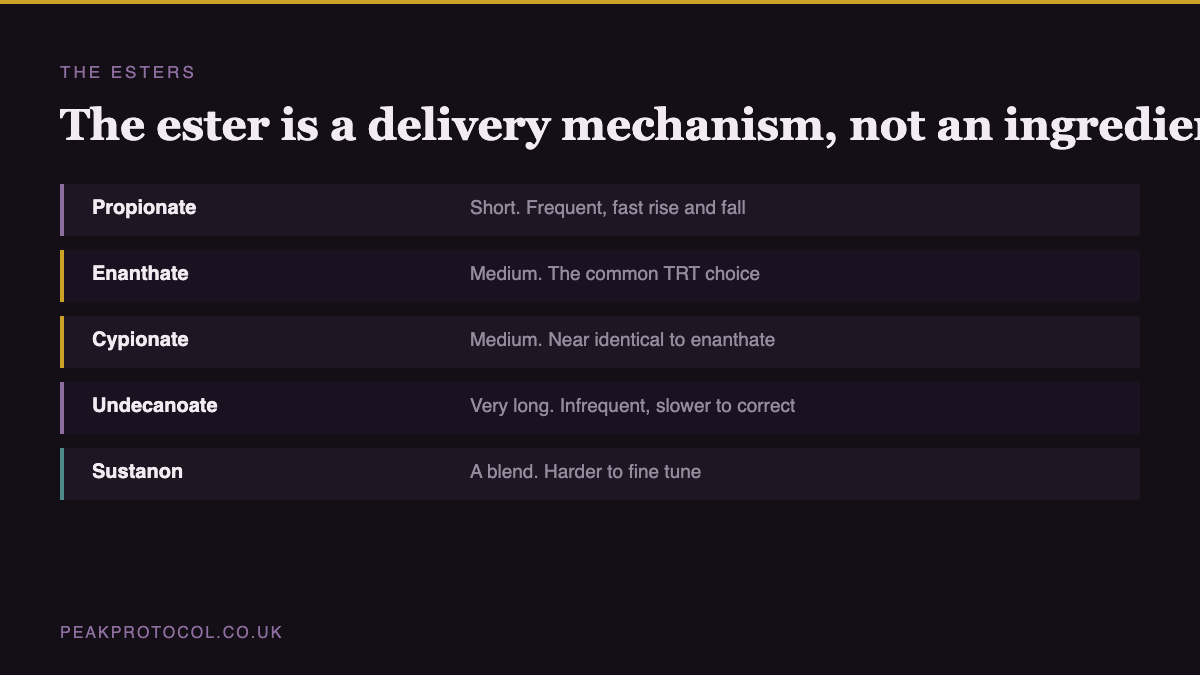
The ester itself is inert. It is a delivery mechanism, not an active ingredient, and once cleaved what remains is identical regardless of which ester it arrived attached to. Milligram for milligram, a longer ester also delivers slightly less actual testosterone, because more of the weight is the ester.
The forms of testosterone in circulation
Propionate. Short. Frequent administration, levels rise and fall quickly, and it clears fastest. Commonly reported as more irritating at the injection site.
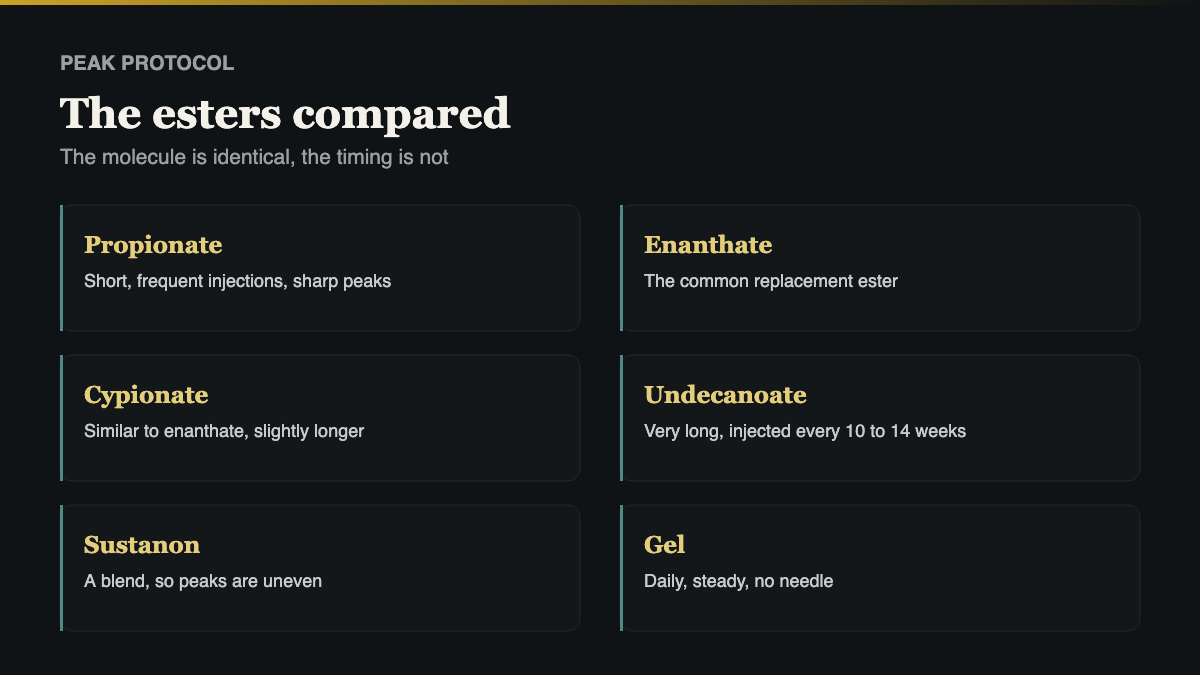
Enanthate and cypionate. The two most common, both medium length and very similar in practice. Weekly or twice weekly administration is typical. Most prescribed TRT in the UK and elsewhere uses one of these.
Undecanoate. Very long acting. Administered infrequently, which some people prefer, at the cost of a slower correction if the dose turns out to be wrong.
The practical difference for most people is injection frequency and how stable levels feel, rather than any difference in what the testosterone does once released.
Sustanon and the blends
Sustanon is a blend of several testosterone esters of differing lengths in a single preparation, designed to give a faster onset from the short esters alongside a longer tail from the longer ones.
It is a legitimate licensed medicine used in TRT. The theoretical drawback of any blend is that levels are harder to fine tune, since you cannot adjust one component independently, and some clinicians prefer single esters for that reason.
The legal position on testosterone
Testosterone occupies two categories at once, which is why the legal picture confuses people.
It is a Class C controlled drug under the Misuse of Drugs Act 1971, and it is a prescription only medicine under medicines legislation.
In practice that means possession for personal use is not a criminal offence, supply is, with a maximum of fourteen years, and lawful supply requires a prescription dispensed by a registered pharmacy. Any website shipping testosterone to a UK address is supplying a controlled drug regardless of where it claims to be based.
The full picture is in are steroids legal in the UK.
Replacement against supraphysiological testosterone
This is the distinction that matters more than any other on this page, and it is a distinction of dose rather than of substance.
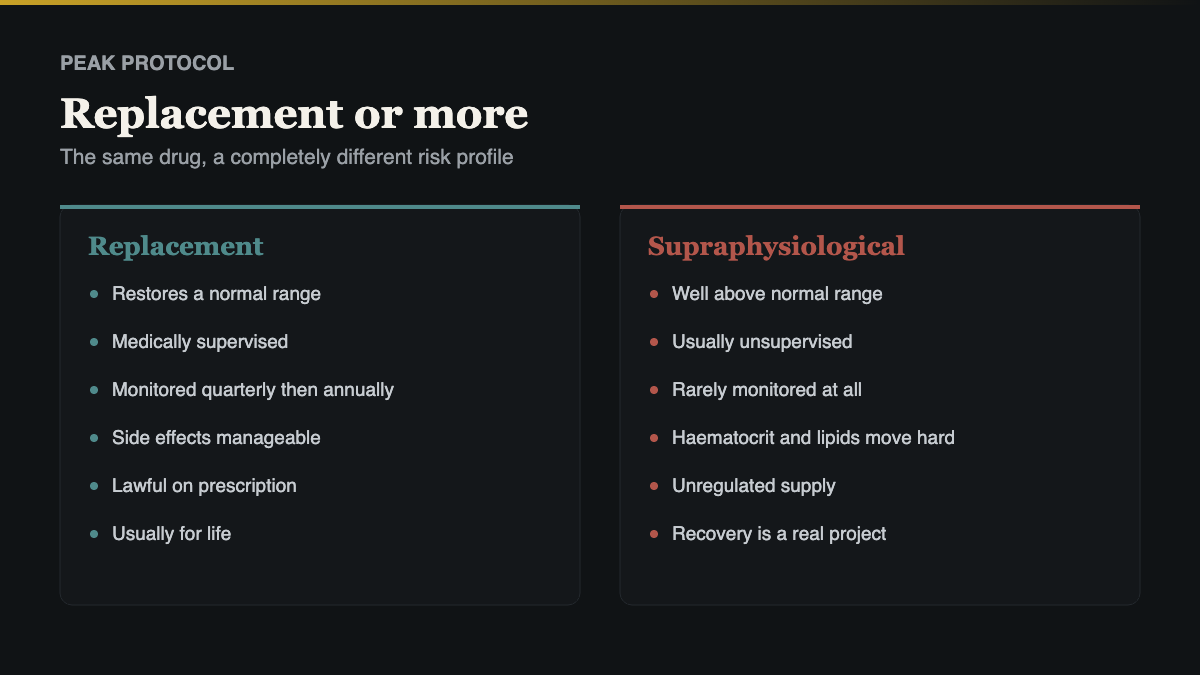
Replacement doses aim to restore a man with clinically low testosterone to somewhere in the normal range and keep him there, monitored. That is TRT, it is legal on prescription, and the risk profile is well characterised and manageable.
Supraphysiological doses aim to exceed the normal range, often substantially. That is where the performance effects come from, and it is also where most of the harm sits. The relationship is not linear: several risks, particularly haematocrit and cardiovascular strain, scale sharply with dose.
Two men can both be injecting testosterone enanthate and be in entirely different situations. Any discussion that treats them as the same thing is not worth reading.
Why testosterone is the base of almost every protocol
Because suppression is unavoidable. Introducing any anabolic compound shuts down natural production, and without testosterone present the result is a man with the effects of whatever he is taking and none of the testosterone his body requires to function.
The consequences of that state, low libido, erectile difficulty, lethargy and low mood, are why testosterone is included even in protocols aimed at other compounds. It is not there for its anabolic effect so much as to replace what has been shut off.
That fact is worth sitting with, because it means every protocol is structurally dependent on the thing that causes the suppression in the first place.
Aromatisation, and what follows
Testosterone converts to oestradiol through aromatase, present in fat tissue among other places. Raise testosterone substantially and oestradiol rises with it.
Some oestrogen is necessary in men, for bone density, lipids, libido and mood. Too much drives water retention, blood pressure and gynaecomastia, which is the one effect that does not reverse.
Because conversion happens in fat tissue, higher body fat means more conversion, which is one of the few genuinely modifiable factors here. Monitoring oestradiol on bloodwork is how you see this coming rather than discovering it, and the medicines used to control it are prescription only in the UK.
Suppression, and why it is hard to stop
External testosterone suppresses LH and FSH, natural production falls to near zero, the testes shrink, and sperm production stops in most users.
Recovery after stopping typically takes months and varies enormously, and for some long term users it does not fully return, ending in prescribed TRT permanently. See coming off steroids.
Fertility is the part most consistently underweighted. If children are a possibility in the next few years, this belongs at the front of your thinking rather than the back.
Effects specific to testosterone
Beyond the general side effect picture, a few are particularly associated with testosterone itself.
Raised haematocrit is common and dose dependent, and it is the effect most likely to need active management. It is also trivially detectable on a full blood count.
Water retention and raised blood pressure follow largely from aromatisation. Acne and accelerated hair loss follow from conversion to DHT in susceptible men, covered in steroids and hair loss.
Mood effects are real in both directions: many men on replacement doses report improvement, while supraphysiological doses are more associated with irritability and disturbed sleep.
Testosterone in women
Almost everything written on this subject assumes a male reader, and it is worth being explicit about why the calculation differs.
Women produce testosterone too, at far lower levels, and it matters for libido, bone density and mood. Prescribed testosterone is used in women in specific clinical situations, at doses a fraction of male replacement.
Non medical use at male doses is a different proposition entirely, because several of the effects are permanent rather than reversible: deepening of the voice, clitoral enlargement and facial hair growth do not resolve when use stops. That is a materially different risk calculus to the one described elsewhere on this page, and it deserves stating rather than being left as an afterthought.
The prescribed forms
Injections are the most common route and the one this page has mostly described. Two other forms exist and are worth knowing about.
Gels are applied daily to the skin, give very stable levels and avoid needles entirely. Their specific caution is transfer to other people through skin contact, which matters around children and partners and is a genuine reason some households rule them out.
Oral testosterone undecanoate exists in a formulation absorbed through the lymphatic system, avoiding the liver toxicity that made earlier oral testosterone unusable. It is less commonly prescribed in the UK than injections.
Which suits someone is partly clinical and partly practical, and it is worth raising rather than accepting whatever a provider offers by default.
The counterfeit problem
Testosterone is the most counterfeited compound in this market, precisely because it is the most used.
Testing programmes internationally have found underground vials containing a different ester than labelled, a fraction of the stated concentration, several times the stated concentration, or no active ingredient at all. Sterility is a separate and equally serious problem, covered in injection safety.
The practical consequence is that dose control is impossible outside a prescription. Someone carefully calculating a protocol from an unverified vial is calculating from a number that may bear no relationship to what is in it.
Three things people get wrong
That pharmaceutical grade means safe. It means the product is what the label says at the dose the label says. It says nothing about whether the dose you are taking is sensible. A verified vial used at four times a replacement dose is verified and still supraphysiological.
That more is proportionally better. The dose response curve for muscle gain flattens while the risk curve does not. Past a point you are accepting substantially more cardiovascular and haematological risk for progressively smaller returns, which is a poor trade that people make because the first increase felt worthwhile.
That your levels tell you you are fine. A testosterone reading confirms the compound is being absorbed. It says nothing about haematocrit, lipids, blood pressure or liver function, which are where the actual risk sits and none of which you can feel. Testing testosterone alone and concluding all is well is the most common monitoring mistake there is.
The lawful route in brief
If low testosterone is your actual concern rather than an assumption, the route is a morning blood test with SHBG, LH and FSH, twice, followed by a proper assessment. See testosterone blood tests and how to get TRT in the UK.
How the NHS and private routes compare is set out in NHS vs private TRT.
That route is legal, monitored, and gives you a verified product at a known dose. It is slower than ordering online and it is the only version where anybody is checking what happens to you.
For confidential advice, TALK TO FRANK. The NHS page on anabolic steroid misuse covers the clinical picture.
Five more things people get wrong
Five misunderstandings come up more than any others, and the first is the one that changes the legal answer.
One, thinking the drug is the problem. Testosterone UK wide is exactly the same molecule whether it comes from a pharmacy or a website. What differs is the dose, the supervision and whether anyone is measuring anything. Prescribed replacement and unsupervised supraphysiological use share a name and very little else.
Two, thinking possession is an offence. It is not, for a medicinal form held for your own use, because Schedule 4 Part 2 exempts it. Supply carries fourteen years and importation is separate, which is where nearly everyone who orders online actually stands.
Three, thinking the ester changes the drug. It changes the timing, not the molecule. Propionate, enanthate, cypionate and undecanoate all deliver testosterone; they differ in how quickly it arrives and how long it lasts.
Four, thinking a normal blood level means no risk. Haematocrit, HDL and blood pressure all move on testosterone UK protocols even at replacement doses, which is exactly why monitoring is the treatment rather than an optional extra.
Five, thinking counterfeits are rare. Nothing on the unregulated market has been inspected, concentrations are frequently wrong, and sterility cannot be assumed. A hologram proves nothing at all.
The lawful route, step by step
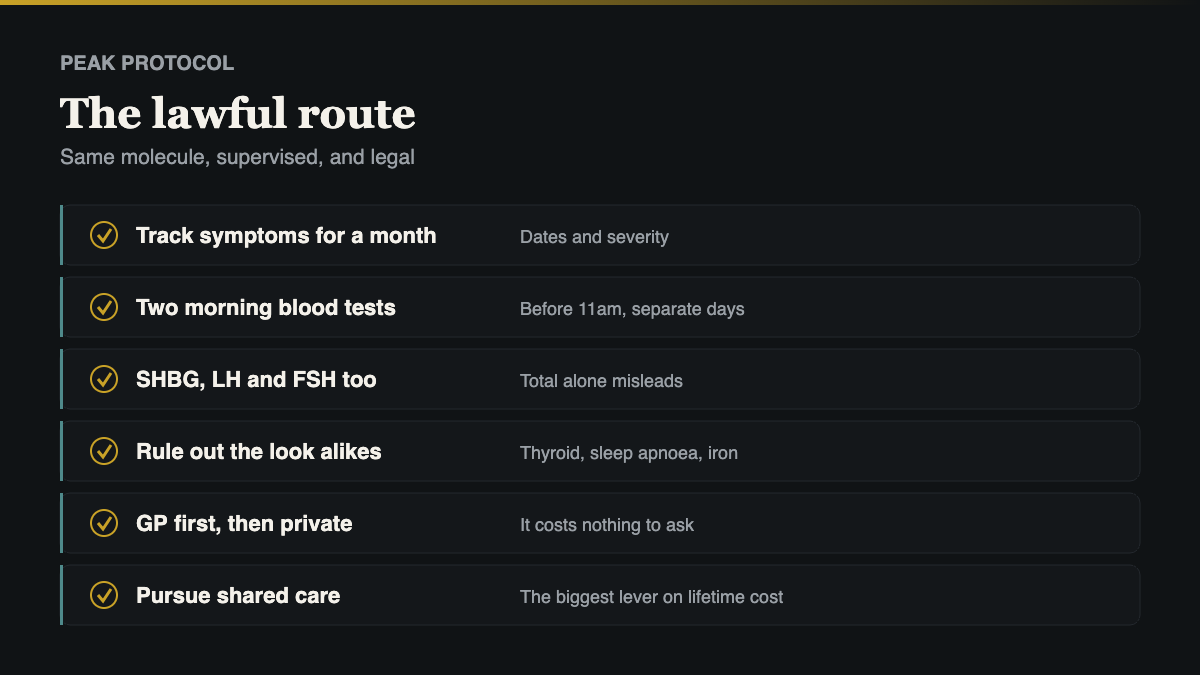
If what you actually want is testosterone, there is a lawful route to the identical molecule, and it is worth taking in this order.
Get the bloods first, from anywhere. Two morning samples on separate days with SHBG, LH and FSH alongside total testosterone. Testosterone blood test UK covers exactly what to ask for and why afternoon testing produces wrong answers.
Rule out what looks identical. Sleep apnoea, thyroid disease, iron deficiency and depression produce the same symptom list and are all commoner. Low testosterone symptoms covers what genuinely discriminates.
Then ask the NHS before paying anyone. Prescriptions are free in Scotland, Wales and Northern Ireland. How to get TRT in the UK sets out the steps and what to say, TRT UK covers what treatment involves, and TRT cost compares the routes over a year rather than a first appointment.
And if you are already using unsupervised testosterone UK sourced from the grey market, test anyway. Haematocrit, lipids and blood pressure are the numbers that matter, and they are the same numbers whether the supply was lawful or not. Steroid blood tests covers the panel. Peak Protocol sells supplements, cannot prescribe, and takes no referral fees.
Testosterone: common questions
Is testosterone legal in the UK?
It is a Class C controlled drug and a prescription only medicine. Possession for personal use is not an offence, supply without a prescription is, with a maximum of fourteen years.
What is the difference between testosterone enanthate and cypionate?
Very little in practice. Both are medium length esters with similar half lives, and once the ester is cleaved the testosterone is identical.
Is TRT the same as taking testosterone?
The substance can be identical. The dose and the supervision are not. TRT restores a low level to normal under monitoring, rather than exceeding it.
Why is testosterone included in protocols aimed at other compounds?
Because any anabolic compound suppresses natural production, and without testosterone present the result is a man with no functioning testosterone at all.
How do I know if testosterone I have is genuine?
Outside a prescription, you generally cannot. It is the most counterfeited compound in this market, and underground testing has found wrong esters, wrong concentrations and inactive product.
Is testosterone UK legal to possess?
Yes, in a medicinal form for your own personal use. Testosterone is Class C but sits in Schedule 4 Part 2, which exempts personal possession. Supplying it carries up to fourteen years and importing it from an overseas seller is a separate offence.
What is the difference between TRT and using testosterone UK wide without a prescription?
The molecule is identical. What differs is the dose, whether anyone is supervising, and whether haematocrit, lipids and blood pressure are being measured. Replacement restores a normal range under monitoring; unsupervised use usually aims well above it with none.
Which testosterone ester is used for treatment in the UK?
Enanthate and undecanoate are the usual injectable prescriptions, with undecanoate given every ten to fourteen weeks, and gels are common for people who prefer steady daily levels without injections. Cypionate is more common in the United States than here.