
Medical disclaimer, stated plainly. Nothing on this site is medical advice, nothing sold here is a medicine, and no page can substitute for a professional who can see your history.
That is the whole of this medical disclaimer in three lines. Everything below explains what each of them means in practice and what to do instead.
On this page
- This is information, not advice
- What our products are, legally
- Why this medical disclaimer exists
- When to speak to a professional
- We do not sell anabolic steroids
- Medication, conditions and interactions
- Doses, labels and tolerances
- Reporting a reaction
- Blood tests and monitoring
- What we can and cannot answer
- Who this site is for
- How to read a health page safely
- Why we say all this out loud
- Keep a record of what you take
- What this medical disclaimer does not cover
- Questions about this medical disclaimer
This is information, not advice
The guides on this site are written for education and harm reduction. They are general in nature and they cannot account for your age, your history, your medication, your blood results or anything else that would matter to a clinician.
This medical disclaimer is not a formality attached to content that is quietly advisory anyway. The pages are written so that they do not tell you what to do about your own body, which is why the guides about controlled compounds contain no dosing protocols and why the product pages describe what an ingredient does rather than what it will do for you.
What our products are, legally
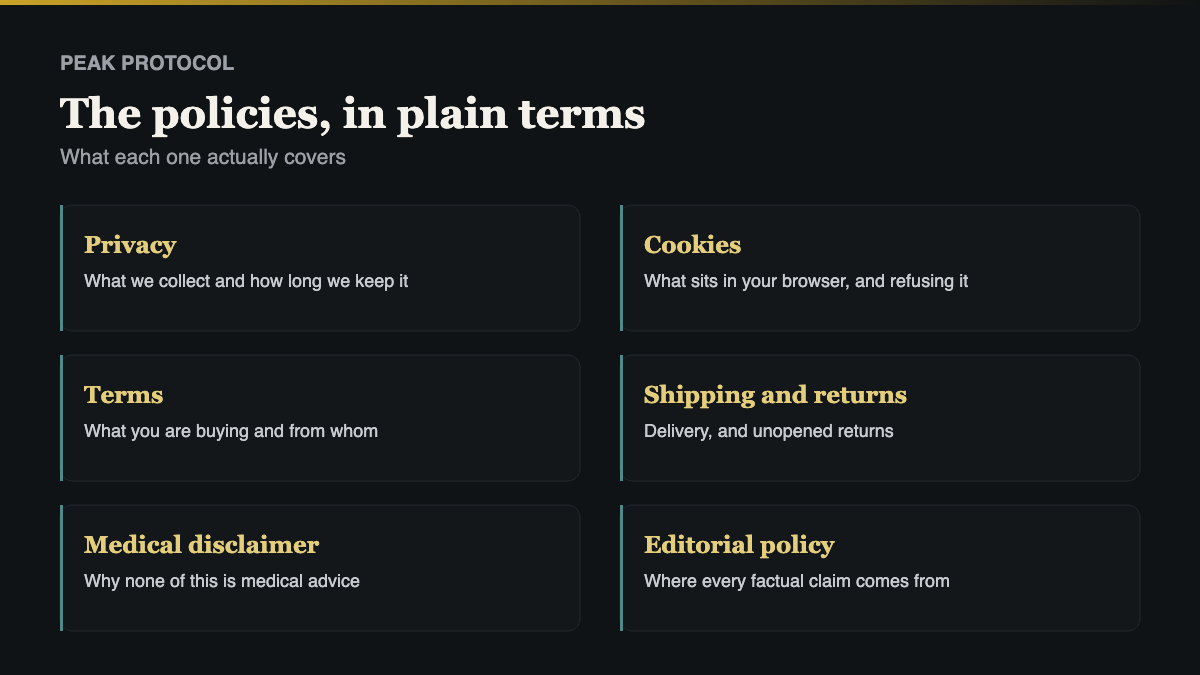
Every product sold here is a food supplement, regulated as food rather than as a medicine. That places them under the Food Standards Agency rather than the MHRA, and it sets what may be said about them.
Food supplements are not intended to diagnose, treat, cure or prevent any disease. Only claims on the Great Britain nutrition and health claims register may be used, and only where the product delivers the required amount of the nutrient. A supplement that carries an authorised claim about a normal bodily function is not making a medical claim and this medical disclaimer does not turn it into one.
Why this medical disclaimer exists
Most sites carry a medical disclaimer because a template told them to. This one exists because of what the rest of the site contains, and it is worth understanding the difference before you read on.
Roughly half of what we publish covers anabolic steroids, testosterone replacement and related compounds we do not sell and never will. Those guides are written for people who have already decided, or who are trying to work out whether the thing they have been offered is what they were told it is. They exist because accurate information reduces harm and silence does not.
That creates an obvious risk of being read as guidance, and this medical disclaimer is the place we say clearly that it is not. Explaining what a compound does to the liver is not the same as telling anyone to take it, and explaining which risks can be monitored is not a protocol.
The other half of the site sells food supplements, and the temptation there runs the opposite way. A supplement page that hints at a medical benefit is both unlawful and dishonest, so the pages state what an ingredient does at the dose supplied and stop there.
When to speak to a professional
Speak to a GP or a pharmacist before starting a supplement if any of the following applies, and treat this part of the medical disclaimer as the actively useful part.
| Situation | Why it matters |
|---|---|
| You take prescription medication | Interactions are real and a pharmacist can see your whole list |
| You have a diagnosed condition | Liver, kidney and cardiac conditions change what is sensible |
| You are pregnant or breastfeeding | Several ingredients here are not advised, and doses differ |
| You are under 18 | This site is for adults and the products are not intended for children |
| You have symptoms you are trying to treat | A symptom is a reason to be assessed, not a reason to supplement |
| Your blood results are abnormal | That is a clinical conversation, not a shopping decision |
The NHS is the right starting point for any of these and costs nothing.
We do not sell anabolic steroids
We do not sell, supply or source anabolic steroids, SARMs or any prescription only medicine, and we never will. Anabolic steroids are Class C drugs under the Misuse of Drugs Act 1971 and supply carries up to fourteen years.
Our guides cover them because people search for accurate information either way. Nothing in those guides is an encouragement to use anything, and nothing in them is medical advice about doing so. This medical disclaimer applies to them at least as strongly as to the rest of the site.
Medication, conditions and interactions
The single most common question we decline is whether a supplement is safe alongside a particular medication. We decline it every time, and the reason is not caution for its own sake.
Interactions depend on the full list of what someone takes, the doses, the condition being treated and often on blood results. A pharmacist can see all of that in a few minutes and give you a real answer. We can see none of it, and a confident reply from us would be a guess wearing the clothes of advice.
Anyone competing under anti doping rules has a separate problem that this medical disclaimer cannot solve either: a clean formulation is not the same as a clean batch. UK Anti-Doping publishes guidance and batch testing is the only real assurance.
Doses, labels and tolerances
Follow the label. Where a page here quotes a dose used in research, that figure is describing what was studied rather than recommending what you should take, and this medical disclaimer does not convert the one into the other.
More is not better with most of what we sell and is actively worse with some of it. Fat soluble vitamins accumulate, high dose stimulants raise blood pressure, and several popular ingredients have a ceiling above which the only thing that increases is the side effect profile.
Stacking is where most problems start. Two products that are each sensible can put you well over a safe intake of a shared ingredient, most commonly caffeine, vitamin D or zinc. Add up what you are actually taking across everything, including anything prescribed, before you add one more tub.
Reporting a reaction
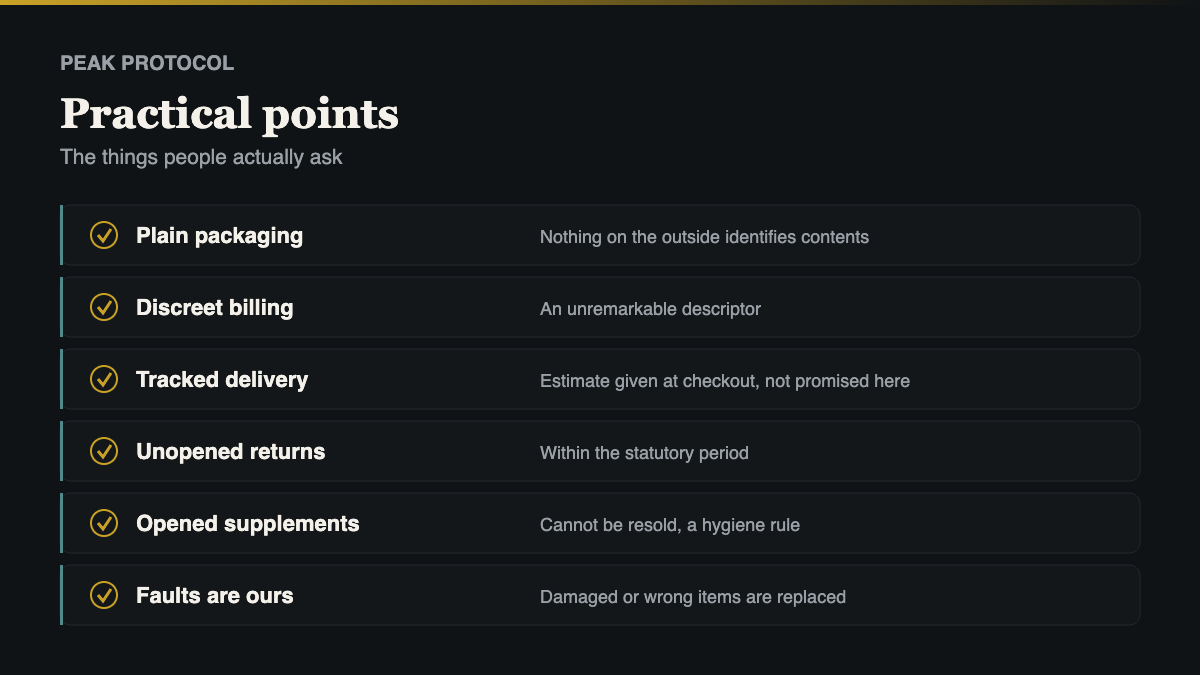
If a product you bought here causes a reaction, stop taking it and speak to a pharmacist or a GP. Then tell us through the contact page, with the batch number from the tub if you still have it.
We take that seriously for a practical reason as well as a decent one. A reaction pattern across a batch is the earliest signal that something is wrong with a supply chain, and we can pull stock and raise it with the manufacturer far faster than any regulator can.
Serious reactions to a food supplement can also be reported to your local authority environmental health team, and reactions to a medicine go to the MHRA Yellow Card scheme. Nothing in this medical disclaimer asks you to come to us first or instead.
Blood tests and monitoring
A recurring question is whether we can interpret a blood test. We cannot, and this medical disclaimer covers that squarely: reading results is a clinical act that depends on reference ranges, the assay used, the time of day and the rest of your history.
What we will say is that monitoring is worth doing and that a GP is the cheapest route to it. Anyone using testosterone, prescribed or otherwise, has a set of markers worth watching, and our guides name them so you know what to ask for. Naming a marker is information. Telling you what your number means is not something we will do.
Private testing is widely available in the UK and results from it are still worth taking to a GP rather than to a forum. A number without a clinician attached tends to produce confident conclusions that are wrong.
What we can and cannot answer
People email us with health questions every week and the honest reply is often that we are the wrong people to ask. Rather than leave that vague, here is the line this medical disclaimer draws in practice.
| We can answer this | We will not answer this |
|---|---|
| What is in a product and at what dose | Whether you should take it |
| What the research says about an ingredient | What it will do for your condition |
| Whether a batch has been tested, and by whom | Whether it is safe with your prescription |
| What the law says about a substance | How to obtain or use a controlled one |
| Which markers a guide mentions | What your own results mean |
| What is in stock, and what it costs | Which product will fix a symptom |
The right hand column is not us being unhelpful. Every one of those questions needs somebody who can see your history, and answering them from an inbox would be guessing with a confident tone attached.
Who this site is for
This site is for adults in the United Kingdom. The products are not intended for anyone under 18, and the guides about controlled compounds are written for adults making their own decisions rather than for anyone being talked into one.
If you are training seriously, the honest summary of everything on this site is that supplements are the smallest of the four things that matter, well behind training, food and sleep. We sell them, and that is still true. This medical disclaimer is a reasonable place to say it, because a site that could not say it would not be worth reading.
If you compete, check anything you take against your sport body rules first. UK Anti-Doping publishes the current list and the strict liability principle means the responsibility for what is in your body is yours, whatever a label says.
What this medical disclaimer does not cover
If you are having a medical emergency, stop reading and call 999. If you are worried about something that is not an emergency, call 111 or contact your GP.
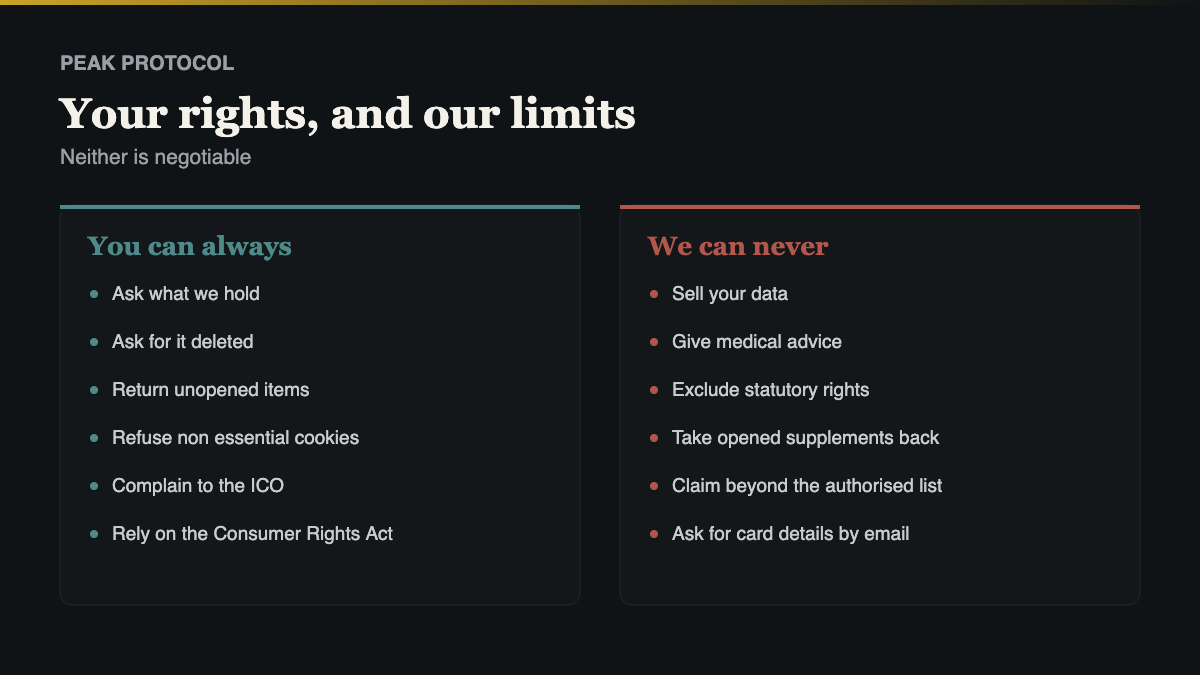
Nothing on this site, including this medical disclaimer, limits your legal rights as a consumer. Our terms set out the contractual position and our returns policy the statutory one, and neither excludes liability for death or personal injury caused by negligence, which cannot lawfully be excluded.
How to read a health page safely
This medical disclaimer is more useful as a reading method than as a legal notice, so here is the method. It applies to our pages as much as to anyone else’s.
Follow one citation before you act on anything. A link that does not say what the page claims it says is the most common error in health writing and it takes twenty seconds to catch. Check whether the research was in people or in cells, because the distance between those two is enormous and gets quietly collapsed in most write ups.
Look for the size of the effect rather than the existence of one. An ingredient can have a real, statistically significant effect that is far too small to notice. Then ask who benefits if you believe the page, which on a site that sells supplements is a question you should be asking about us.
Finally, notice whether the page is willing to say a product does not work. A site where everything works has told you nothing, and no medical disclaimer at the bottom of it changes that.
Why we say all this out loud
Most sites carry a medical disclaimer because a template supplied one, and it sits in six point grey text at the bottom of a page that has spent two thousand words implying the opposite.
The version here is written to be read because the rest of the site is built the same way. The product pages state what an ingredient does at the dose supplied and stop. The guides about controlled compounds explain risk and refuse to explain dosing. Neither of those needs a disclaimer to rescue it afterwards, which is the point.
A medical disclaimer should describe a site accurately rather than apologise for it. If this one ever stops describing this site, that is a fault worth reporting.
Keep a record of what you take
One practical habit does more good than anything else in this medical disclaimer, and almost nobody does it: write down what you take, the dose, and the date you started.
It matters for two reasons. If something goes wrong, a clinician can work out what is involved in minutes rather than guessing from memory, and memory is unreliable about supplements in particular. And if something works, you will know which thing it was, rather than repurchasing four products because one of them helped.
A note on your phone is enough. Include anything prescribed, because that is the column a pharmacist will want first, and include the batch number if a product ever causes a reaction.
Two extra columns are worth the effort. Note how you felt at the start, in one line, because without it you are comparing a memory against a mood. And note when you stopped, because a supplement you took for three weeks eighteen months ago is exactly the detail people forget when a clinician asks what they have taken, and exactly the detail this medical disclaimer would rather you had to hand.
Questions about this medical disclaimer
Can you tell me whether a supplement is safe with my medication?
No. That requires seeing your full list and often your results, which a pharmacist can do in minutes and we cannot do at all.
Are your products approved by the MHRA?
No, and they are not required to be. They are food supplements regulated as food rather than medicines, which is a different framework with different rules.
Does this medical disclaimer mean the information is unreliable?
No. It means the information is general rather than personal. The sourcing standards are set out in our editorial policy and every factual claim links to a primary source.
I have symptoms. What should I do?
See a GP. A symptom is a reason to be assessed rather than a reason to buy something, and that is the answer this site gives even where it costs us the sale.
Is the content medically reviewed?
Not yet. A qualified reviewer is being appointed and until then health pages say so. Our experts covers that gap in full.
One last thing this medical disclaimer should say plainly, because it is the sentence these pages usually leave out. If anything on this site conflicts with what a clinician who has actually seen you says, the clinician is right and we are wrong. That holds even where we have cited a trial, because a trial describes an average and nobody is the average.
For anything clinical, the NHS comes before this site. For what we do and do not sell, see about, and for how the content is written, the editorial policy. Our FAQ answers the ordering questions this medical disclaimer deliberately does not touch.