
This editorial policy sets out where the facts on this site come from, what we are willing to say about a product, how corrections are handled, and which commercial relationships we refuse. It is written to be checked rather than to be reassuring.
An editorial policy is only worth anything if you can test it against the pages. Everything below is stated in a form you can go and verify on the site in about five minutes.
On this page
- Sourcing
- Who writes and who checks
- Product claims
- How we handle uncertainty
- How we weigh evidence
- Corrections
- Commercial relationships
- Where AI fits, and where it does not
- Harm reduction content
- Images, data and citations
- What we will not publish
- Updates and review
- What this policy asks of you
- Four things you can test today
- What this policy costs us
- What this policy does not cover
- Questions about this editorial policy
Sourcing
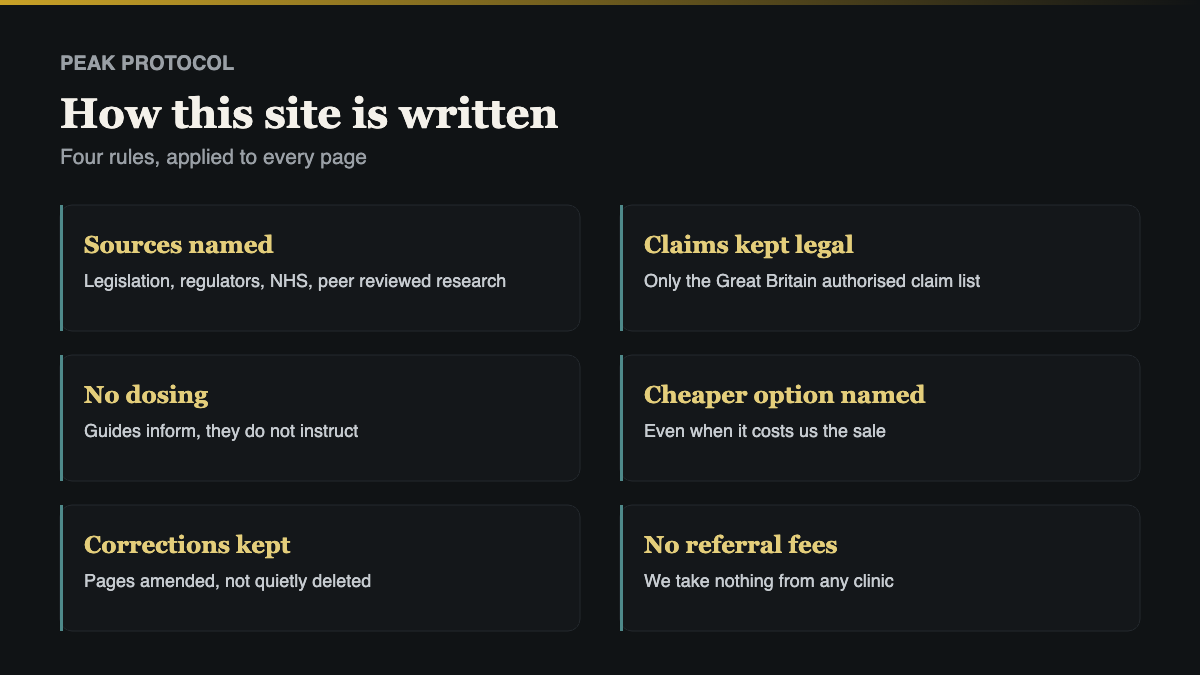
Every factual claim traces to a primary source and the link is in the page. Legislation comes from legislation.gov.uk, for example the Misuse of Drugs Act 1971, rather than from somebody else’s summary. Health information comes from the NHS and from peer reviewed research. Drug information comes from Talk to Frank.
This editorial policy treats secondary sources as a warning sign. Where a page links to another blog rather than to the thing the blog is describing, the claim has usually not been checked by anyone.
Who writes and who checks
Pages are written by the people who source the stock and answer the enquiries, which is a small team rather than a content department. That is a weakness in one direction and a strength in another, and this editorial policy names both rather than hiding one of them.
The weakness is obvious: nobody here is a clinician, and the pages are not medically reviewed. The strength is that whoever writes about a product has read its label, checked its dose against the research and priced it against the alternatives, which is more than a briefed copywriter does.
Every guide goes through a second pair of eyes before publication, and the check is specific rather than a read through. The checker verifies that every link resolves to the source it claims, that every dose figure matches the label, and that nothing in the page has drifted into telling the reader what to do about their own body.
Where a page covers something clinical, it carries a notice saying it has not been medically reviewed. That notice is a statement of fact under this editorial policy rather than a caveat bolted on for safety, and it disappears only when there is a named reviewer to replace it.
Product claims
Only wording on the Great Britain nutrition and health claims register is used on a product page, and only where the product delivers the required amount of the nutrient. Where an ingredient has no authorised claim, the page says so rather than implying one exists.
This editorial policy forbids three specific things outright: describing a supplement as a legal steroid or steroid alternative, which is misleading and outside UK advertising rules; before and after photographs implying a supplement caused a transformation; and repeating a manufacturer figure we cannot verify.
Where we cannot verify a number, the page says we cannot verify it. That sentence appears on real product pages and it is the single easiest way to test whether this editorial policy is operating.
How we handle uncertainty
Where trials are small, few, or conflicting, the page says so in the same breath as the finding rather than in a footnote nobody reads. Several product pages on this site tell you the product will do very little for you.
That is not modesty. It is the only thing that makes the pages where we say something works worth reading. A site that recommends everything has recommended nothing.
How we weigh evidence
Not all research is equal and this editorial policy does not pretend otherwise. The order we work in is straightforward, and it explains why some ingredients get a confident paragraph and others get a shrug.
| Strength of evidence | How the page treats it |
|---|---|
| Meta analyses and systematic reviews in humans | Stated as an effect, with the size of that effect |
| Several randomised trials pointing the same way | Stated as likely, with the caveats named |
| One small trial | Described as preliminary, and said to be preliminary in the same sentence |
| Animal or in vitro work only | Named as animal or laboratory work, never as an effect in people |
| Manufacturer data we cannot see | Not used, and the page says the figure is unverified |
| Anecdote, forums and testimonials | Not used as evidence anywhere on the site |
Effect size matters as much as significance. An ingredient with a real but tiny effect gets described as having a real but tiny effect, which is the difference between this editorial policy and the marketing convention of reporting only that something worked.
Corrections
When something is wrong it is changed, and the change is not hidden. This editorial policy does not allow a quiet edit that makes an error disappear as though it had never been published.
Corrections come to us through the contact page and go to whoever wrote the page rather than into a support queue. A specific disagreement with a citation attached is the most useful message anyone sends us, and we read them even when we end up disagreeing.
We would rather republish a page with an awkward admission in it than leave a confident error standing. Two of the corrections made under this editorial policy were to our own pricing and to a product listing that described something we could not fully identify.
Commercial relationships
Nothing on this site is paid placement. No manufacturer has paid to appear, to be reviewed, or to be described in a particular way, and no page carries a sponsored section.
We do not buy links, sell links, or exchange them. Requests to do so are declined once and not negotiated.
We do sell products, which is the obvious conflict and the reason this editorial policy exists. The way it is managed is structural rather than promised: product pages name the competing product on our own shelves where one is a better buy, and the brand pages include our own label in the comparison and rank it below others where that is true.
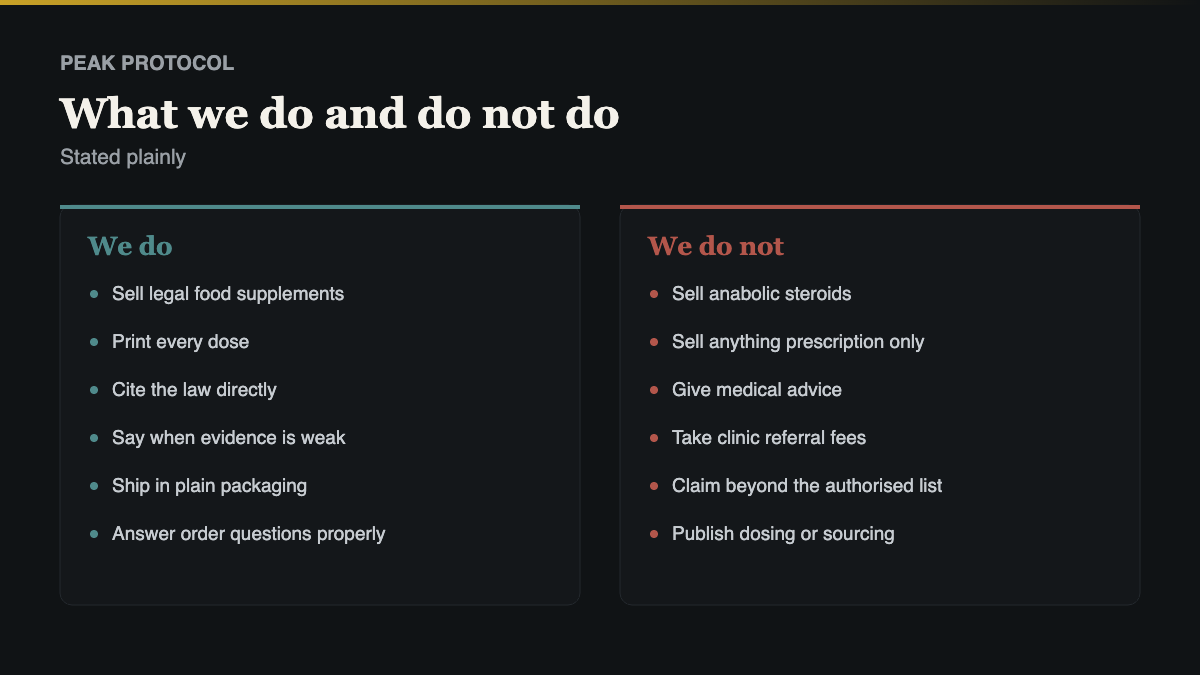
| What we do | What we refuse |
|---|---|
| Sell our own label alongside twenty two other brands | Paid placement, sponsored posts and gifted reviews |
| Name the better competing product on our own pages | Describing any supplement as a legal steroid |
| Publish guides about compounds we do not stock | Dosing protocols for anything controlled |
| Print the dose and the cost per serving | Repeating an unverifiable manufacturer figure |
| Correct errors in the open | Quiet edits that hide a mistake |
Where AI fits, and where it does not
Pretending no modern site touches these tools would be dishonest, so this editorial policy says where they sit. They are used for drafting structure and for checking our own writing back, in the same way a spellchecker is used.
They are never the source of a fact. Every figure, dose, law and citation on this site was checked by a person against the primary source named in the link, because these tools invent plausible references and a plausible reference is worse than none.
Nothing is published unread. If a sentence on this site is wrong, a human put it there and a human is responsible for correcting it, which is the only version of this that means anything.
Harm reduction content
Roughly half of what we publish covers compounds we will never sell. This editorial policy treats that as a duty rather than a marketing tactic: people make these decisions with or without accurate information, and the version with accurate information goes better.
The line those pages do not cross is dosing. They explain what a substance does, what the risks are and which of those risks can be monitored. They stop before telling anyone how to take one, and that limit is not negotiable whatever the search demand looks like.
Images, data and citations
Product photographs show the product as supplied. Where a photograph is of the packaging rather than of our own stock, the page says so, and there are no rendered mock ups presented as photography anywhere on the site.
Every table of doses, prices or costs per serving is built from the labels and from our own till prices on the day the page was written. Prices move, so a comparison table carries the date it was compiled and this editorial policy requires that date to be visible rather than buried.
Citations link to the source itself rather than to a search result or an aggregator, and external links open to the page that carries the claim rather than to a home page you then have to hunt through. Where a source has moved, the link is updated rather than left to rot.
What we will not publish
This is the part of the editorial policy that costs money, which is the only reason it is worth writing down. Each of the following has been asked for and declined.
Dosing protocols for anabolic steroids, SARMs or anything else controlled. Cycle and post cycle guides, whatever they are labelled. Comparisons between a supplement and a controlled substance that imply equivalence. Sponsored placement in a comparison table. Guest posts carrying a link to a pharmacy that is not one. Affiliate content for sellers we cannot verify.
We also decline to publish urgency. No countdown timers, no invented stock scarcity, no manufactured last chance. If a product is genuinely low in stock the page says the number, and if it is not, the page says nothing at all.
Updates and review
Pages are reviewed on event rather than on schedule. A change to the legal classification of a substance, a trial large enough to move a conclusion, or a change to what may lawfully be claimed all trigger a rewrite. Every guide carries the date it was last reviewed.
One part of this editorial policy is not yet satisfied and we say so on our experts: there is no named medical reviewer. A reviewer registered with the GMC or GPhC is being appointed, and until then health pages carry a notice rather than an implied review.
What this editorial policy asks of you
A policy that only binds the writer is half a policy. The useful half for you is knowing what to do when something here looks wrong, because you are the part of the system that catches what our own checks miss.
Check the date on any comparison table before you rely on the prices in it. Follow at least one citation on any page you are about to act on, because a link that does not say what the page claims it says is the single most common error in health writing and it takes twenty seconds to catch.
Treat any page that tells you what to do about your own body as a page to check with a professional, including ours. This editorial policy is designed to stop us writing that page in the first place, and if you find one that reads like it, we have failed and we want to know.
Four things you can test today
An editorial policy is only as good as the checks a stranger can run against it, so here are four that take about a minute each and that would expose us immediately if we were bluffing.
Open any product page and look for the sentence saying what the product will not do. Open the same page and find the comparison table naming a rival product we also stock. Open any guide about a controlled compound and try to find a dose. Open any health page and look for the notice saying it has not been medically reviewed.
The first two should be present, the third should be absent, and the fourth should be present. If any of those comes out the other way, this editorial policy is not being followed on that page and we want to know through the contact page.
We publish the tests rather than the promises because promises are what everyone publishes. The specific value of an editorial policy written this way is that it can be falsified, and a claim that cannot be falsified is decoration.
What this policy costs us
Every rule here has a price, and it is more useful to name the prices than to present the whole thing as costless virtue.
Refusing paid placement means we earn nothing from the brands we stock beyond the margin on what we sell. Naming a better competing product loses us specific sales, repeatedly and measurably. Publishing guides about compounds we do not sell costs weeks of writing with nothing to buy at the end of them. Saying an ingredient does very little costs us the easiest sales in the industry.
The reason this editorial policy survives those costs is that the alternative is a site nobody has a reason to believe. There are already hundreds of those, they compete on advertising spend, and we would lose that competition anyway.
What this policy does not cover
This editorial policy governs what we publish. It does not govern what a manufacturer prints on a label, what a customer writes in a review, or what a third party site says about a product we happen to stock.
Where a label makes a claim we think is unsupportable, the product page says so rather than repeating it, and in a few cases we have declined to stock the product at all. That is the limit of what an editorial policy can do about somebody else’s packaging.
Reviews are the customer’s words and we do not edit them for tone. We remove a review only where it is abusive, names a person, or gives dosing instructions for something controlled, and the last of those is the only one that comes up often.
Questions about this editorial policy
How can I check you follow this editorial policy?
Open any product page and look for the sentence stating what the product is not, and for the comparison table naming alternatives on our own shelves. If neither is there, the policy is not operating and you should tell us.
Do you accept free products for review?
No. Nothing here is a gifted review and no brand has supplied stock on the condition of coverage.
Who decides what gets written about?
The editorial team, from questions people actually ask rather than from keywords with commercial value. That is why several pages exist on subjects with nothing to sell at the end.
What happens if a manufacturer disputes something?
The same as when a reader does. If they are right the page changes. If they are not, it does not, and stocking their product does not alter that.
Is this editorial policy medically reviewed?
No. It is our policy rather than clinical content. The health pages it governs will be reviewed once a named reviewer is appointed.
Our about page covers why the site is built this way and our experts covers who does the work. The Food Standards Agency sets the rules this editorial policy operates inside.