
Information and harm reduction only, never medical advice. Sourced from the NHS, TALK TO FRANK, the MHRA and peer reviewed research, and written to say plainly where the evidence runs out rather than filling the gap. Always speak to a qualified clinician before changing anything. See our editorial policy.
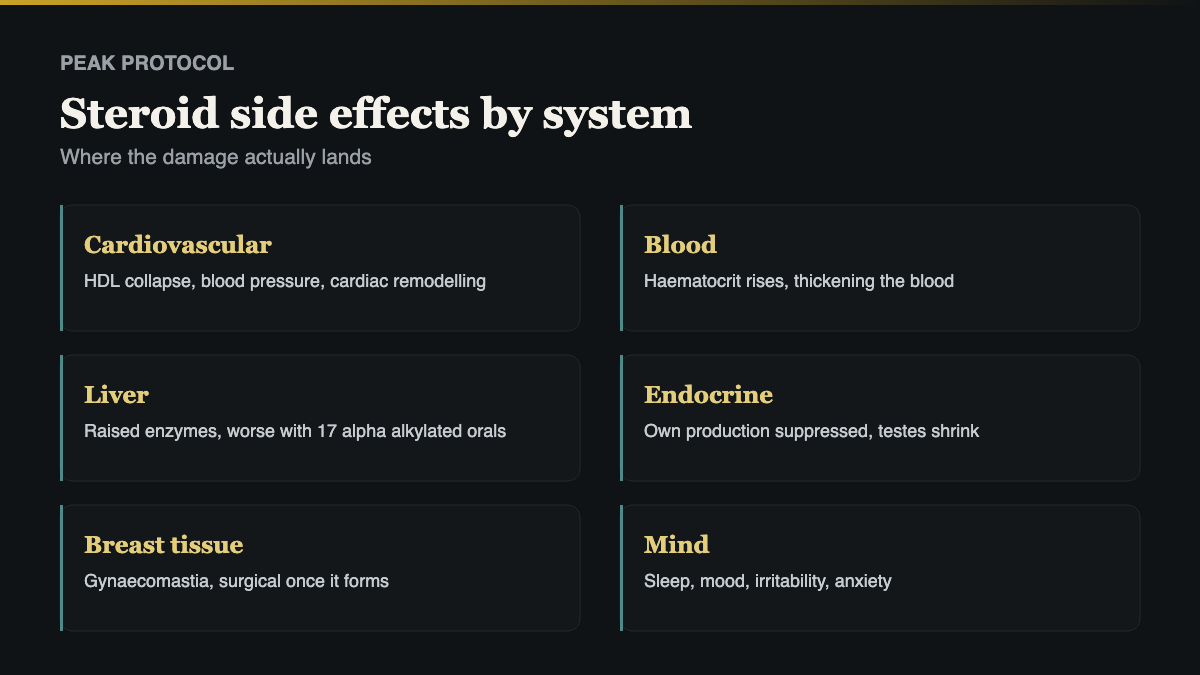
This page covers what anabolic steroids do to the body, using the evidence rather than the folklore. It is written for two audiences: people deciding whether to use, and people already using who would rather know what to watch for than find out the hard way.
We are not going to inflate the risks to frighten you, because exaggeration is why people stop believing health information and go back to forums. We are also not going to minimise them. Several of the effects below are permanent, and the most serious one produces no symptoms at all until it is advanced.
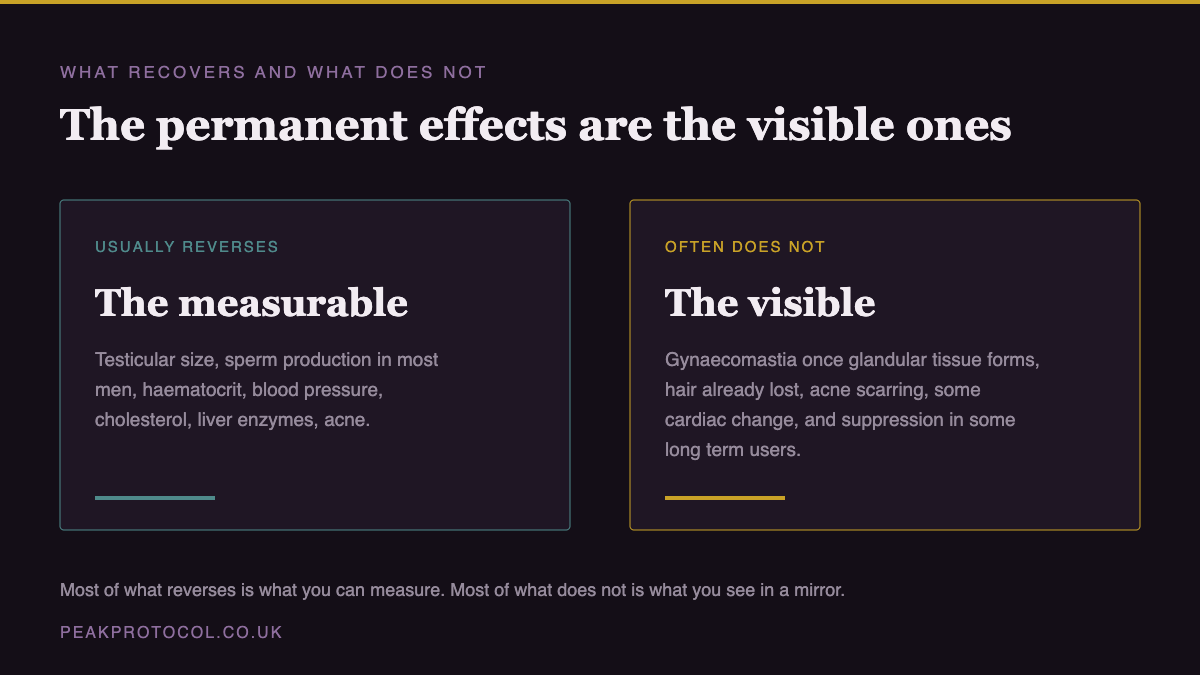
Heart and circulation: the effects that matter most
If you read one section, read this one. Cardiovascular effects are the most likely to shorten a life and the least likely to announce themselves.
The cardiovascular effects, and the checks worth asking for, are covered in depth in steroids and heart health.
Anabolic steroids reliably lower HDL cholesterol, the protective fraction, and raise LDL. They raise blood pressure. Long term users show measurable changes in heart structure, particularly thickening of the left ventricle, and reduced pumping efficiency compared with non using athletes matched for training.
None of that produces symptoms in the way an injury does. You do not feel your HDL falling. Blood pressure is famously symptomless until it is dangerous. This is precisely why bloodwork and a blood pressure cuff matter more than how you feel, and why regular monitoring is the single highest value harm reduction step available.
Blood thickening, the most acute risk
Testosterone stimulates red blood cell production. Some of that is the point, since it is part of why endurance and recovery improve. Taken too far it raises haematocrit, the proportion of your blood made up of red cells, and thicker blood clots more readily.
Raised haematocrit is a recognised cause of stroke and clotting events in users, and it is trivially detectable on a routine full blood count. It is also straightforward to manage once known. Not knowing is the problem, not the effect itself.
Testosterone suppression, the effect that outlasts use
Introducing external testosterone tells the hypothalamus and pituitary that there is plenty available, so they reduce the signals driving your own production. Natural output falls, often to near zero, and the testes shrink because they are no longer being stimulated.
Testicular atrophy is usually reversible, and recovery time varies from weeks to well over a year depending on how long and how heavily someone used. For some men, particularly after prolonged use, natural production never fully returns and they end up on prescribed TRT permanently, having started out intending a short cycle.
Fertility
The same suppression that shrinks the testes stops sperm production. Counts fall substantially and in many users reach zero. This surprises people, because the visible signs of virility are all pointing the other way.
Why sperm production stops and how long recovery usually takes is explained in steroids and fertility.
It is frequently reversible after stopping, though recovery is measured in months rather than weeks, and it is not reversible for everyone. There is no reliable way to know in advance which category you fall into.
If children are a possibility within a few years, this belongs at the top of your considerations rather than the bottom. Sperm banking beforehand is straightforward and inexpensive.
Gynaecomastia, the effect that can end in surgery
Testosterone converts to oestradiol through the aromatase enzyme. Raise testosterone substantially and oestradiol rises with it, and in susceptible men that stimulates growth of glandular breast tissue.
The critical detail is that this is glandular tissue, not fat. Once it has formed it does not respond to training, dieting or stopping. Surgery is the only route back. That makes gynaecomastia one of the few genuinely permanent effects, and the early warning, tenderness or a lump behind the nipple, is worth taking seriously the moment it appears rather than waiting to see.
Full detail in gynaecomastia and steroids.
The liver, and why orals are different
Oral compounds are usually 17 alpha alkylated, a modification that lets them survive the first pass through the liver. That same modification makes them hepatotoxic.
Liver enzymes rise measurably on oral compounds. At the more serious end, cholestasis, where bile flow is impaired, and peliosis hepatis, blood filled cysts in the liver, are documented, as are liver tumours with long term use.
This matters for a specific and common misconception: people who avoid injections because needles seem more dangerous are frequently choosing the compounds with the clearer organ toxicity. Injectables carry infection and sterility risks. Orals carry liver risk. Neither is the safe option.
Hair loss
Anabolic steroids do not cause male pattern baldness. They accelerate it in anyone who was going to get it, sometimes dramatically, compressing years of gradual thinning into months.
The mechanism is conversion of testosterone to dihydrotestosterone, which acts on genetically susceptible follicles. If nobody in your family has lost hair, your risk is lower. If your father and grandfather did, expect it.
Loss that has already occurred does not return when use stops. See steroids and hair loss.
Skin and acne
Increased sebum production drives acne, most commonly across the back, shoulders and chest. It ranges from mild and irritating to severe cystic acne that scars permanently.
Scarring is the part worth attention. The acne resolves. The scars do not, and severe cases are worth seeing a GP about early rather than waiting it out.
Mood, sleep and mental health
This is consistently underweighted, partly because it is harder to measure than a blood marker and partly because it is harder to admit to.
During use, irritability, a shorter fuse, and disrupted sleep are commonly reported, and some compounds are far more associated with this than others. Trenbolone in particular has a reputation for sleep disturbance and mood effects that is not merely folklore.
After stopping is where the more serious risk sits. Testosterone is suppressed, natural production has not resumed, and the resulting period of low mood can be severe. Depression during withdrawal is documented and it is one of the reasons people cycle back on sooner than intended, which turns intermittent use into continuous use.
If you are experiencing thoughts of self harm, contact your GP, call 111, or call the Samaritans free on 116 123. This is not a reason to feel foolish, it is a recognised effect.
Kidneys
Less discussed than the liver and not negligible. Cases of focal segmental glomerulosclerosis, a form of kidney scarring, are documented in long term high dose users, likely driven by the combination of greatly increased muscle mass, raised blood pressure and in some cases high protein intake and dehydration.
Kidney function is a routine blood test and belongs in any monitoring panel.
Tendons and injury
Muscle strength increases faster than tendons and connective tissue adapt. The result is a period where the force you can generate exceeds what the structure attaching it to bone is ready for, and tendon ruptures, particularly pectoral and biceps, appear disproportionately in this population.
This is one of the few risks that is partly manageable through behaviour: progressing load more conservatively than your strength allows.
Sleep apnoea
Testosterone can worsen obstructive sleep apnoea, and increased neck and upper body mass contributes independently. Untreated apnoea causes daytime exhaustion and raises cardiovascular risk on its own, which compounds the effects above.
If your partner reports that you have started snoring heavily or stopping breathing, that is worth investigating rather than dismissing.
Which effects reverse and which do not
Usually reverses: testicular size, sperm production in most men, acne, raised haematocrit, blood pressure, cholesterol changes, liver enzymes after stopping oral compounds.
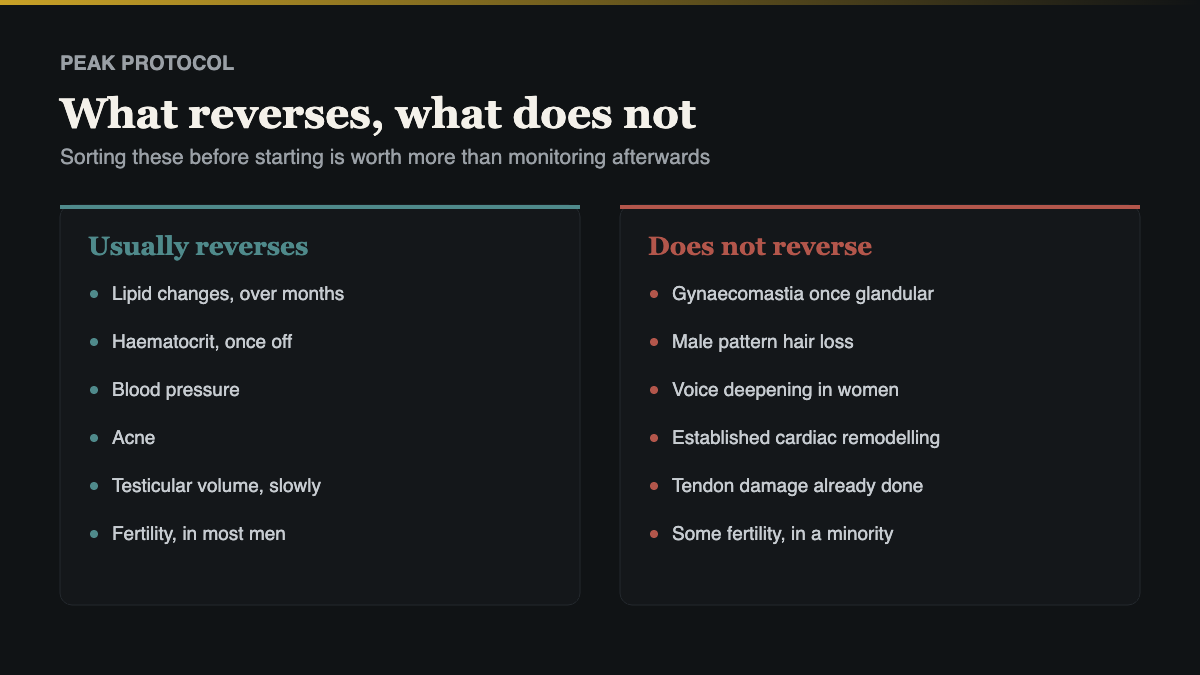
Often does not: gynaecomastia once glandular tissue has formed, hair already lost, acne scarring, some degree of cardiac structural change after prolonged use, and natural testosterone production in a subset of long term users.
The pattern is worth noticing. Most of what reverses is what you can measure. Most of what does not is what you can see in a mirror or feel about yourself, which is often what motivated use in the first place.
Symptoms that mean go to hospital now
Do not wait on any of these, and do not ask a forum first.
- Chest pain, tightness, or pain spreading to the arm or jaw
- Sudden severe headache, weakness on one side, slurred speech or facial droop
- Yellowing of the skin or eyes, very dark urine, or severe pain under the right ribs
- Breathlessness at rest, or a swollen, painful, warm calf
- Coughing blood
- Thoughts of harming yourself
Call 999 for the first two. Medical staff are treating the problem, not reporting you, and being honest about what you have taken changes the treatment you receive. Withholding it is genuinely dangerous.
Reducing the risk
If you are using regardless, these are the things that measurably reduce harm.
Much of the unpredictability comes from the products themselves, which counterfeit and contaminated steroids explains.
Test your blood. Before starting, and at intervals afterwards. See what to check. A baseline you took before starting is worth more than any single reading later.
Monitor blood pressure at home. A cuff costs very little and catches the effect most likely to matter.
Never share injecting equipment, and use safe technique. See injection safety. NHS needle and syringe programmes supply clean equipment free and without judgement.
Tell one person. Someone who knows what you are taking and would recognise if something changed.
Be honest with clinicians. Every time.
For confidential advice, TALK TO FRANK. The NHS overview of anabolic steroid misuse is a reasonable second source.
Dose, duration and why effects vary so much
Almost every risk on this page scales with three things: how much, for how long, and what else alongside it. Treating anabolic steroids as a single category with a single risk profile is the mistake both the scaremongering and the reassuring versions make.
A man on prescribed TRT at replacement dose, monitored quarterly, occupies a very different position from someone running several grams a week of multiple compounds with no bloodwork. Both are technically taking anabolic steroids. The comparison is close to meaningless.
Duration matters as much as dose. Most of the effects that do not reverse, cardiac structural change, permanent suppression, are associated with years of continuous use rather than a single period. Long term continuous use, which is what happens when someone never fully comes off, carries a different risk profile from intermittent use, and it is the pattern most likely to develop by accident rather than by decision.
The compounds also differ substantially. Oral 17 alpha alkylated compounds carry the liver risk. Compounds that aromatise heavily carry the gynaecomastia risk. Nandrolone is associated with sexual dysfunction in a way testosterone is not. Trenbolone with sleep and mood effects. A blanket statement about steroid side effects flattens all of that.
The people around you
Two effects fall outside the user, and both get missed because health information is written as though the person reading it lives alone.
Mood, at home. The irritability and shortened fuse that people describe do not stay in the gym. Partners and family notice before the user does, and the low mood after stopping is often harder on the people nearby than on the person experiencing it. If someone close to you has said something, that is data rather than nagging.
Transfer and exposure. Testosterone gels transfer through skin contact, which matters around children and partners. That is a TRT consideration rather than an injectable one, but it belongs here because people rarely think to ask about it.
If you are worried about someone else rather than yourself, TALK TO FRANK takes calls from family and friends too.
Five misreadings that cause the most harm
Most of the harm in this population does not come from being unaware that steroid side effects exist. It comes from five specific misreadings of steroid side effects, and each one leads somewhere different.
One, judging by what you can feel. The steroid side effects people notice are acne, sleep, mood and libido. The ones that shorten lives are silent: falling HDL, rising haematocrit, creeping blood pressure. Feeling fine is not evidence of anything, and it is the commonest reason blood work never gets ordered at all.
Two, assuming everything reverses. Some steroid side effects resolve completely once you stop, and the lipid picture largely does. Others do not. Gynaecomastia becomes a surgical problem once glandular tissue forms. Accelerated male pattern hair loss does not grow back. In women, voice deepening is permanent. Sorting the reversible steroid side effects from the permanent ones before starting is worth more than any monitoring done afterwards.
Three, blaming the wrong compound. People running several products attribute steroid side effects to whichever one they trust least, which is guesswork dressed as reasoning. Trenbolone is progestogenic rather than oestrogenic, so gynaecomastia there runs through prolactin and does not respond to the same management. Attribution matters because the fix differs.
Four, treating dose as the only variable. Duration matters as much. Many steroid side effects are cumulative, and time on is what drives suppression, cardiac remodelling and the difficulty of recovery, not the weekly figure by itself.
Five, hiding it from a doctor. A list of steroid side effects is close to uninterpretable without knowing what is on board, and clinicians who see this regularly have heard all of it and are not going to report you. Withholding the history is the reason monitoring so often catches nothing.
What to actually do
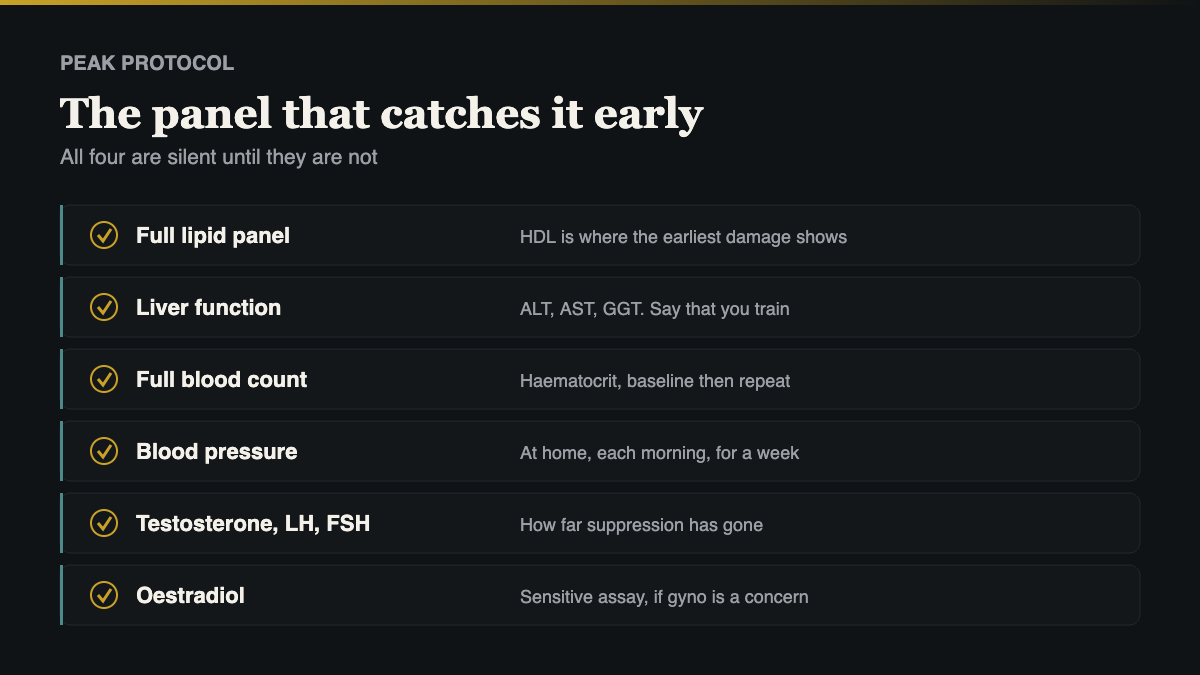
Knowing the list is not the same as acting on it. There is a short, cheap sequence that turns steroid side effects from an unknown risk into a managed one, and the whole sequence costs less than a month of most people’s supply.
Start with the four tests that matter. A full lipid panel, because HDL is where the earliest measurable of the steroid side effects lands. Liver function, remembering that heavy training raises some markers independently, so say that you lift. A full blood count for haematocrit, which is the steroid side effect most likely to cause an acute event. And blood pressure taken at home across a week, because one clinic reading tells you almost nothing. Our guide to steroid blood tests works through each of them.
Get a baseline, not a snapshot. Almost all of the important steroid side effects are changes rather than absolute values. A haematocrit of 52 percent means one thing in a man who started at 44 and something else in a man who has always run high, and without the starting figure nobody can tell you which you are.
Treat the specific ones specifically. If the concern is breast tissue, gynaecomastia and steroids explains why the window for a non surgical answer is narrow. If it is hair, steroids and hair loss covers the mechanism. If it is injection sites, steroid injection safety covers sterility and technique. Compound specific steroid side effects are set out on the individual pages, including trenbolone and Anavar.
And know what stopping involves. A good share of the worst steroid side effects appear on the way down rather than during use, because your own production has been suppressed and takes months to return. Coming off steroids sets out that timeline honestly. If the underlying problem is a genuine deficiency rather than performance use, how to get TRT in the UK is the lawful, supervised route to the same molecule.
Steroid side effects: common questions
What is the most dangerous side effect of steroids?
Cardiovascular effects, because they are the most likely to shorten a life and produce no symptoms until advanced. Raised blood pressure, lowered HDL and structural heart changes are the concerns.
Does gynaecomastia go away if I stop?
No. Once glandular breast tissue has formed it does not resolve with stopping, training or dieting. Surgery is the only route back, which is why early tenderness behind the nipple should not be ignored.
Are injectable steroids safer than oral ones?
They carry different risks rather than fewer. Orals are hepatotoxic because of the chemical modification that lets them survive the liver. Injectables avoid that and add infection and sterility risks.
Will my testosterone recover after I stop?
For most men, over months. For some long term users it does not fully return, and they end up on prescribed TRT permanently. Bloodwork is the only way to know.
Can steroids cause depression?
Yes, particularly after stopping, when natural production has not yet recovered. It is a recognised effect and it can be severe. Speak to a GP or call 111.
Which steroid side effects are permanent?
Gynaecomastia once glandular tissue has formed, accelerated male pattern hair loss, and virilisation in women including voice deepening. Most lipid and blood count changes reverse after stopping, although those steroid side effects take months rather than weeks to unwind and resolve less completely in people who cycle repeatedly with short breaks.
Can you avoid steroid side effects with a low dose?
A lower dose reduces the size of most steroid side effects without removing them, and duration matters as much as dose. Suppression of your own testosterone production happens even at replacement level doses, so there is no amount that carries no consequence at all.
Which steroid side effects show up first in blood work?
Falling HDL cholesterol is usually first and can move within weeks, followed by rising haematocrit and blood pressure. All three are silent steroid side effects, which is precisely why they are worth measuring rather than waiting for a symptom to appear.