
Our experts, and what that word means here. This page explains who researches and writes this site, the standards our experts work to, and the limits we are explicit about, including the fact that no named medical reviewer is in place.
This is a health site, which means who writes and checks the content matters more than how it is designed. Most sites in this category answer the our experts question with a photograph and a job title. This page answers it with what is actually true, including the uncomfortable part.
On this page
- The gap, stated first
- What medical review will mean
- The editorial team
- The sources our experts work from
- The standards applied to every page
- What our experts will not do
- How a page actually gets written
- How often pages are reviewed
- What actually qualifies someone here
- Who is accountable when a page is wrong
- Why we do it this way
- What you can hold us to
- What changes when a reviewer arrives
- How this compares with the rest of the industry
- Questions about our experts
The gap, stated first
This section is not yet complete, and we are not going to pretend otherwise.
Peak Protocol is appointing a named, qualified medical reviewer, a doctor or pharmacist registered with the General Medical Council or the General Pharmaceutical Council, to review every health page before it is published. Until that appointment is made and named here, our health articles carry a clear notice saying they are awaiting medical review.
We could have invented a plausible sounding advisor with a stock photograph. A great deal of this industry does exactly that, and it is remarkably hard to detect from outside. We would rather show you an incomplete our experts page than a fabricated credential, because if we lie here you have no reason to believe anything else on the site.
If you are assessing whether to trust a health site, that test is worth applying generally: find the named reviewer, then check the register. A name with no registration number, or a number that does not resolve, tells you more than the whole rest of the page.
What medical review will mean
Every health page will carry the reviewer’s name, their registered qualification and registration number, and the date the page was last checked. Those three together are what makes a review checkable rather than decorative.
Where the reviewer disagrees with a draft, the draft changes. That is the part that makes review worth having and it is the part most often absent where our experts pages exist purely for appearances. Where the evidence is genuinely uncertain, the page will say the evidence is uncertain rather than picking whichever answer is more convenient.
Review will cover the health guides and the product pages that make physiological claims. It will not cover the law pages, which are checked against legislation rather than against clinical judgement, or the policy pages, which are ours.
The editorial team
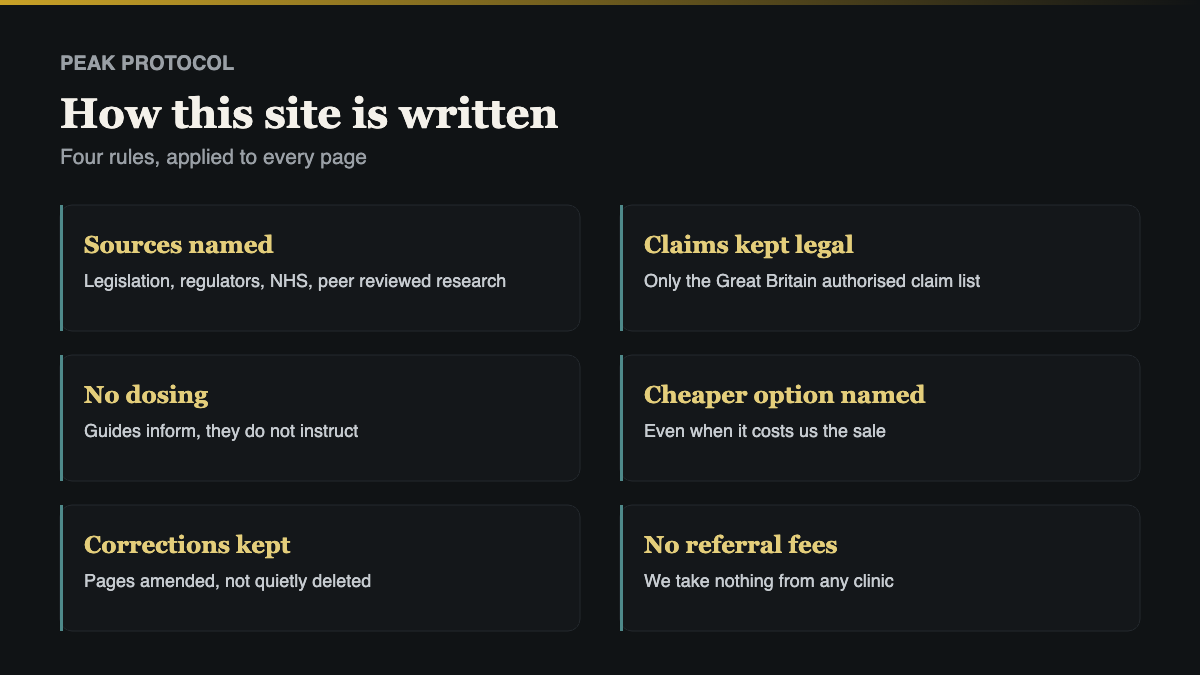
Content is researched and written by the Peak Protocol editorial team. There is no individual byline on most pages because the work is genuinely collaborative: one person drafts, another checks the citations, and disagreements get resolved before publication rather than after.
What our experts are not is clinicians. The team researches and writes to a documented standard and cites primary sources so you can check the work, and that is a different thing from clinical expertise. Conflating the two is the misrepresentation this page exists to avoid.
The sources our experts work from
Every factual claim traces to a primary source, and the links are in the pages so you can follow them rather than taking our word for it.
| Subject | Source our experts use | Why that one |
|---|---|---|
| UK law | legislation.gov.uk, for example the Misuse of Drugs Act 1971 | The statute itself rather than a summary of it |
| Health information | NHS | Publicly accountable, updated, and written for patients |
| Drug information | Talk to Frank | Harm reduction framing rather than deterrence framing |
| Medicines regulation | MHRA | The regulator for the products we deliberately do not sell |
| Permitted claims | GB nutrition and health claims register | The only list a supplement claim may lawfully come from |
| Supplement rules | Food Standards Agency | The regulator for what we do sell |
| Anti doping | UK Anti-Doping | Because a clean formula is not a clean batch |
The standards applied to every page
Four rules govern what our experts publish, and they are the same rules whether the page sells something or not.
State the uncertainty. Where trials are small, few or conflicting, the page says so in the same sentence as the finding rather than in a footnote.
Never repeat an unverifiable number. Manufacturers publish figures that are sometimes marketing rather than measurement. Where we cannot verify one, the page says we cannot verify it instead of passing it on.
Keep claims inside the register. Only wording that is authorised in Great Britain appears on a product page, and only where the product delivers the required amount of the nutrient.
Correct in the open. When something is wrong it is changed and the change is not hidden. Our editorial policy sets out the full process.
What our experts will not do
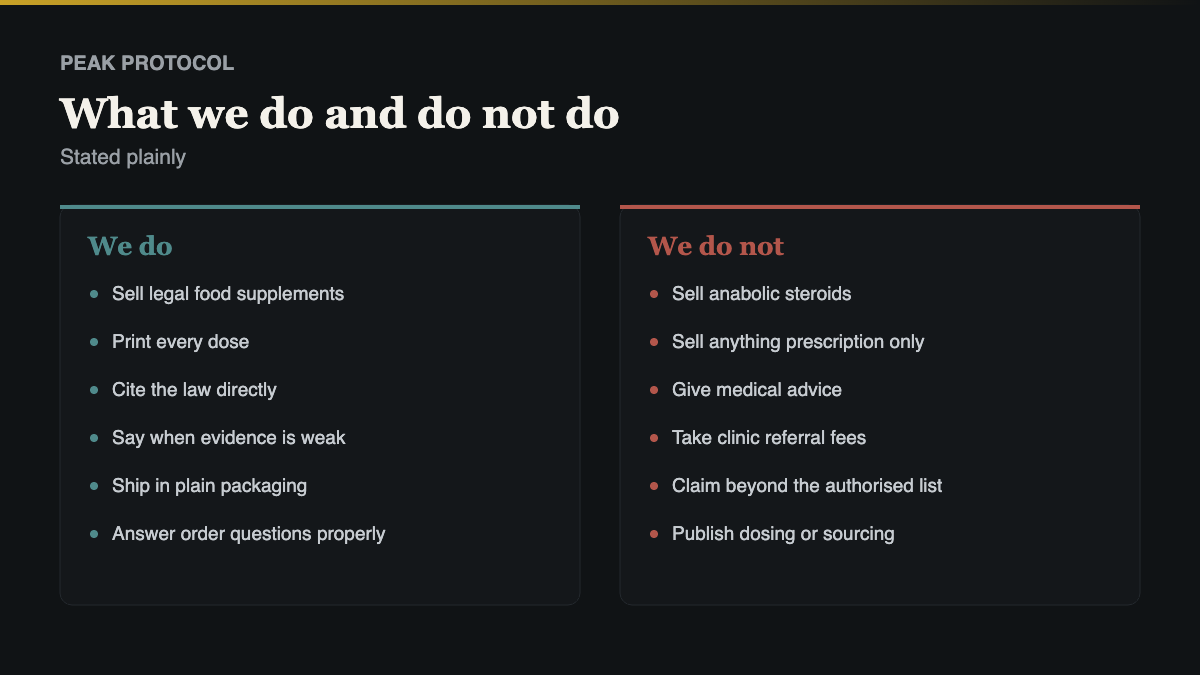
No dosing protocols for controlled compounds. The guides explain what a substance does and what it risks, and stop before telling you how to take it.
No individual medical advice. Nobody here can see your history, your medication or your blood results, and an email cannot substitute for someone who can. Our medical disclaimer states that in full.
No endorsements beyond the evidence. Our experts will not describe a supplement as a legal steroid or a steroid alternative, which is misleading and sits outside UK advertising rules as well.
What actually qualifies someone here
Expertise is a word that does a lot of unearned work on supplement sites, so it is worth saying what our experts have and, just as usefully, what they do not.
What they have is years of reading labels against the research, sourcing stock from the manufacturers rather than through a middle layer, and answering the same questions from customers often enough to know which ones the industry avoids. That is trade knowledge and it is real.
What they do not have is a clinical qualification. Nobody on this team is a doctor, a pharmacist or a registered dietitian, and no page here implies otherwise with a stock photograph of somebody in a white coat. There are no invented credentials on this site, no borrowed logos and no nutritionist who turns out to be an unregulated job title.
The honest version of what our experts are good for is narrow and useful. They can tell you what is in a tub, whether the dose matches the research, what it costs per serving against the alternatives, and what the law says. For anything about your own body, the answer is a professional who can see you.
Who is accountable when a page is wrong
Anonymity is the standard trick in this industry. A page with no author cannot be wrong, because there is nobody for the error to belong to, and that is precisely why so many health pages carry no name at all.
Our position is the opposite one and it is deliberately uncomfortable. The editorial team is accountable as a team, corrections go to whoever wrote the page rather than into a support queue, and the editorial policy commits us to changing a page in the open rather than quietly editing an error out of existence.
If you find something wrong, the contact page reaches a person. A specific disagreement with a citation attached is the most valuable message anyone sends our experts, and it gets read even when we end up disagreeing with it.
Why we do it this way
The commercial case for an honest our experts page is weaker than the case for a fabricated one, at least in the short term. A named advisor with a photograph converts better than a paragraph admitting the appointment has not happened yet.
The reason we do it the other way is that this site asks readers to believe difficult things: that a cheap supplement beats an expensive one, that a whole category has weak evidence, that the answer to their question is a blood test rather than a purchase. None of that is believable from a source that has already been caught inventing a credential.
So the our experts page carries the gap, and it will carry the name the day there is one.
How a page actually gets written
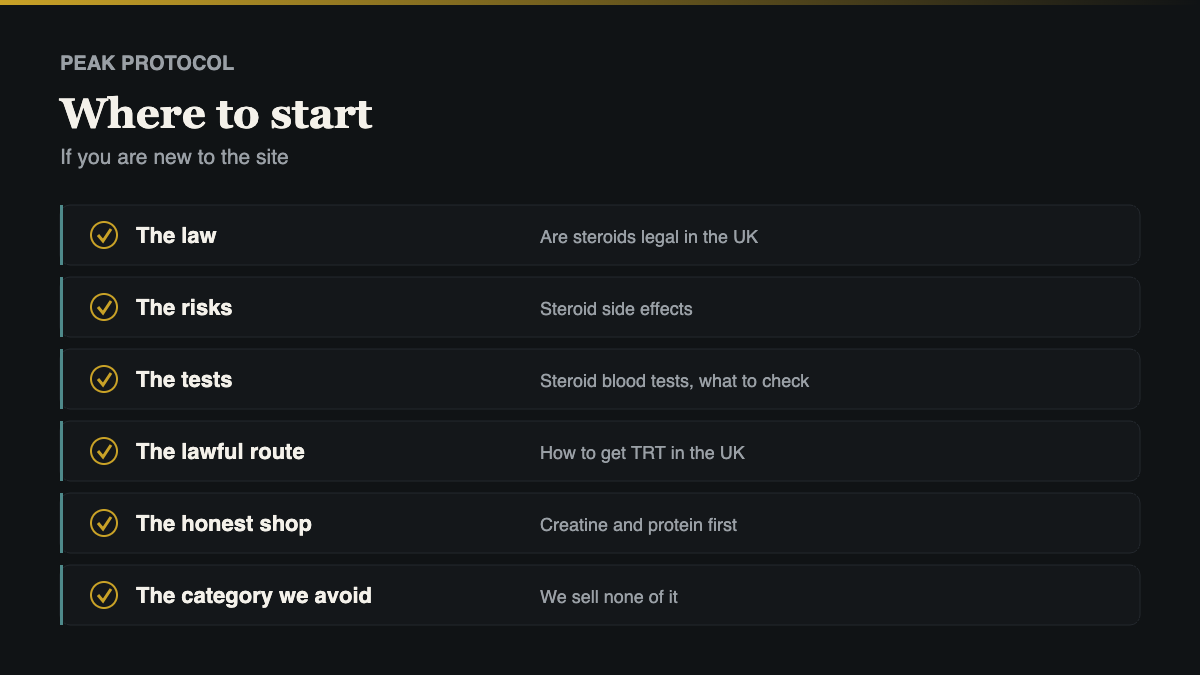
The process is unglamorous and it is worth setting out, because our experts page claims mean very little without it.
Question first. Every page starts from a question people actually ask, taken from search behaviour and from the messages we get, rather than from a keyword with commercial value attached. That is why several pages exist on subjects with no product at the end.
Sources before drafting. The statute, the NHS page, the trials and the claims register get read before a word is written. Where those disagree with what the industry says, the page follows the sources and says that the industry position differs.
Draft, then adversarial check. A second person reads the draft looking for the weakest claim in it and tries to break it. Anything that does not survive gets cut or qualified. This is the step that removes most of the confident nonsense.
Publish with the uncertainty intact. The finished page keeps the hedges. A page that reads as more certain than the evidence is a page our experts have failed to check properly.
How often pages are reviewed
On event rather than on schedule. Three things trigger a rewrite: a change to the legal classification of a substance, a new trial large enough to move a conclusion, and a change to what may lawfully be claimed about an ingredient.
Law changes rarely and evidence changes slowly, so most of these pages are stable for long periods, and a date stamp that moves every month usually means the date is being refreshed rather than the content. Every guide carries the date it was last reviewed so you can judge how old the position is.
Product pages are reviewed whenever the product changes: a reformulation, a pack size change, or a price move. When we corrected seventeen prices that had carried an import placeholder rather than a real figure, every product page quoting those prices was rewritten the same day, including the comparison tables on other products that referenced them.
What you can hold us to
Promises about expertise are cheap, so here are four you can test on any page without taking our word for anything. Each takes under a minute and each one would embarrass us if it failed.
Every dose figure on a product page matches the label on the tub you receive. Every citation links to the source itself rather than to a search result or another blog. Every health page says in plain words that it has not been medically reviewed. Every comparison table names a competing product on our own shelves where one is a better buy.
If any of those fails on a page you are reading, our experts have let something slip and the contact page is the fastest way to tell us. We would rather hear it from you than leave it standing because nobody looked.
The reason this section exists is that the phrase reviewed by experts appears on thousands of supplement sites and means almost nothing. A claim you can check in sixty seconds is worth more than a badge, and it is the only kind of claim we are willing to make about our experts.
What changes when a reviewer arrives
When a registered clinician joins, three things change and it is worth setting them out now so the difference is visible rather than announced.
First, health pages will carry a named reviewer and the date of review, rather than the notice they carry today. Second, the reviewer will have a veto on anything clinical, which means our experts can be overruled on their own copy by someone who knows more. Third, the review will be scheduled rather than triggered, because clinical content drifts out of date quietly.
What will not change is the sourcing standard, the refusal to publish dosing protocols for controlled compounds, or the rule that a product page names a better competing product when one exists. Those are editorial commitments rather than clinical ones, and a reviewer does not make them stronger or weaker.
Until that appointment happens, the honest description of our experts is the one at the top of this page: people who know the products and the law extremely well, and who are not clinicians. Anything more would be a claim we cannot support.
How this compares with the rest of the industry
It is worth naming what the alternative looks like, because the gap our experts admit to is smaller than the gap most sites hide. The common pattern is a stock photograph of somebody in a white coat, a first name, and a job title that sounds regulated but is not.
Nutritionist is the clearest example. In the United Kingdom the word is not protected, so anyone may use it, while dietitian is protected and requires registration. A site listing a nutritionist as its reviewer may be listing a qualified person or a weekend course, and the reader cannot tell which from the page.
Our experts would rather say plainly that nobody here is clinically qualified than borrow a title that implies it. The trade is that we lose the badge and keep the ability to look at the site without wincing.
Questions about our experts
Is the content on this site medically reviewed?
Not yet. A qualified reviewer is being appointed and until that happens every health page says so. We are not going to claim a review that has not taken place.
Who are your experts, then?
A research and editorial team that works from primary sources and cites them. They are not clinicians, and this page exists so that distinction is never blurred.
How will I know when a reviewer is appointed?
Their name, registered qualification, registration number and the review date will appear on every health page, and this page will name them. A registration number you can check is the point.
Do brands pay to influence what our experts write?
No. Nothing on this site is paid placement and no manufacturer has ever paid to appear or to be described a particular way. The editorial policy sets out the commercial rules.
What if I disagree with something a page says?
Tell us through the contact page, ideally with a citation. It goes to whoever wrote the page, and a specific disagreement with a source attached is the most useful message we get.
Why does a shop publish guides about compounds it will not sell?
Because people search for them either way, and the alternative to accurate information is the information they would otherwise find. That reasoning is set out in full on our about page.
Our editorial policy covers the process our experts follow, and the about page covers why the site is built this way.