
NHS vs private TRT is less a choice between good and bad care than a trade between time, cost and thresholds. Both routes can prescribe testosterone replacement therapy for men with a genuine deficiency, and both should follow the same basic steps: symptoms, repeated morning blood tests, a search for the cause, and regular monitoring. This guide compares them side by side, explains how to check a private clinic, and lists the red flags that suggest a clinic is selling testosterone rather than treating a condition. It sits within our TRT UK guide, and TRT is distinguished from steroid use on our steroids in the UK hub.
NHS vs private TRT: the short version
- Both routes should diagnose from symptoms plus at least two early morning testosterone tests, and look for an underlying cause.
- The NHS route starts with a GP and may involve referral to endocrinology or urology. It is slower but treatment is covered by standard prescription arrangements.
- Private clinics are faster and may treat men the NHS would not, but costs for consultations, tests and medication add up and continue for as long as treatment does.
- Private providers in England must be registered with the Care Quality Commission and doctors must be on the GMC register.
- TRT suppresses fertility and needs lifelong monitoring. Neither route should skip that conversation.
- Peak Protocol is not a clinic, does not prescribe and has no commercial relationship with any TRT provider.
Diagnosis should be the same on both routes
Testosterone deficiency (male hypogonadism) is diagnosed from a combination of symptoms and blood tests, not from blood tests alone. Symptoms include low libido, erectile problems, fatigue, low mood and loss of muscle, many of which have other causes. Our guide to low testosterone symptoms goes through them.
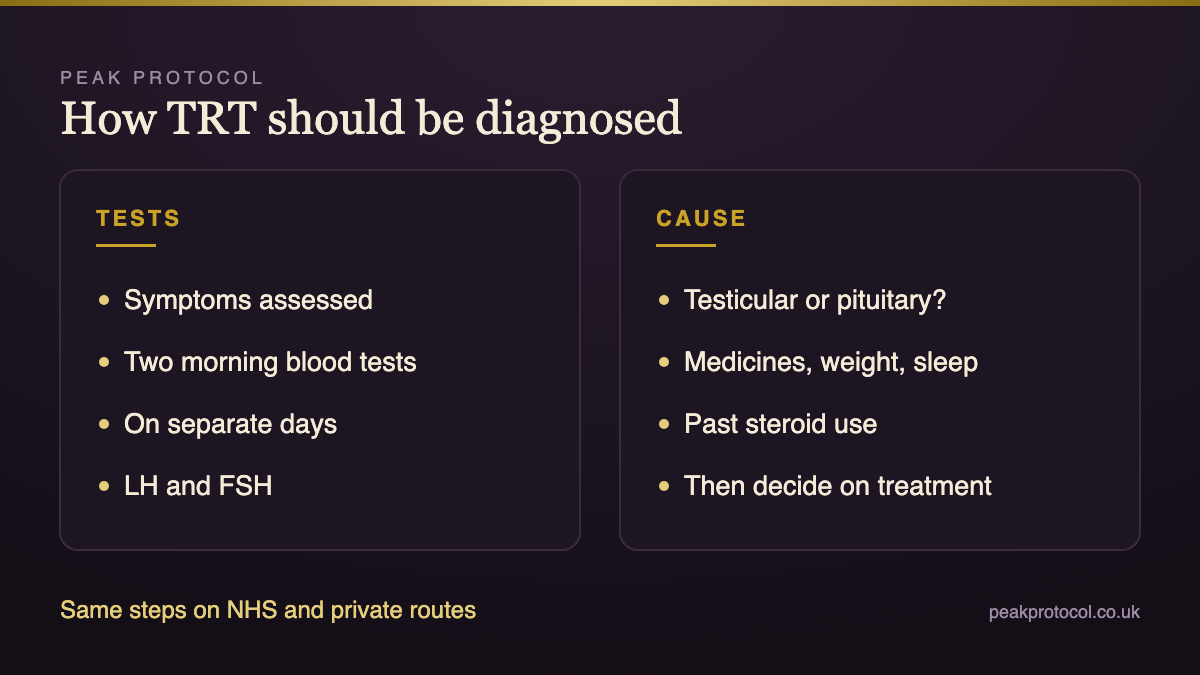
Testosterone varies through the day and falls after illness, poor sleep and heavy training, so a single result is not enough. UK guidance, including from the British Society for Sexual Medicine, calls for at least two early morning, ideally fasting, blood tests on separate days, with LH and FSH to show whether the problem starts in the testicles or the brain. A good assessment also checks for causes such as obesity, medicines, pituitary problems and, in former steroid users, suppression that may recover on its own. Our testosterone blood test guide explains the numbers.
The NHS route
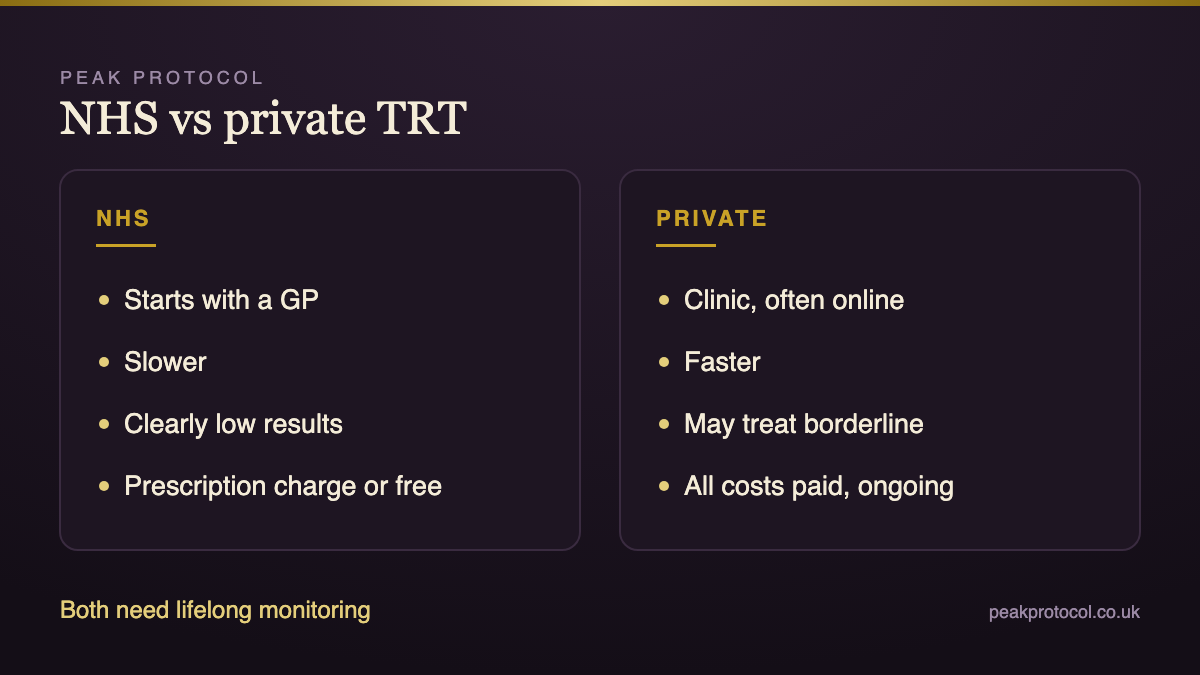
The NHS route begins with a GP appointment. The GP will ask about symptoms, arrange blood tests and, if results are low, repeat them. Depending on the picture, they may start treatment themselves, or refer to an endocrinologist or urologist to investigate the cause before treatment begins.
Advantages: investigation of the underlying cause is thorough, care is joined up with the rest of your medical record, and medication is covered by the usual prescription arrangements. Prescriptions are free in Scotland, Wales and Northern Ireland and charged per item in England, where a prepayment certificate can reduce the cost for people on regular medication. The NHS prescriptions guidance sets out current charges and exemptions.
Disadvantages: waiting times for specialist referral can be long, and NHS clinicians tend to treat only when results are clearly low and symptoms fit. Men with borderline results are more likely to be monitored than treated.
The private route
Private clinics offer faster appointments, often online, with blood tests by home kit or at a partner lab. Some are run by endocrinologists or men’s health specialists with a careful approach; others are closer to subscription businesses.
Advantages: speed, convenience and more flexibility for men with borderline results and clear symptoms. Disadvantages: every part is paid for, including consultations, repeat blood tests and medication, and those costs continue for as long as treatment does, which for most men is indefinitely. Some clinics are less thorough about looking for an underlying cause. Our TRT cost guide breaks down what private treatment typically involves, and our TRT clinics by city pages explain local NHS services and what to check in private providers.
NHS vs private TRT side by side
| NHS | Private | |
|---|---|---|
| First step | GP appointment | Clinic consultation, often online |
| Speed | Slower, specialist waits possible | Usually weeks, sometimes days |
| Threshold to treat | Clearly low results and symptoms | May treat borderline cases |
| Search for the cause | Usually thorough | Varies by clinic |
| Cost | Prescription charge in England, free elsewhere in the UK | Consultations, tests and medication all paid |
| Monitoring | GP or specialist | Clinic, sometimes shared with GP |
| Regulation | NHS governance | Registered regulator and GMC doctors |
How to check a private clinic
Before paying a private provider, check that it is registered with the right regulator: the Care Quality Commission in England, Healthcare Improvement Scotland in Scotland, Healthcare Inspectorate Wales in Wales or RQIA in Northern Ireland. Look up the prescribing doctor on the GMC register, which shows whether they are licensed to practise and whether they are on the specialist register.
Ask for a written breakdown of every cost for the first year and ongoing years, including tests. Ask how they will investigate the cause of low testosterone, how often they will monitor haematocrit, PSA and other markers, and whether they will share care with your GP. A good clinic answers all of this readily.
Red flags
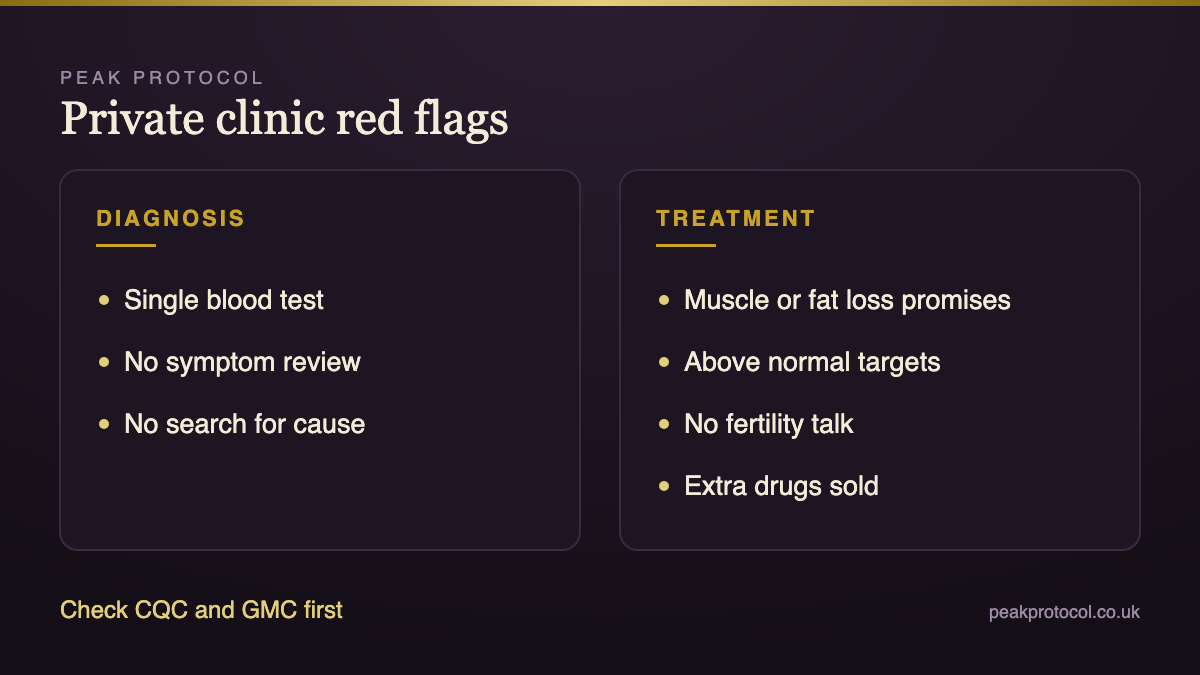
- Offering treatment after a single blood test, or without asking about symptoms.
- Promising muscle gain, fat loss or performance, which is not what TRT is for.
- Targeting levels well above the normal range.
- Not discussing fertility before starting.
- Selling additional drugs without a clear medical reason.
- Reluctance to share information with your GP.
Advertising prescription only medicines to the public is restricted under the Human Medicines Regulations 2012, so a provider that markets testosterone itself, rather than its clinical service, is a warning sign too. If what is on offer looks like performance enhancement, it is closer to the steroid use described in our steroids hub than to medical treatment.
Fertility and long term commitment
Testosterone treatment suppresses the signals that drive sperm production, so men who want children should discuss fertility before starting, whichever route they take. Our guide to steroids and fertility explains the mechanism, which is the same.
TRT is usually long term. Stopping leads to a return of symptoms, and after years of treatment natural production may be slow to recover. Monitoring continues for as long as treatment does, including haematocrit, as explained in steroids and heart health.
Where supplements fit
Supplements do not treat testosterone deficiency. Zinc contributes to the maintenance of normal testosterone levels in the blood, and vitamin D matters when you are deficient, which is common in UK winters, but neither is a substitute for assessment. Our testosterone support range is described on that basis, and anything with symptoms of deficiency should start with a GP.
What happens at the first appointment
Whether it is a GP or a private clinician, expect questions about symptoms, how long they have lasted, sleep, alcohol, weight, medicines and any past steroid use. Be honest about the last point: previous anabolic steroid use is one of the most common causes of low testosterone in younger men, and it changes the plan, because suppression may recover without treatment.
Blood tests are usually booked for early morning, ideally fasting, and repeated. Alongside testosterone, expect LH and FSH, a full blood count, and often prolactin, liver function, lipids, glucose or HbA1c, and PSA in older men. Bring a list of what you take, including supplements.
Monitoring once treatment starts
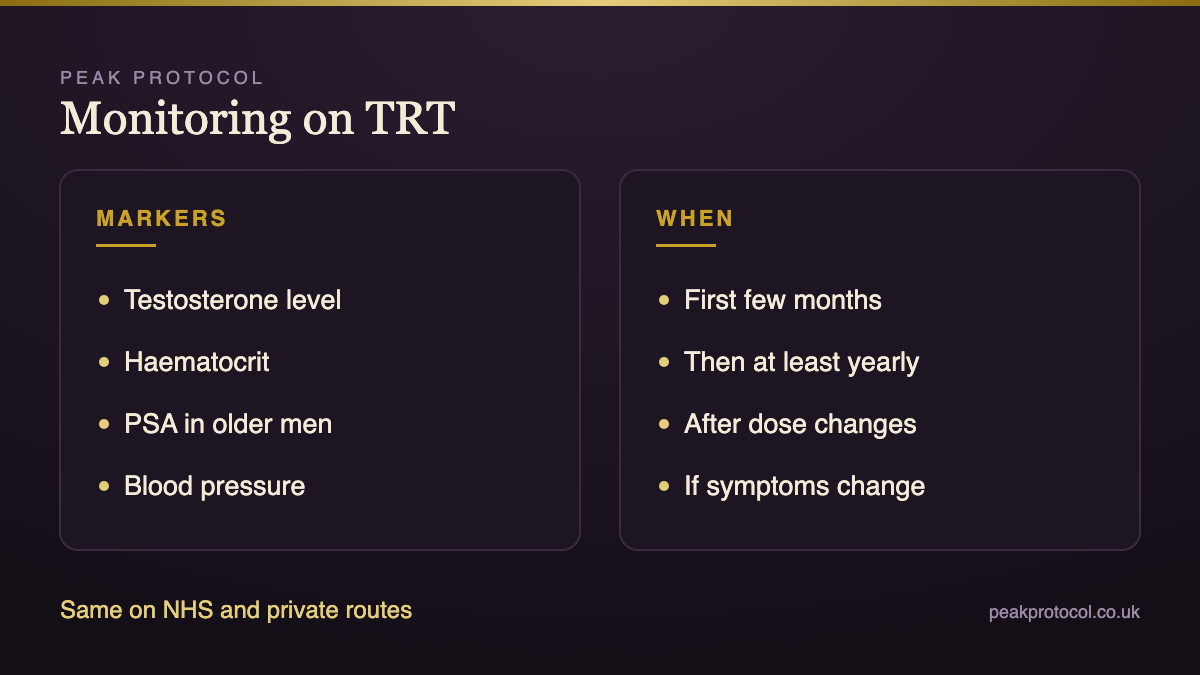
Treatment is reviewed after the first few months and then usually at least once a year. Monitoring typically includes testosterone levels, haematocrit, PSA and a digital rectal examination in older men where appropriate, and a check on symptoms and side effects. The purpose is to keep testosterone in the normal range, catch thickening of the blood early and make sure treatment is still helping.
| Marker | Why it is checked |
|---|---|
| Testosterone | Confirms levels sit in the normal range |
| Haematocrit | Detects thickening of the blood |
| PSA | Prostate monitoring in older men |
| Symptoms and blood pressure | Confirms treatment is helping and safe |
Five misunderstandings about NHS and private TRT
- “The NHS will not prescribe testosterone.” It does, for men with symptoms and repeatedly low results.
- “Private means better.” It means faster and paid for. Quality varies in both.
- “One low result is enough.” Testosterone varies, so repeat morning tests are standard.
- “TRT will build muscle like steroids.” TRT aims for normal levels, not above normal ones.
- “I can stop whenever I like with no effect.” Symptoms usually return, and natural production can be slow to restart.
NHS vs private TRT: common questions
Can I get TRT on the NHS?
Yes, if you have symptoms and repeatedly low morning testosterone results. A GP will assess you and may start treatment or refer you to a specialist.
Is private TRT better than NHS TRT?
Not necessarily. Private care is faster and may treat borderline cases, but it costs more over time and the quality of investigation varies between clinics.
How do I know a private TRT clinic is legitimate?
Check its registration with the relevant regulator, such as the Care Quality Commission in England, and look up the prescribing doctor on the GMC register.
Will my GP continue private TRT?
Some GPs agree to shared care arrangements, others do not. Ask your GP before starting privately if you hope to move treatment later.
Does TRT affect fertility on either route?
Yes. Testosterone suppresses sperm production whichever route you take. Discuss fertility before starting.
Is TRT the same as taking steroids?
No. TRT restores normal levels in diagnosed deficiency with monitoring. Steroid use pushes levels well above normal without medical oversight.
Sources and review status
This guide draws on guidance from the British Society for Sexual Medicine, the NHS prescriptions guidance, the Human Medicines Regulations 2012 and information published by the Care Quality Commission and the GMC register. It does not recommend any provider.
Written by the Peak Protocol editorial team. This page has not been reviewed by a medical or legal professional. It is information, not medical or legal advice, and it is not an encouragement to use any drug. Peak Protocol sells legal sports supplements and does not sell anabolic steroids, SARMs or prescription medicines. How we research and correct content is set out in our editorial policy.