
Information and harm reduction only, never medical advice. Sourced from the NHS, TALK TO FRANK, the MHRA and peer reviewed research, and written to say plainly where the evidence runs out rather than filling the gap. Always speak to a qualified clinician before changing anything. See our editorial policy.
Coming off is the part that gets the least attention and causes the most trouble. Most of what is written about steroids covers what to take. Very little covers what happens when you stop, which is where the genuine difficulty sits.
This is harm reduction. It is not encouragement, and it does not contain protocols, doses or drug recommendations, because those are prescription medicines and because that is the line between explaining something and instructing someone.
What actually happens when you stop
While you were taking exogenous testosterone, your body stopped making its own. The hypothalamus and pituitary read the external supply and shut down the signals, LH and FSH, that tell the testes to produce.
When you stop, the external supply disappears immediately. The internal supply does not resume immediately. There is a gap, and everything difficult about coming off lives in that gap.
During it you have very little testosterone from any source, which is a lower level than you had before you ever started.
The rough timeline
Recovery varies enormously and anyone quoting precise weeks is guessing. The general shape holds, though.
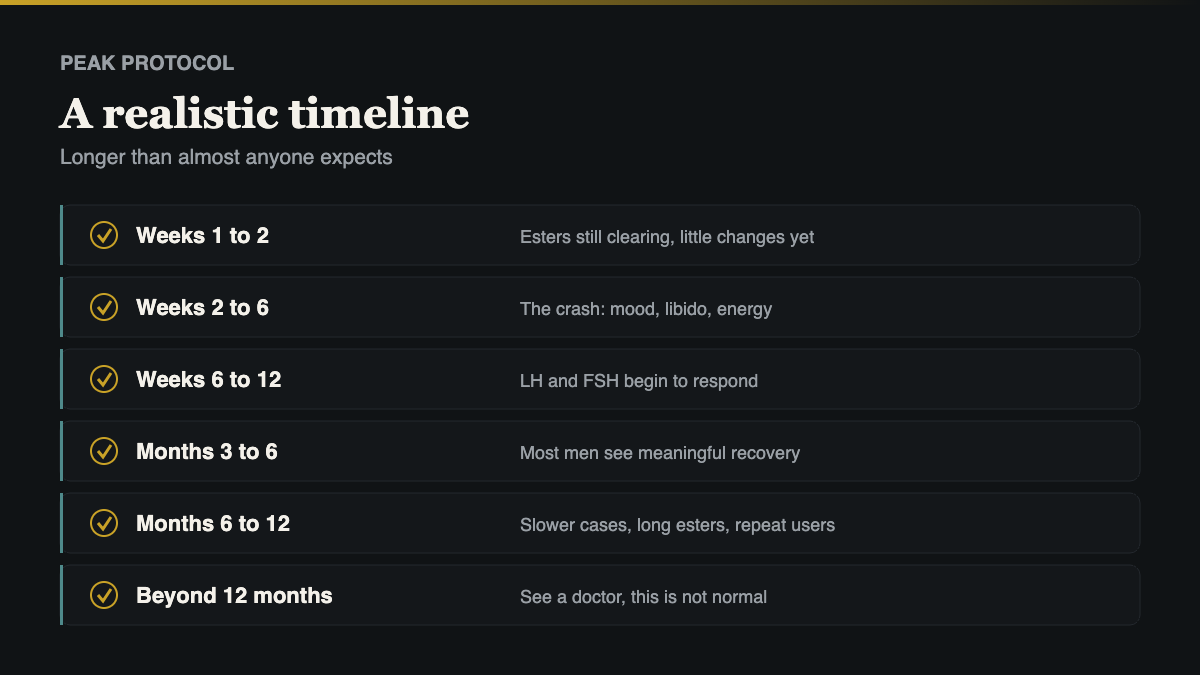
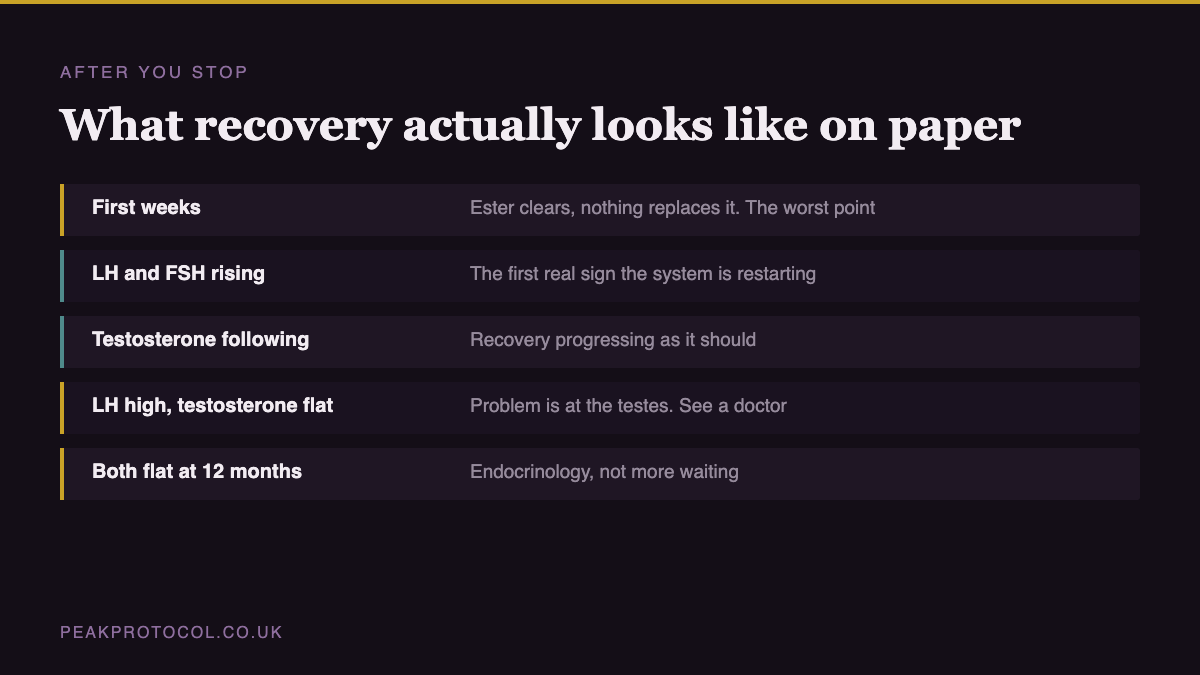
The first few weeks are usually the worst, as the ester clears and nothing has replaced it. Over the following months, LH and FSH gradually rise and the testes respond. Most men see meaningful recovery over three to twelve months.
What determines where you fall is largely how long you used and how heavily, plus your age and what your baseline was beforehand. Short use recovers faster than years of continuous use. A man who never fully came off between cycles is in a different category to someone who ran one and stopped.
Why the crash happens
People describe the same cluster: exhaustion, no motivation, low mood, no libido, and rapid loss of strength and size.
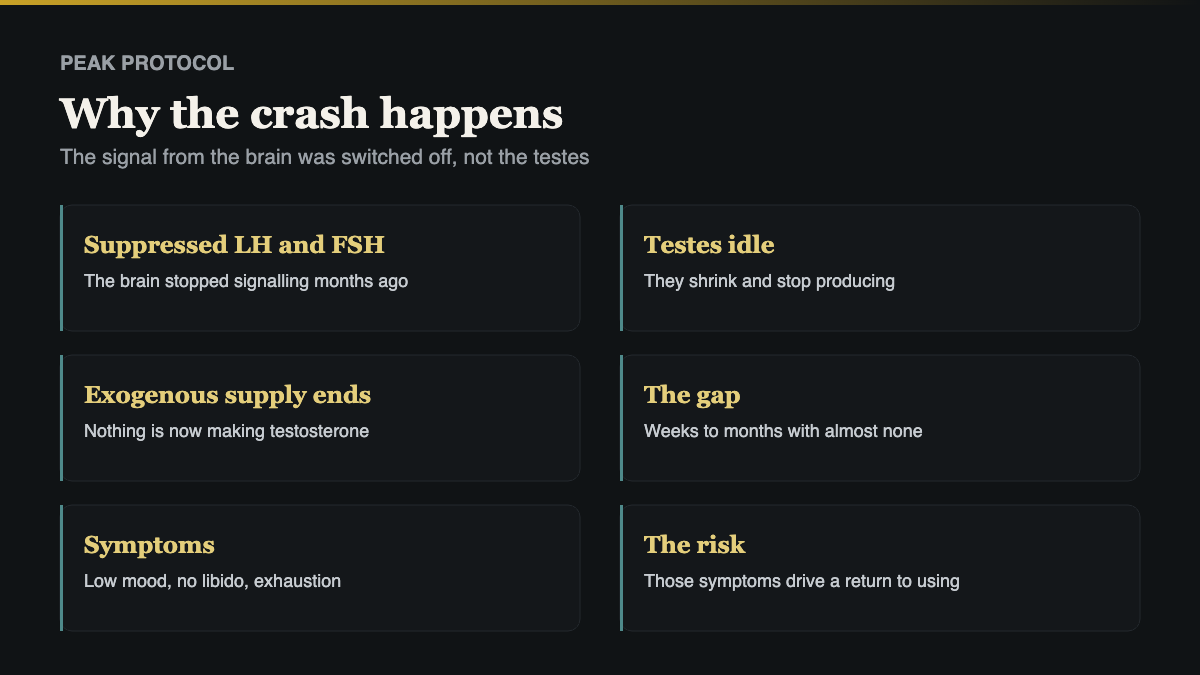
Some of that is hormonal, and it is genuinely a low testosterone state, often lower than before you started. Some of it is water and glycogen, which is why the size loss looks alarming in the first fortnight and overstates what has actually gone.
The psychological part is not weakness. Testosterone affects mood and drive directly, and going from supraphysiological to near zero within weeks is a large physiological change. Treating it as a character failure is why men do not talk about it.
On post cycle therapy
PCT usually refers to using medicines to restart natural production faster, most commonly selective oestrogen receptor modulators and sometimes hCG.
If fertility is the main worry, our guide to steroids and fertility covers testing and realistic recovery times.
We are not going to publish protocols. What is worth stating is the clinical position: these are real medicines with real effects and real risks, they are used legitimately under supervision for exactly this problem, and using them unsupervised on forum instructions is a different proposition to being prescribed them.
The honest summary is that there is a legitimate medical version of what PCT is trying to do, and it involves an endocrinologist rather than a website.
The legal position on PCT drugs
Every drug commonly used for this in the UK, tamoxifen, clomifene, anastrozole, hCG, is a prescription only medicine.
Supplying them without a prescription is an offence, and buying them from a website means the same absent quality control that applies to everything else in that market. People frequently do not realise that the PCT part carries the same legal and contamination issues as the compounds themselves.
The legal route exists: a doctor can prescribe these for post steroid hypogonadism, and some endocrinologists are experienced in exactly this. See how to access a doctor for the pathway, and be straightforward about your history, because it is the most relevant thing in it.
Test, do not guess: the blood tests to get
The single most useful thing you can do coming off is measure rather than infer.
Testing total testosterone, free testosterone, LH and FSH at intervals tells you whether recovery is progressing. If LH is rising and testosterone is following, the system is restarting. If LH is high and testosterone is not responding, the problem is at the testes. If both are flat months later, you need an endocrinologist rather than more time.
Without bloods you cannot distinguish between recovering slowly and not recovering, and those need completely different responses. See what to check.
The mental health side
Depression during withdrawal from anabolic steroids is documented, it can be severe, and it is the effect most likely to be dismissed by the person experiencing it.
If you are having thoughts of harming yourself, contact your GP, call 111, or call the Samaritans free on 116 123 at any hour. This is a recognised physiological effect rather than a personal failing, and it passes as hormones recover.
Tell someone what you are going through. Withdrawal is considerably harder alone, and the people around you will have noticed something is wrong regardless of whether you have explained it.
Keeping what you can
Some loss is inevitable. Some is avoidable, and the avoidable part is largely behavioural.
Keep training, at reduced volume rather than not at all. Continuing to train is the strongest signal for retaining muscle, and men who stop entirely because they feel awful lose considerably more.
Keep protein high, since protein contributes to the maintenance of muscle mass and recovery capacity is reduced. Do not crash your calories at the same time as coming off, because a deficit plus withdrawal is the worst possible combination for retention and for mood.
Prioritise sleep, which is when what testosterone you have is produced.
Our shop stocks the legal supplements with genuine evidence behind them, and we would rather tell you plainly that none of them restart your endocrine system. Creatine and protein help you train and recover. They do not do what you want them to do here.
The trap that turns cycles into permanent use
This is the most important paragraph on the page.
The gap after stopping feels bad. Going back on makes it feel better immediately. That combination is why a very large number of people who intended to run one cycle are still using years later, having never fully come off.
It is not usually a decision. It is a series of individually reasonable choices made while feeling terrible, each one postponing recovery a little further, and the cumulative effect is continuous use with the worst risk profile of any pattern.
Knowing the trap exists is most of the defence against it. If you are about to go back on because coming off is hard rather than because you decided to, that is the moment worth pausing on.
Planning the stop rather than just stopping
Most people come off badly because they come off suddenly, often for a reason outside their control: money, a partner, a health scare, or supply drying up.
A stop you have decided on goes better than one that happens to you, for reasons that are mostly practical. You can arrange bloods beforehand so you have a baseline to measure recovery against. You can time it away from a period that is already stressful. You can warn the people around you, which matters more than it sounds. And you can avoid stacking it on top of an aggressive diet, since a deficit during withdrawal is the worst combination for both mood and muscle retention.
If you are going to stop at some point, choosing when is one of the few parts of this you fully control.
What it looks like from outside
Partners and family generally describe the same things, and they usually notice before the person does.
Withdrawal rather than temper is the most common: less conversation, more time alone, declining plans. Sleep changes in both directions. And a flatness that reads as being about the relationship when it is not.
Two things help. Telling one person what is happening, so the change has an explanation attached rather than being interpreted as something else. And accepting that if somebody close has raised it, that is information rather than an accusation, because gradual change is very hard to see from the inside.
If you are the person watching someone go through this, TALK TO FRANK takes calls from family and friends too.
If natural production never comes back
For some men, particularly after prolonged high dose use, natural production does not recover to a functional level.
That means lifelong prescribed TRT, which is a legitimate and manageable treatment, and not what most people had in mind when they started. It is worth being clear eyed that this is a real possible endpoint rather than a scare story.
If bloods show no meaningful recovery after a year, that is an endocrinology conversation rather than a longer wait.
Where to get help
Your GP can test and refer, and is not going to report you. TALK TO FRANK gives confidential advice without judgement, including to family members. NHS needle and syringe programmes often have staff experienced with this specific population and will talk to you without you being a current injector.
The NHS page on anabolic steroid misuse covers the clinical picture.
What legitimately helps
Sleep, protein, continued training at reduced volume, patience, bloodwork at intervals, and telling somebody. That list is unglamorous and it is genuinely most of what is within your control.
What does not help is guessing, buying prescription medicines from the same market that sold you the compounds, or making the decision to go back on while you are at the bottom of the dip.
On cruising, and why it is not stopping
Cruising means dropping to a lower maintenance dose between periods of heavier use rather than stopping. It is often presented as a gentler alternative, and it is worth being precise about what it actually is.
Cruising does not allow recovery. Natural production stays suppressed the entire time, because there is still an external supply telling the system to stand down. What it avoids is the withdrawal gap, which is exactly why it appeals, and what it produces instead is continuous suppression measured in years rather than months.
Framed honestly, cruising is not a way of coming off. It is a way of never coming off that feels like a compromise. For some people it eventually becomes prescribed TRT by another name, except without the diagnosis, the monitoring or the legal supply.
That is not an argument that it is worse than the alternative in every case. It is an argument for calling it what it is when you decide.
Five mistakes that make it worse
Five mistakes turn a difficult few months into something much worse, and all five are avoidable.
One, stopping without a plan. Coming off steroids on impulse, usually because supply ran out or something frightened you, means the crash arrives with no bloods, no support and no idea whether what you are feeling is expected.
Two, taking prescription drugs bought online for PCT. The drugs people use are real medicines with real interactions, and buying them from the same unregulated market that supplied the steroids adds a second unknown at the worst possible moment.
Three, judging recovery by how you look. Muscle and weight tell you very little. Whether your own production has restarted is a blood test question, and coming off steroids without ever measuring LH, FSH and total testosterone means you will never know whether you recovered or simply adapted.
Four, going through it in secret. The mood effects are the most dangerous part, and they are considerably worse when nobody around you knows what is happening or why.
Five, treating a return to using as a solution. This is the trap. The symptoms of coming off steroids are relieved instantly by going back on, which is exactly how a temporary decision becomes a permanent one.
Planning your way off, step by step
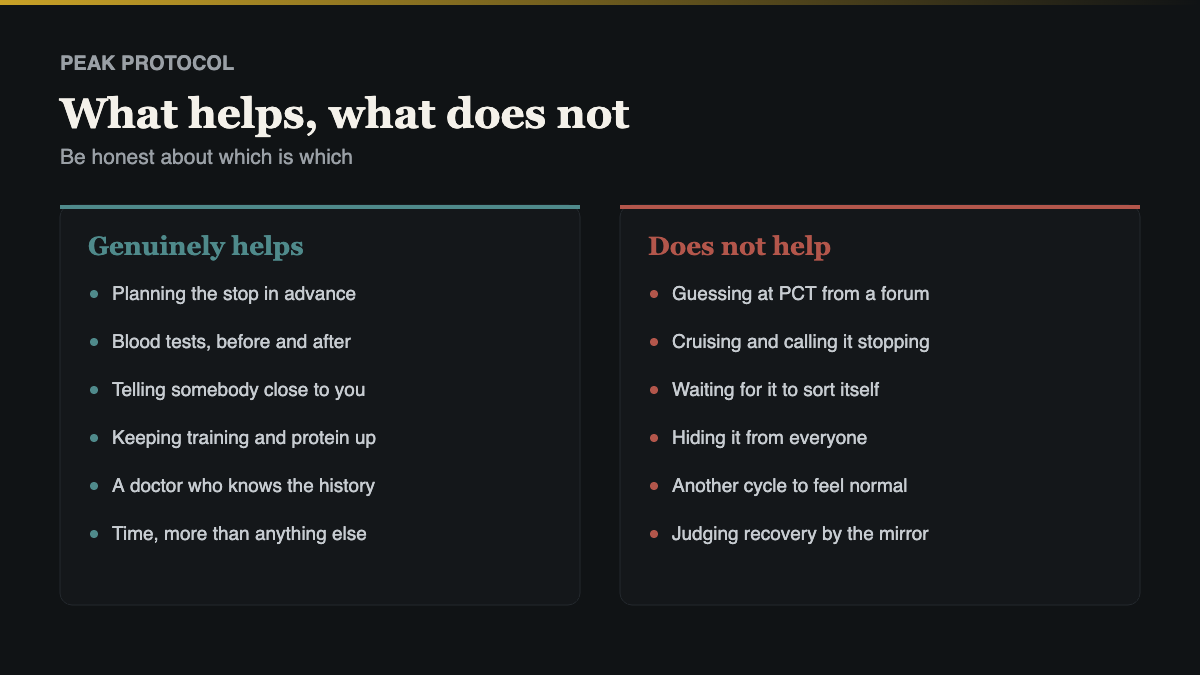
Planning it is most of the difference between a hard few months and a bad year. There are four things worth doing in order.
Get bloods before you stop. Total testosterone, LH, FSH, a full blood count and a lipid panel while you are still on. Without that baseline, nothing you measure afterwards can be interpreted. Steroid blood tests covers the full panel.
Pick the timing deliberately. Coming off steroids during a period with heavy work pressure, relationship strain or a house move stacks the odds badly. Choose a stretch where a few flat months will not cost you something you cannot recover.
Tell one person. Not everyone. One person who will notice if your mood goes somewhere dark and who knows enough to say so. This is the single highest value thing on the page and it costs nothing.
Then get medical support rather than forum protocols. A GP will not report you, and a doctor who knows the full history can interpret your bloods properly and manage the mood effects. If recovery has not happened by twelve months, that is a genuine endocrine problem and needs a specialist. How to get TRT in the UK covers the lawful route if it turns out you now need treatment, and steroid side effects covers what may or may not reverse.
Coming off steroids: common questions
How long does it take to recover after stopping steroids?
Most men see meaningful recovery over three to twelve months, depending mainly on how long and how heavily they used. Bloods showing LH and FSH rising are the sign the system is restarting.
Is PCT necessary?
There is a legitimate medical version of what PCT attempts, and it involves a doctor. The drugs commonly used are prescription only medicines in the UK, and buying them online carries the same legal and quality problems as everything else in that market.
Why do I feel depressed after stopping?
Because you are in a low testosterone state, often lower than before you started, while natural production restarts. It is a documented effect, it can be severe, and it resolves as hormones recover. Speak to a GP or call 111.
Will I lose all my gains?
Some loss is inevitable, and the first fortnight overstates it because much of the early drop is water and glycogen. Continued training and high protein retain considerably more than stopping entirely.
What if my testosterone never recovers?
For some long term users it does not return to a functional level, and the outcome is lifelong prescribed TRT. If bloods show no meaningful recovery after a year, ask for an endocrinology referral.
How long does recovery take when coming off steroids?
Most men see meaningful recovery within three to six months, but it varies enormously. Long esters like nandrolone decanoate extend it because the compound is still releasing after the last injection, and repeated cycles with short breaks make it slower and less complete.
Is post cycle therapy necessary?
The drugs used for it are prescription medicines and buying them from an unregulated market adds a second unknown at the worst point. The evidence base for self managed protocols is thin. What is well established is that blood tests, time, and medical support genuinely help.
Why do I feel so bad after coming off steroids?
Because your own production was switched off at the level of the brain and takes months to restart, so there is a gap with very little testosterone in your system. Low mood, absent libido and exhaustion during that window are expected rather than a sign something has gone wrong.