Testosterone Support
This is the category where the gap between marketing and evidence is at its widest, so it is worth being blunt at the top. No food supplement raises testosterone in a man who is not deficient in the nutrient it contains. What the products below can do is correct a shortfall, and correcting a shortfall in zinc or vitamin D is genuinely worth doing if you have one.
If your testosterone is clinically low, that is a medical situation and it needs a blood test and a doctor, not a tub. We explain that route in full in our guide to TRT in the UK, and we would rather send you there than sell you something that will not work.
On this page
- What we are allowed to say, and why
- Zinc
- Vitamin D3
- Magnesium
- Ashwagandha and the botanicals
- What does not work
- The things that beat every supplement here
- Testosterone and age
- Interactions and cautions
- Getting tested properly
- How to choose from this range
- Common questions
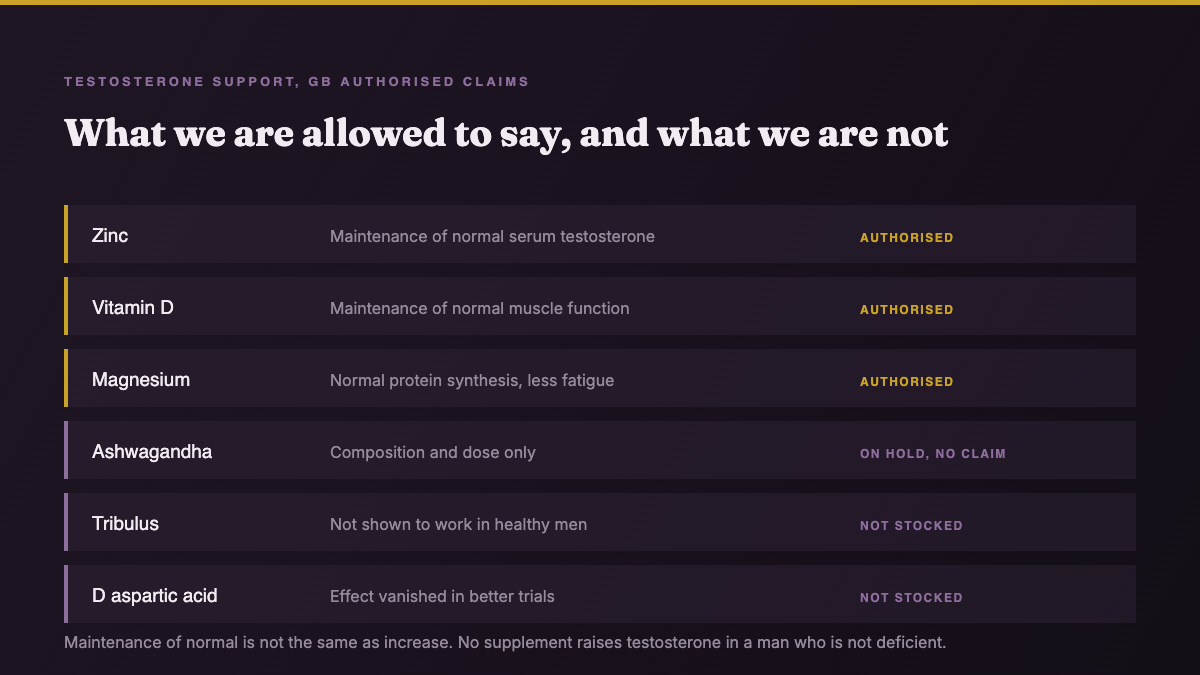
What we are allowed to say, and why
Health claims on food supplements sold in Great Britain are tightly controlled. A claim can only be made if it appears on the GB register of authorised nutrition and health claims, and it has to be used in the approved wording for the approved nutrient at the approved dose.
Zinc has an authorised claim covering the maintenance of normal serum testosterone concentrations. That wording matters. Maintenance of normal is not the same as increase, and the claim is about keeping a normal level normal in someone getting enough zinc, not raising a low level in someone who is not.
Most botanicals, ashwagandha included, have no authorised claim at all. Their applications sit on hold, which means we can tell you what is in the capsule and at what dose, and we cannot tell you what it does. Where you see a competitor making a confident botanical claim, they are breaking the rules rather than knowing something we do not.
Zinc
Zinc is the one ingredient in this category with an authorised claim tied directly to testosterone. It is involved in the enzymes that produce it, and deficiency reliably lowers testosterone in men.
The honest framing is that supplementing corrects a deficiency, it does not create a surplus. Trials in zinc deficient men show meaningful increases. Trials in men who already have enough show nothing. Deficiency is more common in vegetarians and vegans, heavy sweaters, and anyone with a diet low in meat, shellfish and dairy.
The recommended intake in the UK is around 9.5mg a day for men. Supplements typically provide 15mg to 25mg. More is not better, and sustained high intakes interfere with copper absorption, which is why the upper guidance sits around 25mg from supplements. Zinc on an empty stomach causes nausea in a lot of people, so take it with food.
Vitamin D3
Vitamin D has authorised claims for the maintenance of normal muscle function and normal bones, and the association between low vitamin D and low testosterone is well documented in observational data. Whether supplementing raises testosterone in men who are not deficient is much less clear, and the trials are mixed.
What is not in dispute is that a large share of the UK population is short of it between October and March, because at this latitude the sun is too low for the skin to make any. The NHS advises everyone to consider 10 micrograms a day through autumn and winter. That advice stands on its own merits regardless of what it does or does not do for hormones.
Take it with a meal containing fat, since it is fat soluble. This is the single most defensible purchase in this category for a person living in Britain.
Magnesium
Magnesium has authorised claims for normal muscle function, normal protein synthesis and the reduction of tiredness and fatigue. It does not have one for testosterone, and we are not going to imply one.
Where it earns a place in this category is sleep, indirectly. Poor sleep lowers testosterone substantially and quickly, and magnesium is one of the few supplements with a reasonable case for helping sleep quality in people whose intake is low. Form matters more here than in most categories.
| Form | Absorption | Notes |
|---|---|---|
| Bisglycinate | High | Gentle on the stomach. The one to buy for daily use. |
| Citrate | Good | Well absorbed, mildly laxative at higher doses. |
| Oxide | Poor | Cheap and common in multivitamins. Mostly passes through you. |
Ashwagandha and the botanicals
Ashwagandha is the most popular botanical in this category and it has no authorised health claim in Great Britain, so what follows is composition and context rather than a claim about effect.
It is the root of Withania somnifera, standardised in supplements to a percentage of withanolides, typically five percent. Doses in the published literature usually sit around 300mg to 600mg a day of a standardised root extract. When you compare products, compare withanolide content rather than raw milligrams, because a 1000mg capsule of unstandardised powder can contain less active material than a 300mg standardised extract.
Two practical cautions. Ashwagandha is not recommended in pregnancy, and there have been case reports of liver injury associated with it, rare but documented, so it is not something to take indefinitely without thought. If you take thyroid medication or immunosuppressants, speak to your doctor first.
What does not work
Tribulus terrestris. The most persistent testosterone booster on the market and one of the most consistently negative in trials. It does not raise testosterone in healthy men. We do not stock it.
D aspartic acid. An early trial looked promising, then better trials found the effect vanished within days even where it appeared, and one found a decrease at higher doses.
Fenugreek. Mixed and mostly weak. Some trials report changes in libido scores without corresponding hormonal change.
Anything promising steroid like results. If a supplement genuinely raised testosterone the way its marketing implies, it would be a medicine and it would be regulated as one. Actual anabolic steroids are Class C controlled drugs, which is a different legal universe, covered in our guide on whether steroids are legal in the UK.
The things that beat every supplement here
Sleep is first and it is not close. Restricting healthy young men to five hours a night for one week lowered daytime testosterone by ten to fifteen percent. No product on this page will do that in reverse.
Body fat is second. Adipose tissue converts testosterone to oestradiol via aromatase, so losing excess fat raises testosterone measurably. Resistance training helps, chronic excessive endurance training with underfeeding does the opposite. Heavy alcohol intake lowers it directly.
If sleep, body composition and alcohol are not in order, fixing them will do more than everything in this category combined, and it costs nothing. That is an uncomfortable thing for a shop to write, and it is true.
What happens to testosterone with age
Total testosterone falls by roughly one percent a year from the mid thirties, which is slow enough that most of the decline people notice in their forties is driven by weight gain, worse sleep and less training rather than by age itself. Those three are modifiable. Age is not.
SHBG rises with age at the same time, and because SHBG binds testosterone tightly, free testosterone can fall faster than total. That is why a total reading in the normal range does not settle the question on its own, and why a proper panel matters more the older you are.
The practical implication for this page is that a man of fifty with poor sleep and twelve extra kilograms has far more to gain from fixing those than from anything in this category, and the supplements are worth adding once the basics are handled rather than instead of them.
Interactions and who should be careful
These are food supplements rather than inert products, and a few combinations deserve attention. Sustained zinc above about 25mg a day from supplements interferes with copper absorption, so long term high dose use is not a good idea without reason. Zinc also reduces absorption of some antibiotics, so separate them by a couple of hours.
Magnesium can reduce absorption of certain antibiotics and thyroid medication, and the same spacing advice applies. Vitamin D is fat soluble and accumulates, so very high doses taken indefinitely are not harmless, though the amounts in ordinary supplements are well within safe limits.
Ashwagandha carries the cautions set out above, and anyone on thyroid medication, immunosuppressants or sedatives should take advice before starting it. If you are on any prescribed medication, the pharmacist who dispenses it is the fastest free source of an answer.
Getting tested properly
If you suspect your testosterone is genuinely low, guessing is the worst option and buying a booster to find out is worse still. Symptoms that actually warrant a test include persistent low libido, erectile difficulty, unexplained fatigue, loss of morning erections, low mood and loss of muscle despite training.
The test needs to be a morning sample, ideally before eleven, because levels fall through the day, and it should be repeated on a second morning before anyone draws conclusions. Total testosterone alone is not enough. SHBG and albumin are needed to calculate free testosterone, and LH and FSH distinguish a testicular cause from a pituitary one. Our guide to the testosterone blood test covers exactly what to ask for, and low testosterone symptoms covers which symptoms actually mean something.
If the result comes back low on two occasions, the answer is a clinician, not this category. How to get TRT in the UK sets out the NHS and private routes and what each costs.
How to choose from this range
For most men in Britain the sensible list is short. Vitamin D3 through autumn and winter, because the population level shortfall is real. Zinc if your diet is low in meat, shellfish and dairy, or if you sweat heavily in training. Magnesium bisglycinate if your sleep is poor and your intake is likely low.
Take those three and you have covered the nutrients with genuine authorised claims behind them, for a few pounds a month. Everything beyond that is optional and should be bought with clear eyes about what the evidence does and does not show.
Every product below prints its dose, and where a botanical has no authorised claim the page says so plainly. The vitamins and minerals range covers the same nutrients without the testosterone framing, and the full shop lists everything.
Common questions
Do testosterone booster supplements actually work?
Not in the way the marketing implies. No food supplement raises testosterone in a man who is not deficient in the nutrient it contains. Correcting a genuine zinc or vitamin D shortfall can help, and that is a different thing from boosting.
Does zinc increase testosterone?
Zinc has an authorised GB claim for the maintenance of normal serum testosterone concentrations. In practice, supplementing raises testosterone in men who are zinc deficient and does nothing measurable in men who already have enough.
Should I take vitamin D for testosterone?
The clearest reason to take vitamin D in the UK is that most people are short of it between October and March, and the NHS advises considering 10 micrograms a day through those months. The evidence that it raises testosterone in men who are not deficient is mixed.
Is ashwagandha allowed to make claims in the UK?
No. Ashwagandha has no authorised health claim in Great Britain because botanical applications are on hold, so we can tell you the dose and the withanolide content but not what it does.
What is the best form of magnesium?
Bisglycinate for daily use, because it absorbs well and is gentle on the stomach. Citrate is also well absorbed but can be laxative. Oxide is cheap, common in multivitamins and poorly absorbed.
What raises testosterone more than any supplement?
Sleep, body composition and alcohol intake. One week of five hour nights lowered daytime testosterone by ten to fifteen percent in healthy young men, which is larger than any effect shown for a supplement in a non deficient person.
When should I get a blood test instead?
If you have persistent low libido, erectile difficulty, unexplained fatigue, low mood or loss of muscle despite training. Ask for a morning sample, repeated on a second morning, with SHBG, albumin, LH and FSH alongside total testosterone.
Where this comes from
Authorised wording comes from the GB nutrition and health claims register. Vitamin D guidance is published by the NHS.
Food supplements are not a substitute for a varied diet and a healthy lifestyle. Nothing here is medical advice, and low testosterone is a medical matter for a doctor.
Read before you buy testosterone support
We would rather you bought the right thing, or nothing. These guides cover the evidence, the law and the risks in plain terms.
- Test, do not guessNo supplement raises testosterone into a clinical range. A blood test tells you if that is even the problem.
Every guide is in the Peak Protocol guide library.
Showing all 5 results
-
Testosterone Support
Daily Testosterone Support Complex
Original price was: £34.99.£29.99Current price is: £29.99. Add to cart