
Information and harm reduction only, never medical advice. Sourced from the NHS, TALK TO FRANK, the MHRA and peer reviewed research, and written to say plainly where the evidence runs out rather than filling the gap. Always speak to a qualified clinician before changing anything. See our editorial policy.
This is the overview page. If you have arrived here trying to work out what anabolic steroids are, what they do, and what the situation is in the UK, start here and follow the links out to the detail.
Everything below is information and harm reduction. We do not sell anabolic steroids, we are not going to tell you how to run a cycle, and we are not going to pretend the risks are smaller than they are. We are also not going to lecture you, because that is why people stop reading and go back to a forum where nobody is checking anything.
What people mean by anabolic steroids
Anabolic androgenic steroids are synthetic derivatives of testosterone. The full name describes the two effects they carry: anabolic, meaning tissue building, and androgenic, meaning the development of male characteristics. Every compound in the class has both properties, and the ratio between them is what separates one from another.
They are not the same thing as corticosteroids, which is a genuine and common confusion. Prednisolone or a steroid inhaler for asthma is a corticosteroid, an anti inflammatory drug with an entirely different mechanism. When a newspaper says steroids, it usually means anabolic steroids. When a GP says steroids, they usually do not.
In the UK they are Class C controlled drugs, and testosterone itself is also a prescription only medicine used legitimately in testosterone replacement therapy.
How anabolic steroids work
Anabolic steroids bind to androgen receptors in muscle and other tissue. The downstream effect is increased protein synthesis and reduced protein breakdown, which over time means more muscle retained from the same training, and faster recovery between sessions.
That second part is underrated in most explanations. A significant part of the advantage is not that any individual session builds more, it is that you recover fast enough to train harder more often. The compounding effect of that across months is what produces results training alone would not.
They also suppress the body’s own testosterone production. The endocrine system reads the external supply and reduces its own output through the hypothalamic pituitary gonadal axis. That suppression is the source of most of what happens when someone stops, which we cover in coming off steroids.
The main types of anabolic steroid
There are dozens in circulation and a handful account for most use. We have separate pages on each, written the same way as this one.
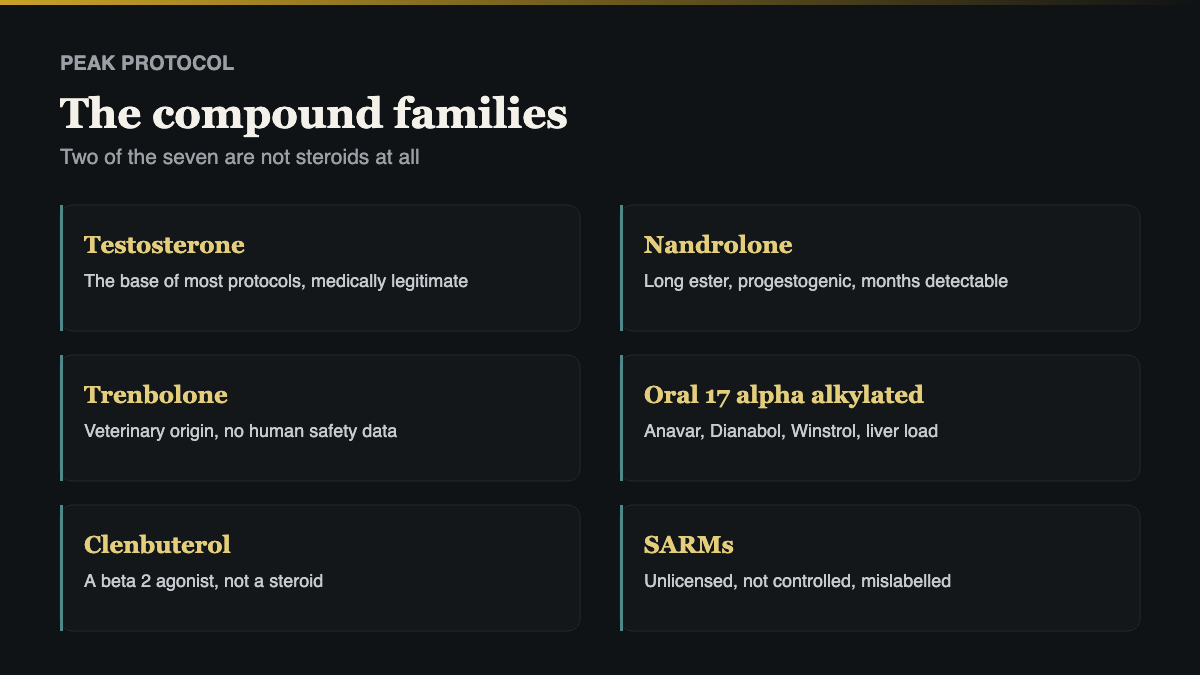
- Testosterone in its various esters, enanthate, cypionate, propionate and the Sustanon blend. The base of most protocols and the only one with a legitimate medical use at ordinary doses. See testosterone.
- Nandrolone, usually as decanoate and commonly called Deca. See nandrolone.
- Trenbolone, among the most potent and the most associated with sleep and mood effects. See trenbolone.
- Methandienone, commonly called Dianabol, an oral. See Dianabol.
- Oxandrolone, commonly Anavar, an oral with a reputation for being mild that is only partly deserved. See Anavar.
- Stanozolol, commonly Winstrol. See Winstrol.
Adjacent but not the same class: clenbuterol, which is a beta 2 agonist rather than a steroid, and SARMs, which are selective androgen receptor modulators and are not licensed medicines in the UK.
Oral against injectable anabolic steroids
The practical division that matters most is oral against injectable, because the risk profile differs.
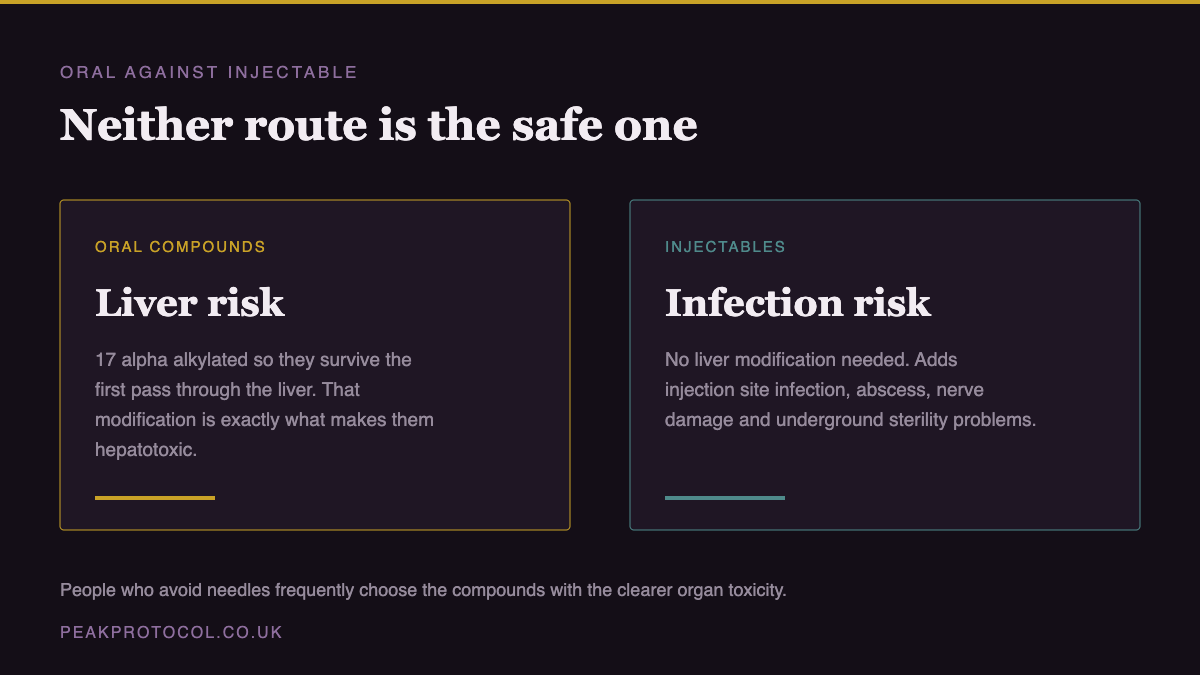
Oral compounds are usually 17 alpha alkylated, a chemical modification that lets them survive the first pass through the liver. That modification is precisely what makes them hepatotoxic. Markers of liver stress rise measurably on oral compounds in a way they generally do not on injectables, which is why bloodwork matters more, not less, for someone who thinks they are taking the safer option because there is no needle involved.
Injectables avoid the liver issue and introduce their own: injection site infection, abscess, nerve damage from poor placement, and in the illegal market, sterility problems from products made outside a clean room. See injection safety.
What a cycle of anabolic steroids means
A cycle is a period of use followed by a period off. The logic behind cycling is that continuous use produces continuous suppression, and periods off are intended to allow natural production to recover.
We are not going to publish protocols, doses or stacking guidance. That is the line between explaining something and instructing someone to do it, and we sit on the explaining side of it deliberately.
What is worth understanding is that the period after a cycle is when most of the difficulty happens. Natural production does not resume the moment the external supply stops, and the gap between the two is where the crash in mood, libido and strength that people describe actually comes from.
Where anabolic steroids stand under UK law
Possession for personal use is not a criminal offence in the UK. Supply, offering to supply, production and importation with intent to supply are, and supply carries up to fourteen years and an unlimited fine.
The detail on possession, supply and postal import is in UK steroid law.
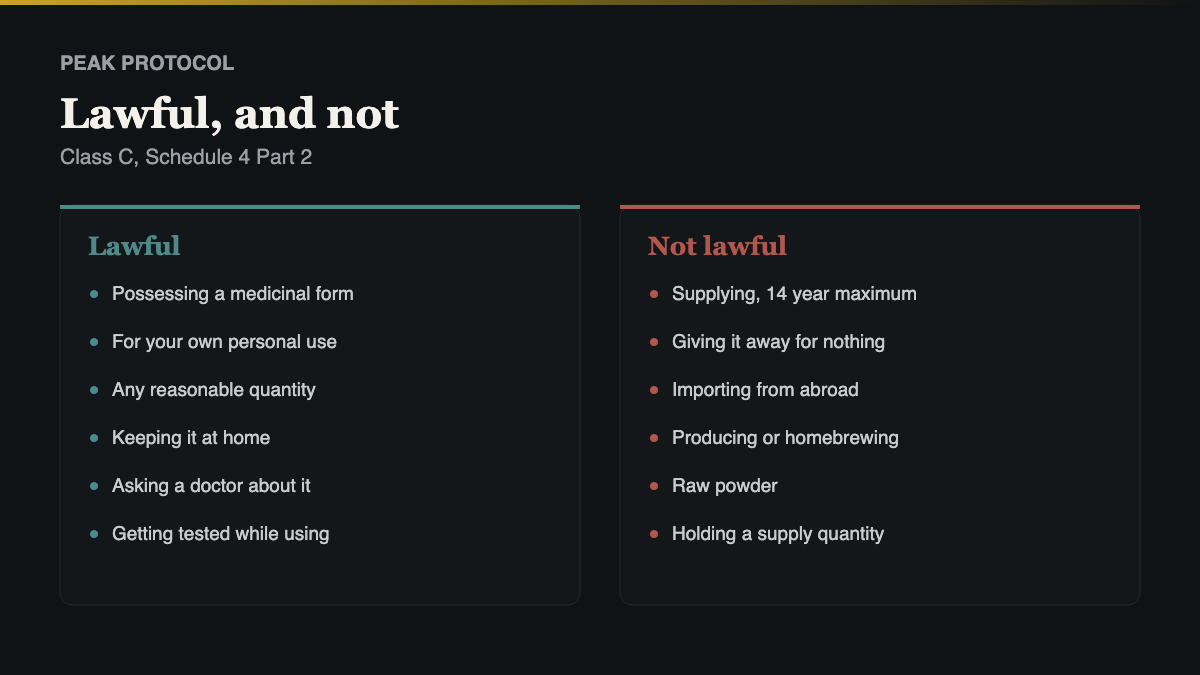
The distinction catches people out because supply in law does not mean dealing. Splitting a bulk order with a training partner is supply. The full picture is in are steroids legal in the UK, including how cases actually arise and what a conviction means afterwards.
What anabolic steroids do to the body
The effects people want are well known. The ones they do not are the reason this site exists.
Two of the most serious areas have their own guides: heart health and fertility.
Cardiovascular. Blood pressure rises, HDL cholesterol falls, and left ventricular changes are documented in long term users. This is the effect most likely to matter in the long run and the least visible in the short one.
Endocrine. Suppressed natural testosterone, testicular atrophy, and reduced fertility, which is reversible for many people and not for all.
Gynaecomastia. Breast tissue development, driven by aromatisation of testosterone to oestradiol. Once established it does not resolve without surgery. See gynaecomastia and steroids.
Hepatic. Liver strain, principally with oral compounds.
Dermatological and cosmetic. Acne, and accelerated male pattern hair loss in anyone genetically predisposed. See steroids and hair loss.
Psychological. Irritability, aggression, sleep disruption and, on stopping, low mood that can be severe. This one is consistently underweighted in discussions of risk.
The full picture is in steroid side effects. The NHS page on anabolic steroid misuse is a reasonable second source.
Who uses anabolic steroids in the UK
The stereotype is a competitive bodybuilder. The reality in the UK is broader and mostly younger: gym users with no competitive ambition at all, men in their twenties and thirties, and an increasing number of people whose motivation is appearance rather than performance.
Competitive athletes face separate rules, covered in anti-doping.
Needle exchange data has for years shown image and performance enhancing drug users making up a substantial share of clients, which is a useful indicator precisely because it counts people rather than opinions.
Understanding that matters because harm reduction written for competitive athletes misses most of the people who need it.
Stopping anabolic steroids, and what happens next
Coming off is the part that gets least attention and causes most of the trouble. Natural production is suppressed and takes time to recover, and during that window people commonly experience low mood, low libido, fatigue and rapid loss of the strength they gained.
That gap is also why people cycle back on sooner than they intended, which is how intermittent use becomes continuous use.
Anything sold as post cycle therapy medication, tamoxifen, clomifene or anastrozole, is a prescription only medicine in the UK. Buying it online is the same legal position as the steroids themselves. See coming off steroids and what to check on bloodwork.
The legal alternatives to anabolic steroids
If low testosterone is the actual problem rather than the assumed one, the legal route is a blood test and a proper assessment, and prescribed TRT is legal, monitored and available both on the NHS and privately.
If the goal is training performance, the honest list of things with evidence is short: creatine monohydrate, hitting your protein target, sleep, and consistency. That is genuinely most of it. We stock a deliberately narrow range in the shop, and several of the product pages tell you when a product will do very little for you.
What does not work is anything sold as a legal steroid. Those are food supplements with names chosen to imply otherwise, and we explain the category properly in legal steroids UK.
For confidential advice without judgement, TALK TO FRANK is the place to go.
How large is the anabolic steroids effect, really
Both sides of this conversation tend to exaggerate, so it is worth being specific.
The most cited controlled trial on the question, published in the New England Journal of Medicine in 1996, gave men either testosterone enanthate or placebo, with or without a training programme, over ten weeks. The group given testosterone without any training gained more lean mass than the group that trained on placebo. The group that did both gained most of all.
Two things follow from that, and people usually take only the one that suits them. The effect is genuinely large, considerably larger than any legal supplement produces, which is why the “just train harder” response does not persuade anyone who has read the literature. And the effect is not magic: the trained placebo group still gained, and the untrained testosterone group did not become a bodybuilder in ten weeks.
What that trial did not measure, because it ran for ten weeks at a supraphysiological but modest dose, is what happens over years at the doses actually used. That is the gap between the research and the practice, and it is where most of the harm sits.
The questions worth asking first
If you are weighing this up, these are more useful than another forum thread.
Have you actually tested? A large number of people who assume low testosterone have never had a morning blood test. Some of them turn out to be in range, and their problem is sleep, bodyfat, alcohol or stress. Some turn out to be genuinely low, in which case there is a legal, monitored route. See testosterone blood tests.
Do you want to keep the results? Gains dependent on continued use are lost when it stops. Deciding to use for one summer is really deciding between an eventual loss and continuing indefinitely.
Do you want children in the next few years? Fertility effects are real, usually reversible and not always. This is the consideration most consistently ignored by people in their twenties and most regretted by people in their thirties.
Who would you tell if something went wrong? If the answer is nobody, that is a risk in itself. Doctors treat this without judgement, and A and E does not report you.
Five mistakes that cause the most harm
The harm in this population rarely comes from ignorance that risk exists. It comes from five specific misreadings, and each one sends people somewhere different.
One, judging safety by feel. The effects you notice are acne, sleep and mood. The ones that shorten lives are silent: HDL collapse, rising haematocrit, creeping blood pressure. Nobody using anabolic steroids UK wide can feel any of those, which is why the blood test matters more than the mirror.
Two, trusting the label. Nothing on the British market has been inspected. Anavar is routinely substituted with cheaper compounds, injectables carry no sterility guarantee, and dosing in underground tablets is erratic. A hologram costs pennies to reproduce.
Three, treating supply as if it were selling. In law, supply means transferring to another person, and money is irrelevant. Splitting an order carries the same fourteen year maximum as dealing.
Four, ignoring duration. Time on drives suppression, cardiac remodelling and the difficulty of recovery far more than the weekly dose does. People running anabolic steroids UK wide for years at modest doses often end up worse off than someone who ran one short course.
Five, hiding it from a doctor. Clinicians who see this regularly have heard all of it and will not report you. Withholding the history is the single commonest reason monitoring catches nothing useful.
What to do next
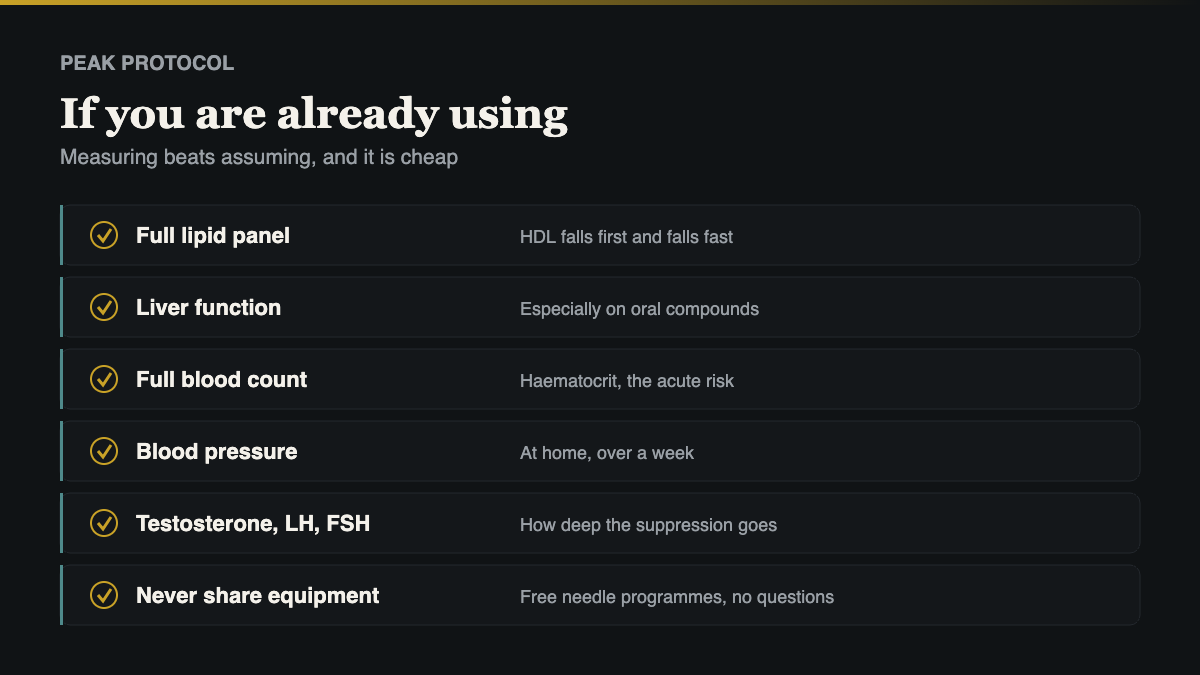
There is a short, cheap sequence that turns anabolic steroids UK risk from an unknown into something managed, and none of it requires you to stop first.
Measure the four that matter. A full lipid panel, liver function, a full blood count for haematocrit, and blood pressure taken at home across a week. Between them they cost less than a month of most people’s supply. Our guide to steroid blood tests works through each one, and steroid side effects covers what they are looking for.
Get compound specific. The generalisations about anabolic steroids UK wide stop being useful once you know what is actually in front of you. Anavar, Dianabol, Winstrol, trenbolone and nandrolone each have their own profile, and two things sold alongside them, clenbuterol and SARMs, are not anabolic steroids at all.
Know the legal line. Possession of a medicinal form is lawful, supply and importation are not. Are steroids legal in the UK sets out where the line sits and how cases actually arise.
And know what stopping involves before you need to. A good share of the worst of it appears on the way down. Coming off steroids is honest about the timeline. If the underlying issue is a genuine deficiency rather than performance, how to get TRT in the UK is the lawful, supervised route.
Anabolic steroids: common questions
What is the difference between anabolic steroids and the steroids a doctor prescribes?
Usually the doctor means corticosteroids, which are anti inflammatory drugs such as prednisolone with a completely different mechanism. Anabolic steroids are testosterone derivatives.
Are anabolic steroids illegal in the UK?
Possession for personal use is not an offence. Supply, production and importation with intent to supply are, with a maximum of fourteen years for supply.
Do anabolic steroids work without training?
They produce some effect without training, but the meaningful results come from the combination. The main advantage is recovering fast enough to train harder more often.
Are orals safer than injections because there is no needle?
No. Oral compounds are chemically modified to survive the liver, and that modification is what makes them hepatotoxic. The risk is different, not smaller.
How long does it take to recover natural testosterone after stopping?
It varies widely between individuals and with how long and how heavily someone used. Bloodwork is the only way to know where you actually are rather than guessing.
Are anabolic steroids UK legal to possess?
Yes, in a medicinal form for your own personal use. They are Class C but sit in Schedule 4 Part 2, which exempts personal possession. Supplying them carries up to fourteen years and importing them is a separate offence.
What is the most dangerous part of using anabolic steroids UK wide?
The cardiovascular effects, because they are silent and cumulative. HDL cholesterol falls within weeks, haematocrit rises, and blood pressure climbs, none of which produces a symptom until it produces a serious one.
Can you tell if anabolic steroids are real without testing them?
No. Nothing on the British market has been inspected, and packaging, holograms and verification codes are all trivially reproducible. In Wales, WEDINOS will analyse a submitted sample free and anonymously, which is the only route to an actual answer.