

This FAQ answers the questions we are actually asked, in the order people ask them: the law first, then what supplements do, then TRT, then the practical business of ordering from us.
Every answer in this FAQ is written to be useful rather than to move stock. Several of them tell you not to buy something, and one of them tells you to see a doctor instead of reading any further here.
On this page
- FAQ: UK law
- FAQ: what supplements actually do
- FAQ: TRT and testosterone
- FAQ: ordering, payment and delivery
- FAQ: trusting this site
- FAQ in one table
- FAQ: reading the evidence yourself
- How this FAQ was built
- FAQ: spotting nonsense elsewhere
- Answers that have changed
- How to ask a better question
- How to use this FAQ
- What this FAQ does not cover

FAQ: UK law
Are steroids legal in the UK?
Anabolic steroids are Class C drugs under the Misuse of Drugs Act 1971. Possession for personal use is not an offence, because they sit in Schedule 4 Part 2 in a medicinal form. Supply, production and importation are offences carrying up to fourteen years. That gap between possession and supply is the single thing this FAQ gets asked to clarify most.
Is importing them for personal use legal?
No, and this is where people come unstuck. The personal possession position does not extend to bringing them into the country. Importation is treated as supply, and ordering from an overseas site is importation. Our law guide sets out the detail.
Do you sell anabolic steroids?
No, and we never will. Every product on this site is a legal food supplement. The guides covering controlled substances exist because people search for accurate information, not because there is anything to sell at the end of them.
What about SARMs?
None are licensed for human use in the UK. Selling them for human consumption is unlawful, suppression of natural testosterone is real rather than theoretical, and independent testing has repeatedly found products mislabelled. We do not stock them.
Is it illegal to read about this?
No. Information is not an offence and this FAQ is not a grey area. What is regulated is supply, production and importation, not knowing how something works.
FAQ: what supplements actually do
Do legal steroids work?
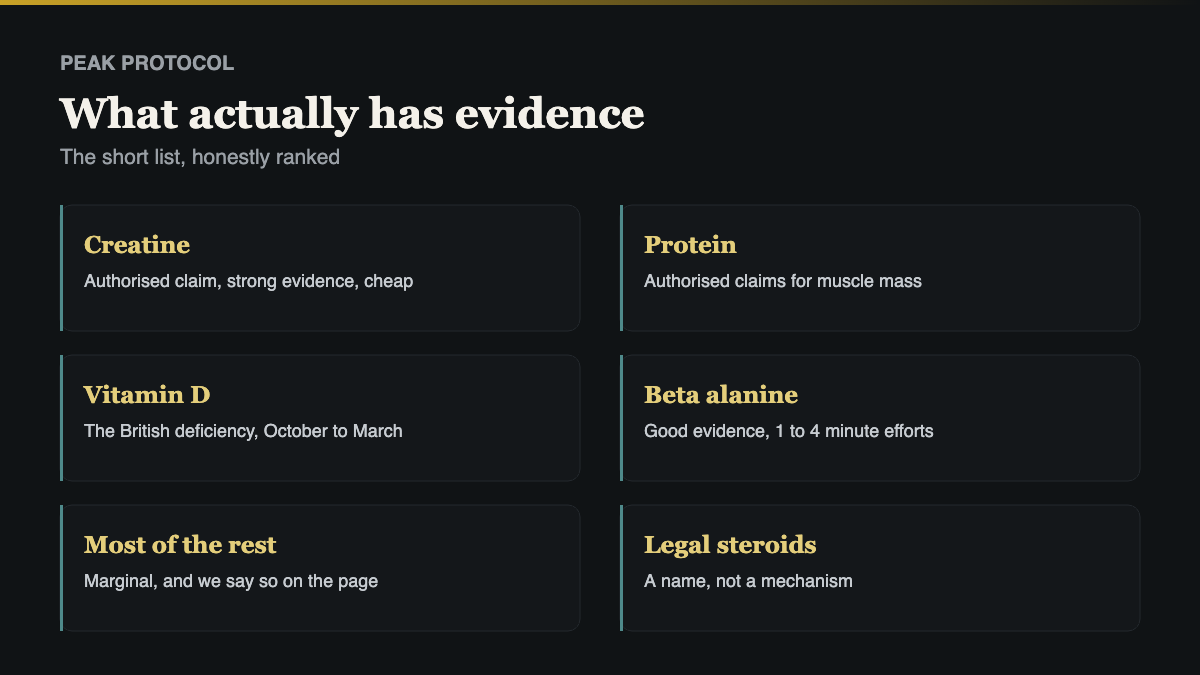
There is no such thing. The phrase describes supplements named to resemble controlled substances, and nothing sold legally in Britain behaves like one. We do not use the term on any product page and it sits outside UK advertising rules as well.
So what does work?
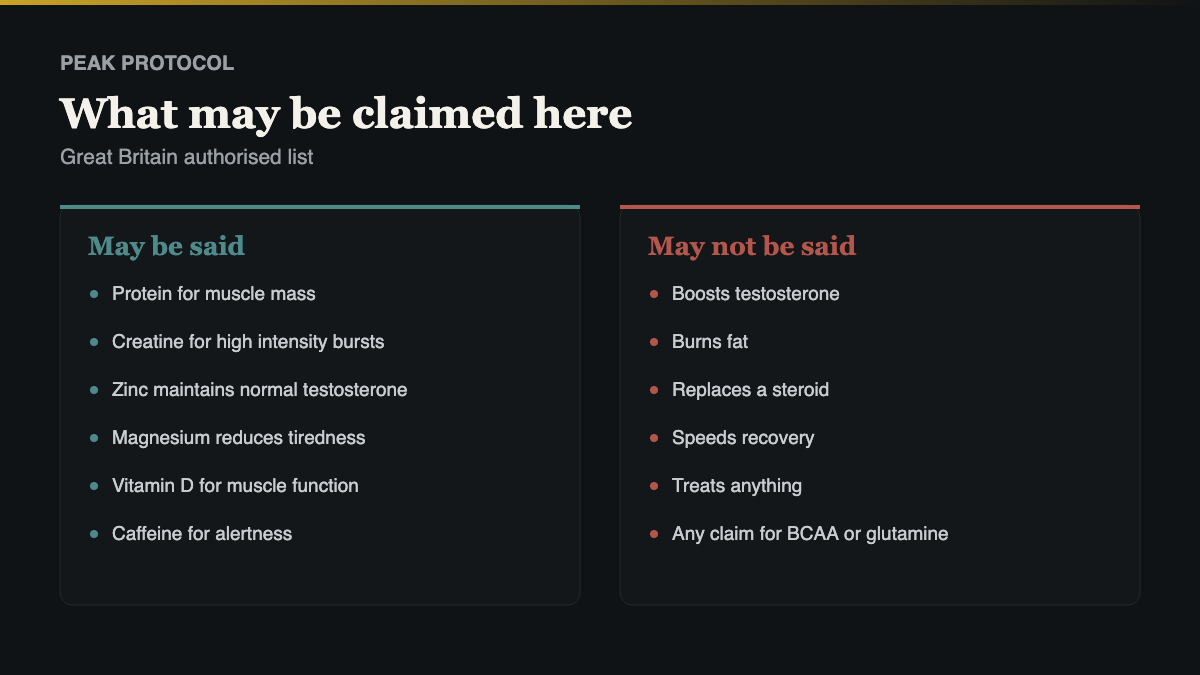
A short list. Protein closes a dietary gap. Creatine improves repeated high intensity efforts and has an authorised claim at three grams a day. Vitamin D corrects the deficiency most British adults have in winter. Beta alanine helps in a narrow one to four minute window. That is most of it, and it is all inexpensive.
Why do some of your product pages talk the product down?
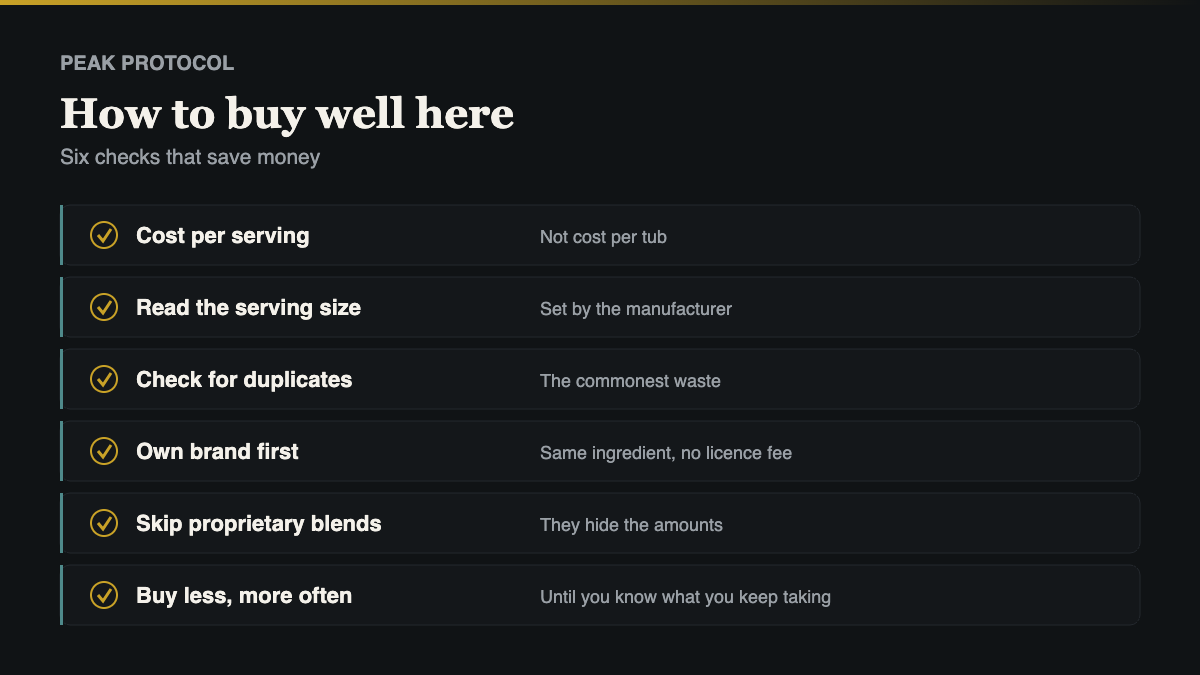
Because the evidence behind some categories is thin, and a page that hides that sells you something you will not buy twice. This FAQ takes the same approach. We would rather lose one sale than lose the reader.
Can a supplement raise my testosterone?
It can correct a shortfall, which is not the same thing. Zinc and vitamin D matter if you are low in them and do nothing measurable if you are not. No legal supplement produces the change a prescription does, and any page implying otherwise is selling you something.
Are your products tested for contamination?
Formulations contain nothing prohibited, but no brand can promise a clean batch without batch testing, and we do not currently run a certification programme. If you compete under anti doping rules, follow UK Anti-Doping guidance and use batch tested products.
Why are your claims so cautious?
Because only wording on the Great Britain nutrition and health claims register may lawfully be used, and only where the product delivers the required amount. A competitor making bolder claims is usually outside the register rather than better informed.
FAQ: TRT and testosterone
What is TRT and is it legal?
Testosterone replacement therapy is a prescribed treatment for diagnosed low testosterone. It is entirely legal with a prescription and it is a medicine rather than a supplement. Our TRT guide covers how it is actually assessed in Britain.
I think my testosterone is low. What should I do?
Get a blood test before anything else, taken in the morning, and repeat it before treating a single result as a diagnosis. The blood test guide explains what to ask for. This is the one FAQ answer that ends with see a doctor and means it.
Can I get TRT on the NHS?
Yes, where it is clinically indicated and confirmed by repeat testing. Access varies by area, which is why we publish fifteen city guides rather than one national answer.
Will a supplement do instead of TRT?
No. If you have clinically low testosterone, a supplement is not a substitute for treatment. If you do not, you do not need either.
FAQ: ordering, payment and delivery
How do I pay?
Nothing is charged at checkout. You place the order, contact support with the order number, and we send the payment details for a bank transfer. How to pay covers every step and explains why the details are not published on the site.
Do you take cards?
Not yet. Card processing is being set up and this FAQ will change the day it goes live.
How long does delivery take?
Orders paid before the afternoon cut off are dispatched the same working day, tracked as standard, in plain outer packaging. The estimate is shown at checkout before you pay.
Is the packaging discreet?
Yes. Nothing on the outside indicates the contents and the billing descriptor is equally unremarkable. That applies to every order rather than being an option.
Can I return something?
Unopened supplements can go back within fourteen days. Opened ones cannot, for hygiene reasons that apply across the industry, unless they are faulty. Shipping and returns has the detail.
Do you ship outside the UK?
Orders are handled for delivery within the United Kingdom.
FAQ: trusting this site
Who writes this?
The Peak Protocol editorial team, working from primary sources: legislation, the NHS, Talk to Frank and peer reviewed research. Our experts covers the people and the gap we are honest about.
Is the content medically reviewed?
Not yet, and we say so rather than implying otherwise. A qualified reviewer registered with the GMC or GPhC is being appointed, and until then health pages carry a notice. We would rather show an incomplete page than a fabricated credential.
Why does a shop publish harm reduction material?
Because people make these decisions either way, and the version with accurate information goes better. Withholding it does not prevent use, it moves the reader to a worse source.
Do you accept paid placements or sponsored posts?
No. Nothing on this site is paid for by a manufacturer, and no brand has ever paid to appear or to be described in a particular way. Our editorial policy sets out the commercial rules.
What do I do if I find a mistake?
Tell us through the contact page with the page and what you think is wrong. It goes to whoever wrote it, and corrections are made in the open rather than quietly.
FAQ in one table
If you want the whole FAQ compressed, this is it.
| Question | Short answer |
|---|---|
| Are anabolic steroids legal to possess in the UK? | Possession for personal use is not an offence. Supply and importation are |
| Do you sell them? | No, and we never will |
| Do legal steroids exist? | No. The phrase describes supplements named to resemble them |
| What actually works? | Protein, creatine, vitamin D, and beta alanine in a narrow window |
| Can a supplement replace TRT? | No. If you are clinically low, that is a prescription question |
| How do I pay? | Bank transfer, arranged after you order. Nothing is charged at checkout |
| How fast is delivery? | Same working day dispatch before the cut off, tracked, plain packaging |
| Can I return an opened tub? | Only if it is faulty. Sealed goods rules apply across the industry |
| Is the content medically reviewed? | Not yet, and every health page says so |
| Do brands pay to appear here? | No. Nothing on this site is paid placement |
FAQ: reading the evidence yourself
How do I tell a good supplement study from a bad one?
Three checks get you most of the way. How many people were in it, whether there was a placebo group, and whether the outcome measured is the one being claimed. A study of twelve people with no placebo arm measuring a blood marker is not evidence that something builds muscle.
Why does the same ingredient get opposite headlines?
Usually because one story reports a mechanism and the other reports an outcome. A compound can do something interesting in a test tube and nothing measurable in a person, and most supplement marketing lives in that gap.
What does an authorised health claim actually mean?
That the evidence was assessed and the wording was approved for use at a specified intake. It is a meaningful bar and very few sports ingredients clear it. The Food Standards Agency explains the framework.
If something has no authorised claim, is it useless?
Not necessarily, but it means nobody has demonstrated an effect to the standard the register requires. Treat the absence as a signal about the strength of the evidence rather than as a technicality, which is how this FAQ treats it.
Who should I believe about dosing?
The published trials, then the label. Not a forum, not an influencer, and not a product page that declines to state an amount. Where a dose on this site differs from the research, the product page says so.
How this FAQ was built
Every question on this page was asked by somebody, usually more than once. None were invented to fill a page or chosen because a keyword tool suggested them, which is why several have nothing to sell at the end of the answer.
They came from three places. Emails to the contact address, which is where the legal questions and the worried questions arrive. Analytics, which shows which guides people land on and leave immediately, usually because the thing they wanted was buried. And the questions we could not answer quickly ourselves, which turned out to be the most useful category of all.
Answers in this FAQ are reviewed when the underlying facts move rather than on a schedule, so an entry about the law is rewritten when the law changes rather than refreshed annually for appearances.
FAQ: spotting nonsense elsewhere
The most useful thing this FAQ can give you is not an answer but a filter, because you will read a hundred pages elsewhere for every one of ours.
Treat the phrase legal steroid as a full stop. It is meaningless, it sits outside UK advertising rules, and a site using it has told you what it is. Treat before and after photographs the same way, since they demonstrate training, diet, genetics, lighting and sometimes drugs, and never a supplement.
Check whether a claimed study was in humans or in cells, because the gap between those gets collapsed constantly. Check whether the dose in the research matches the dose in the tub, which is where most ingredient stories quietly fall apart. And notice whether the site is ever willing to say a product does not work, because a shop where everything works has told you nothing.
Those five checks sort most of the industry in under a minute each, and they apply to this FAQ as much as to anybody else’s.
Answers that have changed
Three answers in this FAQ have been rewritten since the site launched, and it is worth saying which rather than quietly replacing them.
The pricing answers changed after we found seventeen products carrying an import placeholder rather than a real price, which we corrected and said so. The answer about medical review was rewritten to say plainly that there is no named reviewer yet, replacing a vaguer earlier version. And several product answers were shortened once we accepted that the honest response was that the evidence is thin.
An FAQ that never changes is either about nothing or is not being checked. If an answer here looks wrong to you, the contact page reaches the person who wrote it.
How to ask a better question
If this FAQ has not answered what you came for, the way the question is framed usually decides how useful the answer can be, here or anywhere else.
Questions of the form is this good tend to produce marketing. Questions of the form what dose was used in the research, and how does that compare with this tub, produce an answer somebody can check. The second kind is also much harder to fudge, which is exactly why it is worth asking.
For anything about your own body, the right question goes to a GP or a pharmacist rather than to an FAQ. We will say that plainly every time, including when it costs us the sale, and it is the single most common answer we give to messages that arrive here.
How to use this FAQ
Read the section that matches your question rather than the whole page. The law section is the one worth reading in full if you are weighing up anything controlled, because the consequences there are not reversible and the summaries elsewhere on the internet are frequently wrong.
Every answer in this FAQ links to the primary source behind it, and following one of those links is worth more than reading three more answers. Where an answer says we cannot verify something, that is the literal position rather than a hedge.
The guide library goes considerably deeper on everything summarised here, and the table above is the fastest route if you already know roughly what you are after.
What this FAQ does not cover
Three things sit deliberately outside this FAQ, and it is worth being explicit about each.
Dosing anything controlled. The guides explain what a compound does and what it risks. They stop before telling you how to take it. No FAQ answer here will move that line and asking through the contact page will get the same reply.
Medical advice about you. Nothing on this site, in this FAQ or anywhere else, is advice about your situation. It cannot be, because we cannot see your history, your medication or your blood results. Our medical disclaimer states that in full and the MHRA regulates the medicines this site deliberately does not sell.
Where to buy anything illegal. We do not know and would not say. That is not a position we are going to be argued out of, however the question is phrased.
For anything this FAQ does not answer, the guide library covers the subject matter at length and the contact page reaches a person within a working day.