Testosterone in the UK: esters, law and what it actually does
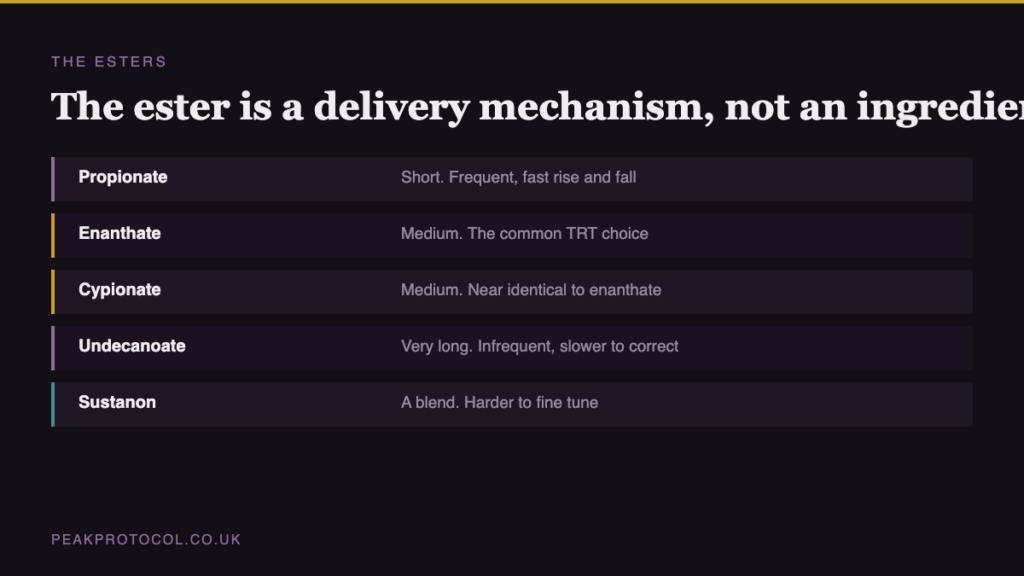
What testosterone is, how the esters differ, where UK law sits, and the difference between a replacement dose and a supraphysiological one.

TRT is where legitimate medicine and the grey market sit closest together, which is exactly why it attracts so much bad information. A man with genuine hypogonadism and a man who read a symptom list at 2am are having very different conversations, and the private clinic market is not always careful about the difference.
These guides cover who actually qualifies, what the NHS route looks like, what private TRT costs and what a testosterone result means. We sell no hormones and have no clinic to refer you to.
On this page

Testosterone replacement therapy is prescribed treatment for hypogonadism, meaning a body that does not produce enough testosterone for normal function. It is replacement rather than enhancement, and that distinction is doing a lot of work.
Done properly it restores a level to the normal range and is monitored. Done as enhancement it takes a normal level above the range, which is a different intervention with a different risk profile whatever the clinic calls it.
Six guides sit here. TRT in the UK is the overview. How to get TRT walks the actual process step by step, and TRT cost and clinics sets out where the money goes.
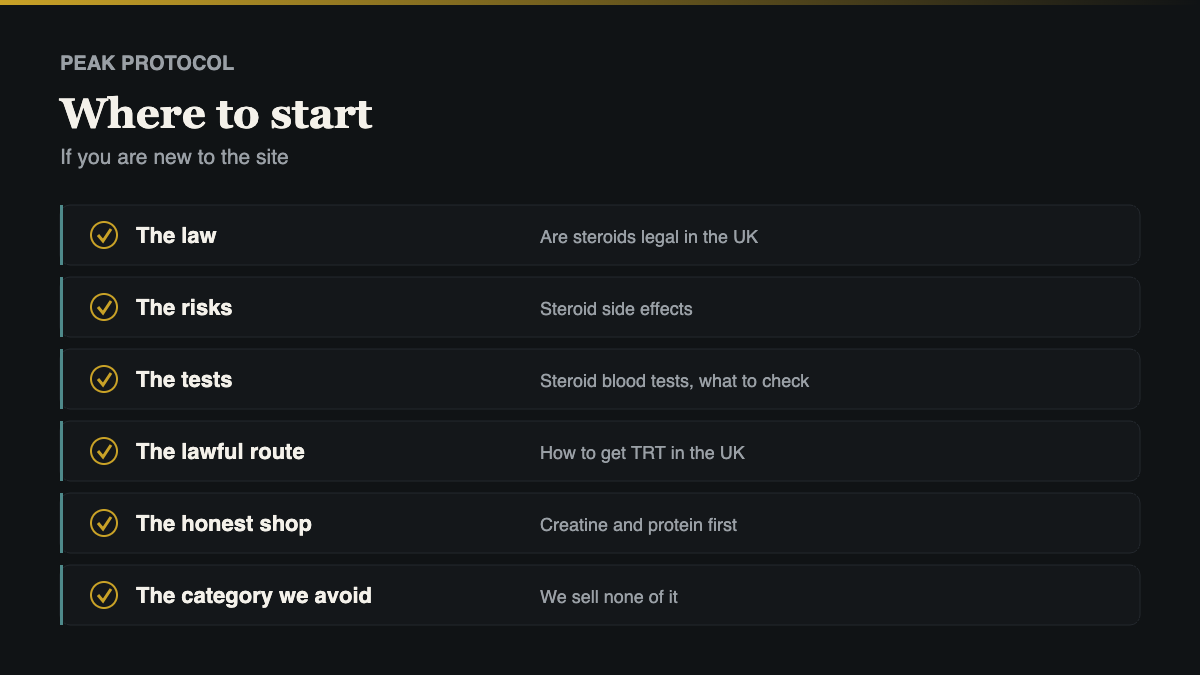
Testosterone blood test UK explains what to ask for and how to read the result, low testosterone symptoms separates the specific from the universal, and testosterone in the UK covers the esters and the legal position.
Diagnosis needs two things together: symptoms consistent with testosterone deficiency, and two separate morning blood tests showing a low level. One low reading is not a diagnosis, and symptoms without biochemistry are not either.
The reason for two morning tests is that testosterone varies by time of day and between days. A single afternoon sample can read low in a man whose morning level is entirely normal, and that artefact is responsible for a great many unnecessary TRT prescriptions.
| Situation | What it usually means |
|---|---|
| Two morning readings clearly below range, with symptoms | Genuine case for TRT |
| One low afternoon reading | Repeat it properly before concluding anything |
| Low reading, high body fat, poor sleep | Treat those first and retest |
| Normal reading, strong symptoms | The symptoms have another cause worth finding |
| Borderline reading, no symptoms | No treatment indicated |
| Low reading while using anabolic steroids | Suppression rather than hypogonadism |
The symptom lists used in TRT marketing are close to useless because they are universal. Tired, low mood, poor concentration and reduced motivation describe deficiency, and also describe poor sleep, stress, depression, thyroid problems and ordinary life.
The more specific signals are loss of morning erections, reduced spontaneous libido rather than performance anxiety, loss of body hair, shrinking testicles and gynaecomastia. Those point at the endocrine system rather than at everything at once.
Our symptoms guide goes through them one at a time and is the most useful page here if you are trying to decide whether to get tested at all.
A testosterone test done badly is worse than no test, because it produces a number that then gets acted on. Doing it properly is not complicated.
Fasted, between 8am and 11am, on two separate days. Ask for total testosterone, SHBG, LH, FSH, albumin and prolactin rather than total testosterone alone, because free testosterone is calculated from those and LH tells you whether the problem is in the testes or above them.
Illness, recent heavy training and poor sleep all lower a reading temporarily, so do not test in the middle of any of them.
It is slower and it is free, and it comes with something the private route often does not: a search for the cause before the prescription.
A GP takes the bloods, repeats them, and refers to endocrinology where results support it. An endocrinologist looks for why the level is low, which matters because the answer is sometimes a pituitary problem that needs treating in its own right.
The criticism of this route is the wait, and it is fair. The criticism of skipping it is that a treatable cause goes undiagnosed and you are on TRT for life instead.
Private TRT clinics fill a real gap and a good number are careful. The structural problem is that a clinic which concludes you do not need treatment earns nothing, and that incentive does not disappear because a doctor is involved.
Signs a clinic is worth using: two morning tests before any prescription, a full hormone panel, a named GMC registered doctor, a discussion of fertility, and monitoring included rather than sold separately. Signs it is not: a diagnosis from one afternoon sample, a symptom questionnaire in place of biochemistry, and a subscription before a consultation.
Our cost guide breaks down where the money actually goes, which is mostly consultations and monitoring rather than the drug itself.
This is the part of the conversation most often skipped, and it deserves to be the loudest.
Starting exogenous testosterone suppresses your own production. In a man who was genuinely deficient, that costs little because there was not much to suppress. In a man whose level was low normal and treatable by other means, it converts a soft problem into a permanent dependency.
Coming off after a long period is difficult and recovery is not guaranteed. TRT is a lifetime commitment far more often than it is a trial, and it should be entered as one.
TRT suppresses sperm production, frequently to zero. For anyone who may want children, that is the first question rather than a footnote, and a responsible prescriber raises it before you do.
There are alternatives that raise testosterone without shutting down the axis, and there are options for preserving fertility alongside treatment. Both require a clinician who is thinking about it, which is another reason the endocrinology route has value.
Being on TRT properly means being measured. Haematocrit is the main one, because testosterone raises red cell production and thickened blood carries a real clot risk. PSA, lipids, blood pressure and oestradiol round out the panel.
Monitoring is usually quarterly in the first year and then less often. A clinic that prescribes without it is selling a hormone rather than providing treatment, and that distinction is the whole of what separates good TRT from bad.
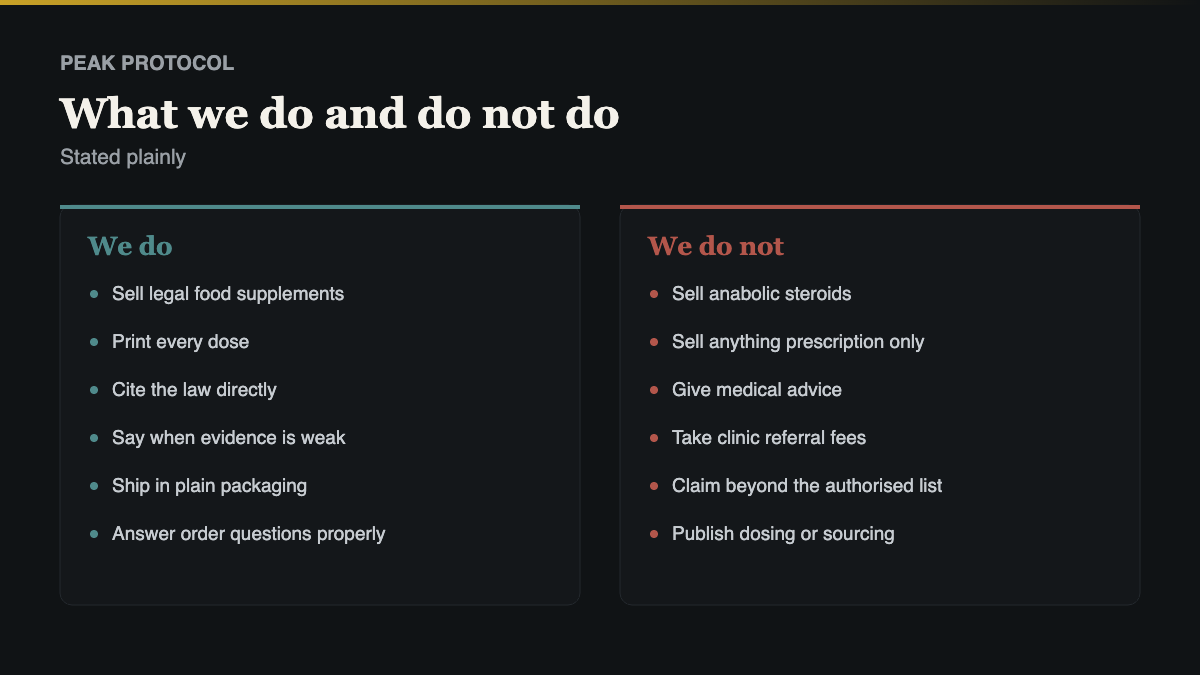
We sell no hormones and cannot prescribe anything. Where a level is genuinely low, the answer is a clinician rather than a supplement, and no product in our range moves testosterone in the way TRT does.
Where the level is normal and the goal is supporting it, the testosterone support range covers what has evidence behind it, which is mostly correcting vitamin D, zinc and magnesium shortfalls where they exist. Our legal steroids guide explains why the rest of that category promises more than it delivers.
A meaningful share of low readings are not primary hypogonadism at all. They are the consequence of something else, and that something else is usually treatable without a lifetime prescription.
Sleep is the biggest one. Testosterone is produced largely during sleep, and chronic short sleep or untreated sleep apnoea lowers it substantially. Body fat is the second: adipose tissue converts testosterone to oestrogen, so losing a significant amount of it raises the reading on its own. Severe calorie restriction, overtraining, chronic stress, opioid painkillers and some antidepressants all suppress it too.
None of that is a reason to dismiss a genuine deficiency. It is a reason to retest after addressing the obvious, because TRT started on a reading that would have corrected itself is a decision that cannot be easily undone.
Plenty of men self administer testosterone bought outside the medical system, and pretending otherwise would be dishonest. It is worth being clear about how that differs from TRT.
It is not TRT, it is unsupervised use of a prescription only medicine. The product is unverified, the dose is usually higher than replacement, and nothing is monitored, which removes the single most valuable part of treatment. Haematocrit in particular can rise to a dangerous level without producing any symptom at all.
We do not point anyone towards a source, and our harm reduction guides cover what can be measured for anybody already in that position. Possession for personal use is not an offence here, so a GP conversation carries no legal risk.
Expectations decide whether treatment feels successful, and the marketing sets them far too high. Here is the honest version for a man who was genuinely deficient.
Libido and morning erections usually improve within weeks and are the most reliable response. Energy and mood often improve, though less predictably, and some of that is the relief of having an explanation. Body composition shifts slowly over months and only alongside training and food. Bone density improves over years.
What TRT does not do is turn an average physique into a competitive one, fix a marriage, or replace sleep. Men who expected those tend to conclude that the dose is too low, and that is the point at which replacement quietly becomes enhancement.
Two morning blood tests below the reference range, alongside symptoms consistent with deficiency. One test is never enough and symptoms alone are not either.
Yes, where the criteria are met. It is slower than private treatment and it includes looking for the underlying cause, which has real value.
The drug can be the same. The dose and the intent are not. Replacement restores a normal level; enhancement pushes above it.
Sometimes, but recovery is unpredictable and can take a long time. Treat it as a permanent commitment when you decide.
Yes, usually significantly. Raise it before starting if children are a possibility, because there are alternatives that preserve it.
Many are. The structural incentive runs towards prescribing, so look for two morning tests, a full panel, a named GMC registered doctor and monitoring included.
Our medical disclaimer applies to everything here: these guides are information rather than advice. The NHS is the place to start.
What testosterone is, how the esters differ, where UK law sits, and the difference between a replacement dose and a supraphysiological one.
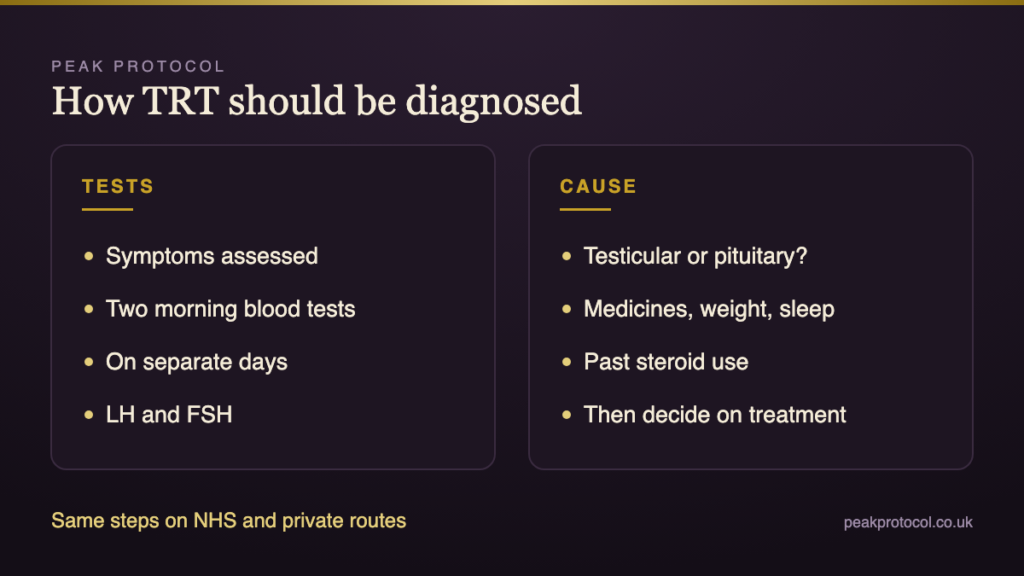
NHS vs private TRT is less a choice between good and bad care than a trade between time, cost and thresholds. Both routes can prescribe testosterone replacement therapy for men with a genuine deficiency, and both should follow the same basic steps: symptoms, repeated morning blood tests, a search…
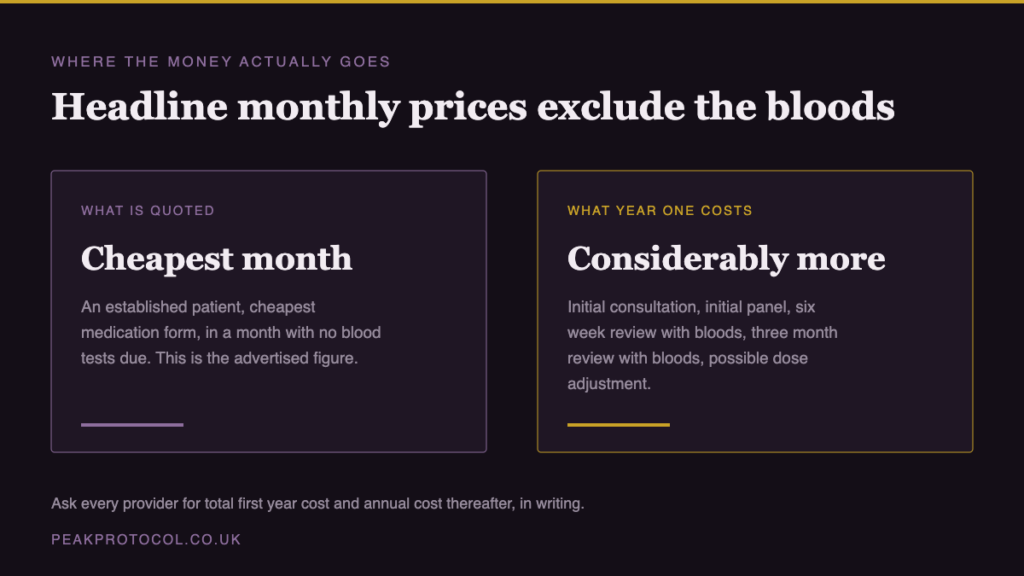
How TRT pricing is structured, why headline monthly figures mislead, and the six questions to ask a clinic before you pay anything.
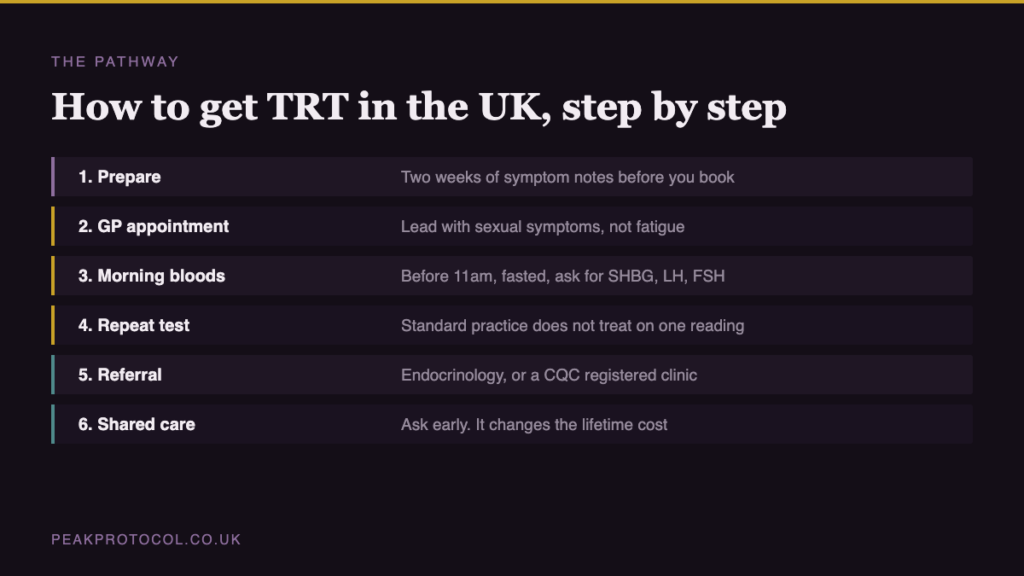
The practical route on the NHS and privately, what to say to your GP, what to do if you are refused, and how shared care changes the cost.
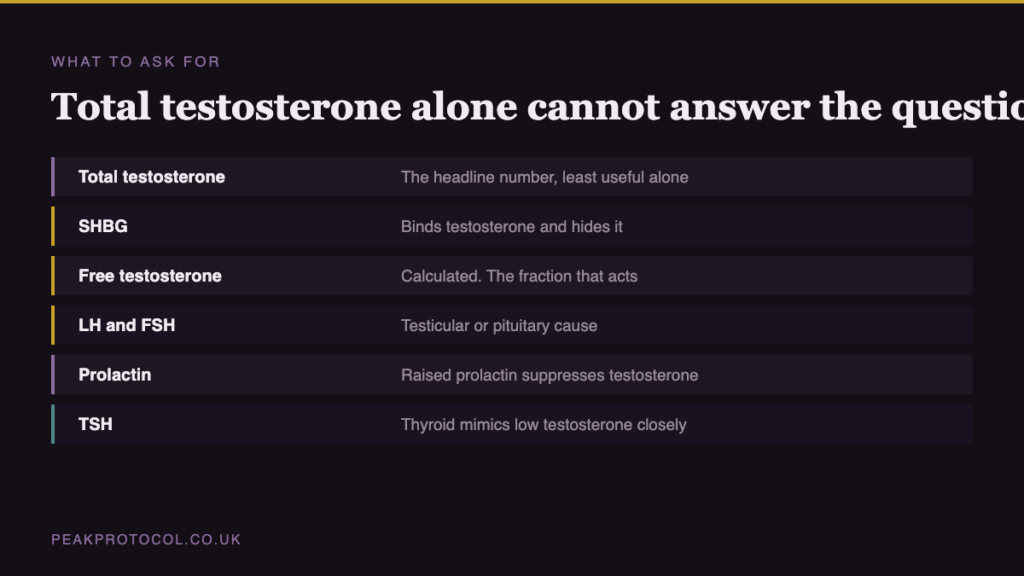
Which markers to request, why morning timing decides your result, and why total testosterone alone cannot answer the question.
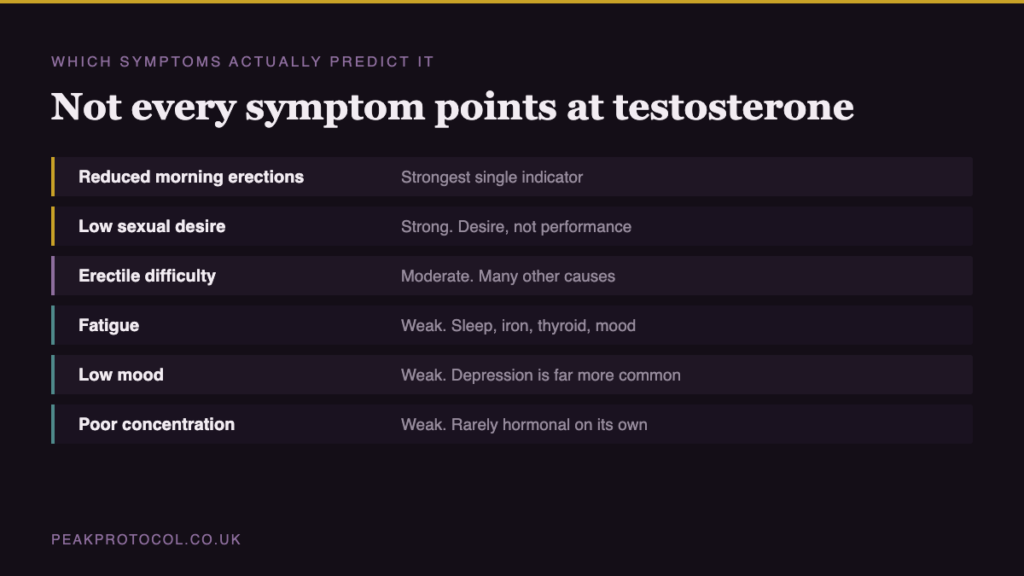
Which symptoms genuinely predict low testosterone and which barely discriminate at all, plus the seven conditions that produce an identical list.
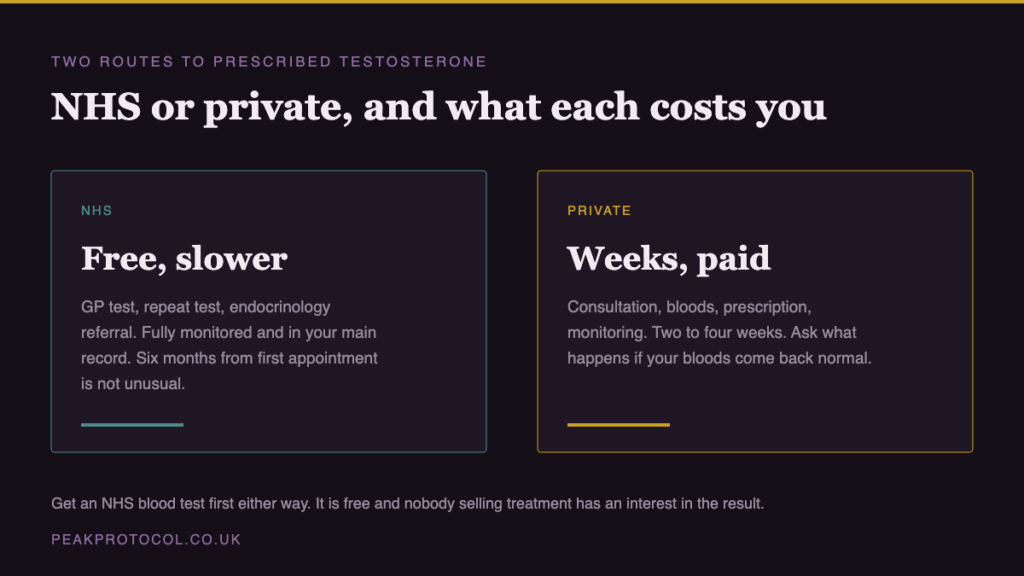
What testosterone replacement is, who it suits, how diagnosis works, and how to tell a proper clinic from one that is simply selling testosterone.