
Class C drugs UK law covers the third and lowest tier of the Misuse of Drugs Act 1971, and it is the tier that matters most to anyone reading this site, because anabolic steroids sit in it. Class C carries the lowest maximum penalty for possession of the three classes, two years rather than seven, and that single fact has produced a great deal of confident nonsense about what you can and cannot do.
The reality is more specific and more interesting. Class C possession carries two years, Class C supply carries fourteen, which is identical to Class B. And anabolic steroids sit under a further exemption that makes personal possession no offence at all. This page sets out the full list, the real penalties, and the six things people most often get wrong.
What this guide covers
- What Class C actually means
- The full list of Class C drugs
- Class C penalties in full
- Anabolic steroids and the Schedule 4 exemption
- Benzodiazepines and the counterfeit problem
- Pregabalin and gabapentin since 2019
- What has left Class C
- Six things people get wrong
- What happens if you are caught
- Class C drugs and driving
- Class C at work and in sport
- Common questions
What Class C actually means
The three classes under the Misuse of Drugs Act 1971 are a sentencing framework. Class C is the tier Parliament judged least harmful of the controlled substances, which is a statement about relative policy rather than a statement about safety. Being in Class C does not mean a drug is mild, and several Class C substances kill people every year in the UK.
The full system, including how the classes relate to the separate schedules that govern medical use, is set out in our guide to the classification of drugs in the UK.
The full list of Class C drugs
Class C is a broader and stranger category than most people expect. It holds muscle building compounds, prescription sedatives, nerve pain medication and a plant chewed in parts of East Africa, all under the same heading.
- Anabolic steroids and anabolic agents. Testosterone and its esters, nandrolone, boldenone, stanozolol, oxandrolone, trenbolone and the rest of the family, along with clenbuterol and selective androgen receptor modulators marketed as research chemicals.
- Growth hormone. Human growth hormone and related peptides, which sit alongside the anabolic agents.
- Benzodiazepines. Diazepam, temazepam, alprazolam, nitrazepam, lorazepam and the rest of the class, whether prescribed or bought.
- Z drugs. Zopiclone and zolpidem, prescribed for insomnia.
- Pregabalin and gabapentin. Controlled since April 2019 after a sharp rise in deaths where they were present.
- Khat. Controlled since June 2014.
- Piperazines. Including BZP, the former legal high.
- Buprenorphine. Used in opioid substitution treatment.
Class C penalties in full
| Offence | Class C maximum | Class B for comparison |
|---|---|---|
| Possession | 2 years and an unlimited fine | 5 years and an unlimited fine |
| Possession with intent to supply | 14 years and an unlimited fine | 14 years and an unlimited fine |
| Supply or offering to supply | 14 years and an unlimited fine | 14 years and an unlimited fine |
| Production | 14 years and an unlimited fine | 14 years and an unlimited fine |
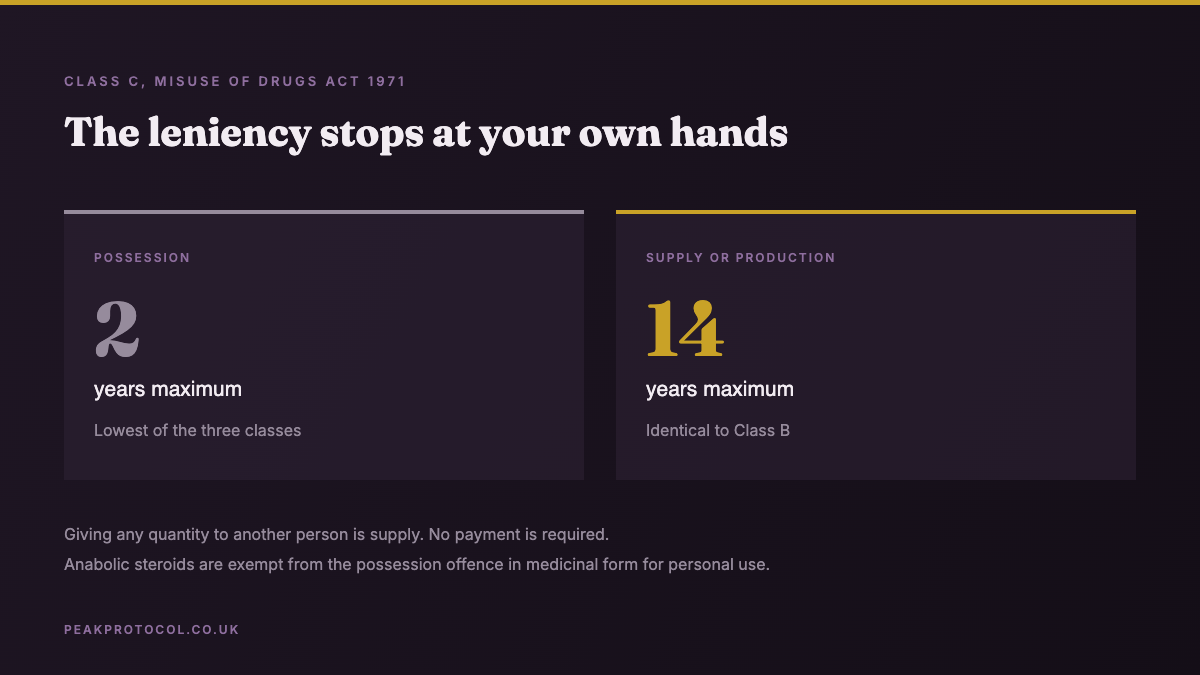
The comparison column is the point. People treat Class C as the lenient tier because of the possession figure, and for possession they are right. For everything else Class C and Class B are identical. The leniency stops the moment a drug moves from you to somebody else.
Anabolic steroids and the Schedule 4 exemption
Anabolic steroids are Class C, and they are also Schedule 4 Part II of the Misuse of Drugs Regulations 2001. That second placement is what makes them behave unlike every other drug on the list.
The effect is that possession of an anabolic steroid in medicinal form, for your own personal use, is not an offence. No other Class C drug gets that treatment. Diazepam bought without a prescription is a possession offence. Testosterone in a vial in your bag, for you, is not.
Three conditions carry the whole exemption, and all three have to hold. It must be in a medicinal product form, it must be in your possession, and it must be for your own use. Raw powder is not a medicinal form. Holding a friend’s vials is not your possession for your own use. Splitting an order is supply, and supply is the fourteen year offence.
Importation is the other trap. Buying from an overseas website is importing, and personal importation by post has produced prosecutions even where the quantity was small. We cover the whole position in are steroids legal in the UK and the compound detail in anabolic steroids in the UK.
Benzodiazepines and the counterfeit problem
Benzodiazepines are the Class C drugs doing the most harm in Britain right now, and almost none of that harm involves a pharmacy. Street benzodiazepines sold as diazepam frequently contain novel compounds that were never benzodiazepines at all, at doses nobody has measured, and they appear in a large share of drug deaths recorded in Scotland.
A prescription changes the legal position entirely. Possessing a benzodiazepine prescribed to you by a doctor is lawful. Possessing the same tablets prescribed to somebody else is not, and passing yours to another person is supply.
Pregabalin and gabapentin since 2019
Pregabalin and gabapentin became Class C in April 2019, following a steep rise in deaths where one of them was detected, often alongside an opioid. Both are widely and legitimately prescribed for nerve pain, epilepsy and anxiety.
The practical consequence is the same as for benzodiazepines. Prescribed to you, lawful. Passed to a friend who says they have the same pain, a supply offence carrying up to fourteen years.
What has left Class C
Two significant moves upward are worth knowing, because outdated pages all over the internet still get them wrong.
Ketamine was Class C until June 2014 and is now Class B, which raised the possession maximum from two years to five.
GHB, GBL and 1,4-butanediol moved from Class C to Class B in April 2022, following the Advisory Council on the Misuse of Drugs review of their role in drug facilitated sexual offences. Any page still listing GHB as Class C is out of date.
Six things people get wrong about Class C
1. That Class C means low risk. It means a lower maximum sentence. Benzodiazepines appear in a very large share of UK drug deaths, and they are Class C.
2. That supply is treated lightly. Class C supply carries fourteen years, the same as Class B. Only possession is lower.
3. That the steroid exemption covers everything. It covers medicinal form, in your possession, for your own use. Nothing else.
4. That giving something away is not supply. Supply under the Act needs no payment and no profit. Handing tablets to a friend is the offence.
5. That a prescription protects the tablets rather than the person. It protects the named patient only. The same box in someone else’s hands is unlawful possession.
6. That ordering from abroad for yourself is safe. It is importation, and it has produced convictions.
If you have decided to use anyway, the honest information is in our guides on steroid side effects, the bloods worth checking and coming off. If you would rather take the prescribed route, TRT in the UK explains it. Everything we actually sell is a legal food supplement, and you can see it in the shop.
What happens if you are caught
The maximum sentence and the likely outcome are different things. For simple possession of a Class C drug with no aggravating features, a first encounter with police in England or Wales far more often ends in a community resolution, a warning or a caution than in a charge. Many forces run diversion schemes that route people into a short education session instead of the courts.
What changes the picture is anything that suggests supply. Quantity beyond personal use, scales, separate bags, lists of names, transfers on your phone and unexplained cash all move a case from the two year bracket into the fourteen year one. Officers do not need to see a sale happen. Possession with intent is proved by inference from the circumstances.
If a case does reach court, the sentence follows Sentencing Council guidelines rather than the statutory maximum. Those guidelines look at role, quantity, whether the operation was commercial and whether anyone vulnerable was involved. A first time defendant caught with a personal quantity and an organiser running a supply chain are sentenced from very different starting points even though the offence label is the same.
Class C drugs and driving
Drug driving is governed separately, by section 5A of the Road Traffic Act 1988, and it catches several Class C substances directly. Specified blood limits exist for diazepam, temazepam, lorazepam, oxazepam, flunitrazepam, clonazepam and methadone. Exceeding the limit is an offence regardless of whether your driving was affected.
There is a statutory medical defence. If the drug was prescribed or supplied for a medical problem, you took it in accordance with the instructions, and your driving was not impaired, the defence is available. Carrying evidence of the prescription is sensible. The defence does not apply to a drug obtained without a prescription, which is another reason the street benzodiazepine trade is so damaging.
Anabolic steroids are not on the drug driving list, so there is no specified limit for testosterone or nandrolone. Impairment offences under section 4 still apply to any substance.
Class C at work and in sport
Legality and eligibility answer different questions. Anabolic agents are prohibited at all times by the World Anti Doping Agency, in and out of competition. A compound being Class C, or being exempt from the possession offence, has no bearing at all on whether it ends a competitive career. A prescription does not help either unless a therapeutic use exemption was granted in advance.
Workplace testing is a contractual matter rather than a legal one. Standard panels look for cannabis, cocaine, opiates, amphetamines and benzodiazepines, and benzodiazepines are the Class C entry most likely to appear. Testosterone is not usually on a workplace panel. If you are in a safety critical role, the contract rather than the Misuse of Drugs Act is the document that matters.
Common questions
What are Class C drugs in the UK?
Class C covers anabolic steroids, growth hormone, benzodiazepines such as diazepam and temazepam, the z drugs zopiclone and zolpidem, pregabalin, gabapentin, khat, piperazines and buprenorphine.
What is the penalty for Class C drugs in the UK?
Possession carries up to two years and an unlimited fine. Supply, production and possession with intent to supply each carry up to fourteen years and an unlimited fine.
Are steroids Class C in the UK?
Yes. Anabolic steroids are Class C and also Schedule 4 Part II, which is why possession in medicinal form for personal use is not an offence while supply carries up to fourteen years.
Is Class C the least serious drug class?
For possession, yes, at two years against seven for Class A. For supply it is not, because Class B and Class C share the same fourteen year maximum.
Is GHB still a Class C drug?
No. GHB, GBL and 1,4-butanediol moved from Class C to Class B in April 2022. Pages still listing GHB as Class C are out of date.
Can you be arrested for possessing a Class C drug?
Yes, unless an exemption applies. In practice a first offence for simple possession often results in a warning, caution or community resolution rather than a charge.
Sources
Primary sources are the Misuse of Drugs Act 1971 Schedule 2, which lists the drugs in each class, and the Misuse of Drugs Regulations 2001 Schedule 4. Penalties are summarised by GOV.UK, and TALK TO FRANK gives confidential information about any drug listed here.
This is information, not legal advice. The law is stated as at the date this page was last checked.