
Creatine is the best researched sports supplement there is, and one of the few with a claim authorised in Great Britain. It helps with repeated short bursts of hard effort, which over weeks of training can mean more strength and more muscle. It does not work like a steroid, it does not affect your hormones and it is not banned in sport. This guide covers the benefits, the dose, whether timing matters, safety, the different forms and how creatine compares with products marketed as legal steroids. Our range is in the creatine shop.
Creatine: the short version
- Creatine increases physical performance in successive bursts of short term, high intensity exercise. That is the authorised GB claim, based on 3 g a day.
- The usual daily amount is 3 to 5 g. A loading phase is optional and only gets you to full stores faster.
- Timing matters far less than taking it every day.
- In healthy adults, long term studies have not found harm to the kidneys or liver at normal doses.
- Creatine monohydrate has by far the most evidence. Other forms have not been shown to work better.
- Creatine is not a hormone, is not a steroid and is not on the anti-doping Prohibited List.
What creatine is
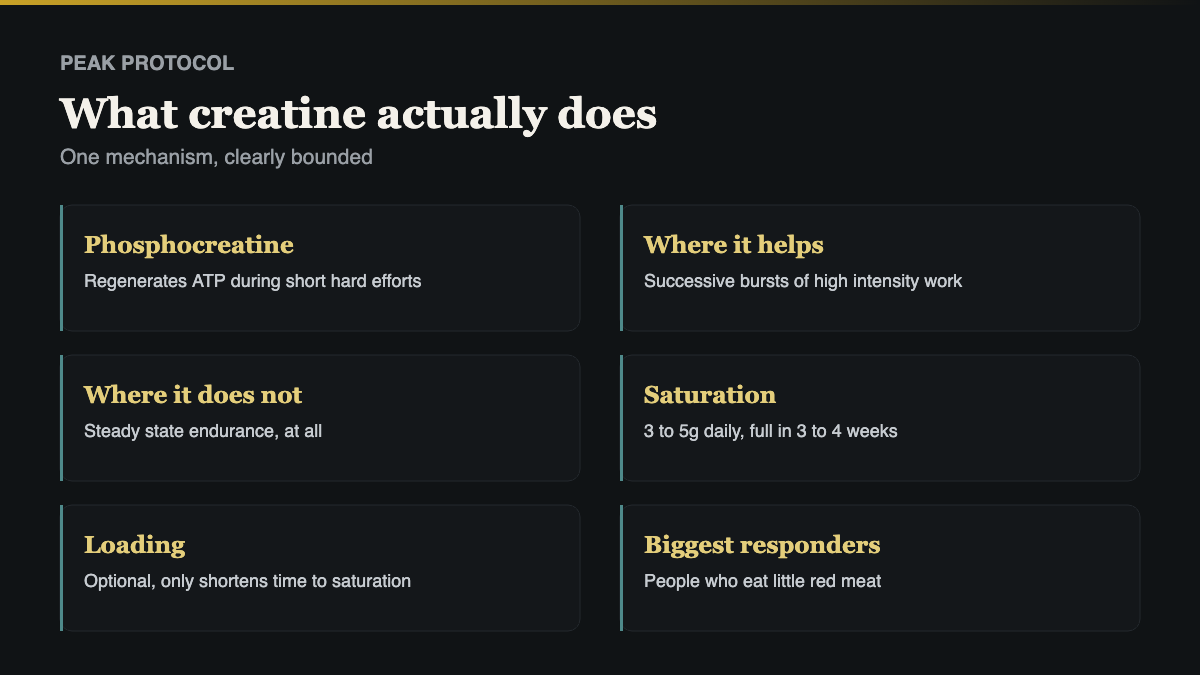
Creatine is a compound your body makes from amino acids and also gets from meat and fish. Most of it is stored in muscle as phosphocreatine, which acts as a rapid energy reserve during very short, very hard efforts such as a heavy set, a sprint or a jump. When phosphocreatine runs low, power output drops.
Diet alone keeps muscle stores well short of full. Supplementing raises them, typically by 20 to 40 percent depending on how much creatine you already eat, and that extra reserve lets you do a little more work in each hard set. Over weeks of training, a little more work adds up. People who eat little or no meat usually start with lower stores and tend to see the largest rise.
Creatine benefits: what the evidence supports
The International Society of Sports Nutrition position stand on creatine summarises hundreds of studies and concludes that creatine monohydrate is the most effective nutritional supplement available for increasing high intensity exercise capacity and lean body mass during training. In Great Britain, the claim a product may make is narrower and exact: creatine increases physical performance in successive bursts of short term, high intensity exercise, with a daily intake of 3 g. That wording is on the GB nutrition and health claims register.
In practical terms, most people who train with weights see modestly greater strength and muscle gains over a training block than they would without it. The effect is real but not dramatic. It does not replace training, sleep or eating enough protein, and it will not make up for a poor programme.
Research into other areas, such as brain function and ageing, is active but less settled, and we do not make claims about it.
Creatine dosage
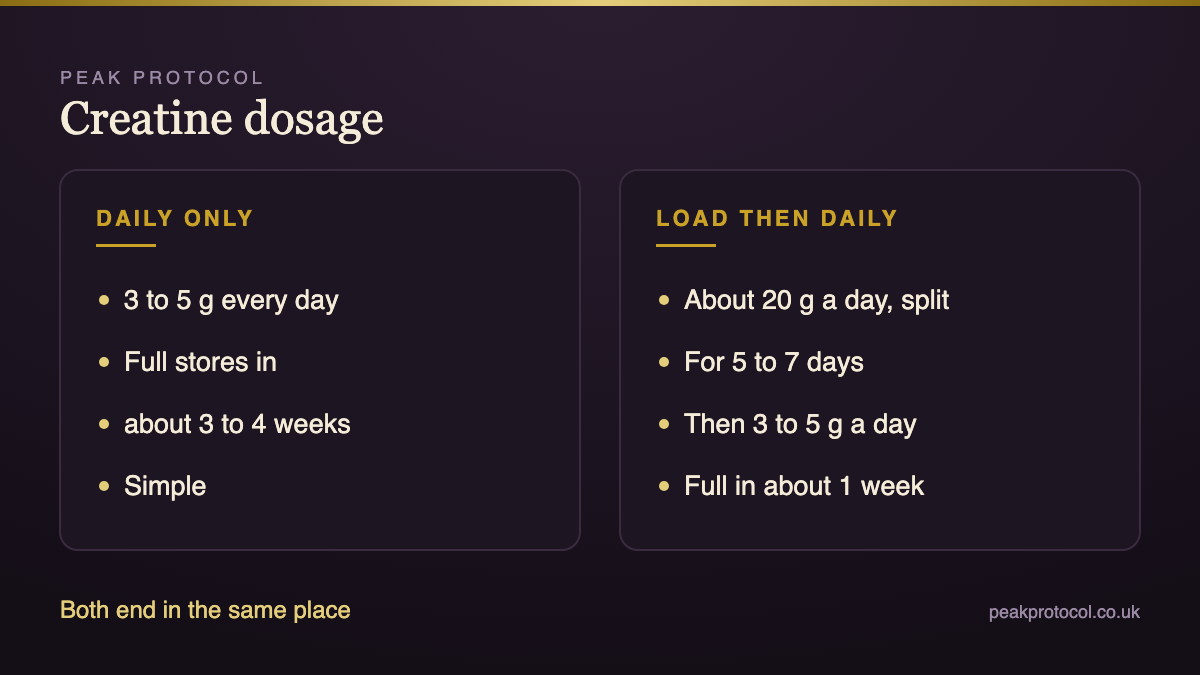
There are two standard approaches, and both end in the same place.
| Approach | How it works | Time to full stores |
|---|---|---|
| Daily amount only | 3 to 5 g every day | About three to four weeks |
| Loading then daily | About 20 g a day split into four doses for 5 to 7 days, then 3 to 5 g a day | About one week |
Loading is not necessary. It simply gets you to full stores sooner, and some people find it causes stomach discomfort. Larger people sometimes use the top of the range. Taking more than your muscles can store does not help, the excess is excreted.
Creatine monohydrate powder dissolves poorly in cold water, so warm liquid or a shake helps. Capsules work too; check how many you need for 3 to 5 g, as it is often four to six.
Creatine timing
Because creatine works by keeping muscle stores topped up rather than as a quick stimulant, the time of day matters much less than consistency. A few studies suggest a small advantage to taking it around training, particularly afterwards with a meal, but the differences are small and not consistent across trials. Take it at whatever time you will remember, every day, including rest days.
Taking it with food that contains carbohydrate and protein may slightly improve uptake into muscle. Caffeine does not cancel it out, despite a persistent myth.
Creatine safety
Creatine has been studied for decades, including trials lasting years, and the European Food Safety Authority opinion on creatine assessed supplementation at 3 g a day as unlikely to pose a risk. In healthy adults, studies have not found harm to kidney or liver function at normal doses.
- Weight gain. Expect one to two kilograms in the first weeks, mostly water drawn into muscle. It is not fat.
- Blood tests. Creatine can raise creatinine, the marker used to estimate kidney function, without any kidney problem. Tell your doctor you take it before a blood test.
- Stomach upset. Most common with large single doses during loading. Splitting doses usually solves it.
- Who should ask a doctor first. Anyone with kidney disease, anyone on medicines that affect the kidneys, and anyone pregnant or breastfeeding.
Claims that creatine causes hair loss come from one small study measuring a hormone marker, not hair. It has not been replicated, and we do not think it justifies alarm, but if you are concerned our guide to hair loss explains what actually drives it.
Creatine forms compared
| Form | Evidence | Our view |
|---|---|---|
| Creatine monohydrate | Hundreds of studies | The default choice and usually the cheapest per effective dose |
| Creapure | A monohydrate made to a specific purity standard | Same molecule, useful if you want a known manufacturer |
| Creatine HCl | Few studies, none showing it works better | Dissolves more easily; not more effective per gram of creatine |
| Buffered creatine | A head to head trial found no advantage over monohydrate | Pay for it only if you prefer the product |
| Creatine malate | Very limited research | Contains less creatine per gram |
We sell several forms because people ask for them, and each product page says plainly how it compares with monohydrate. If you want the best evidence for the least money, start with creatine monohydrate powder.
Creatine versus legal steroids and steroids
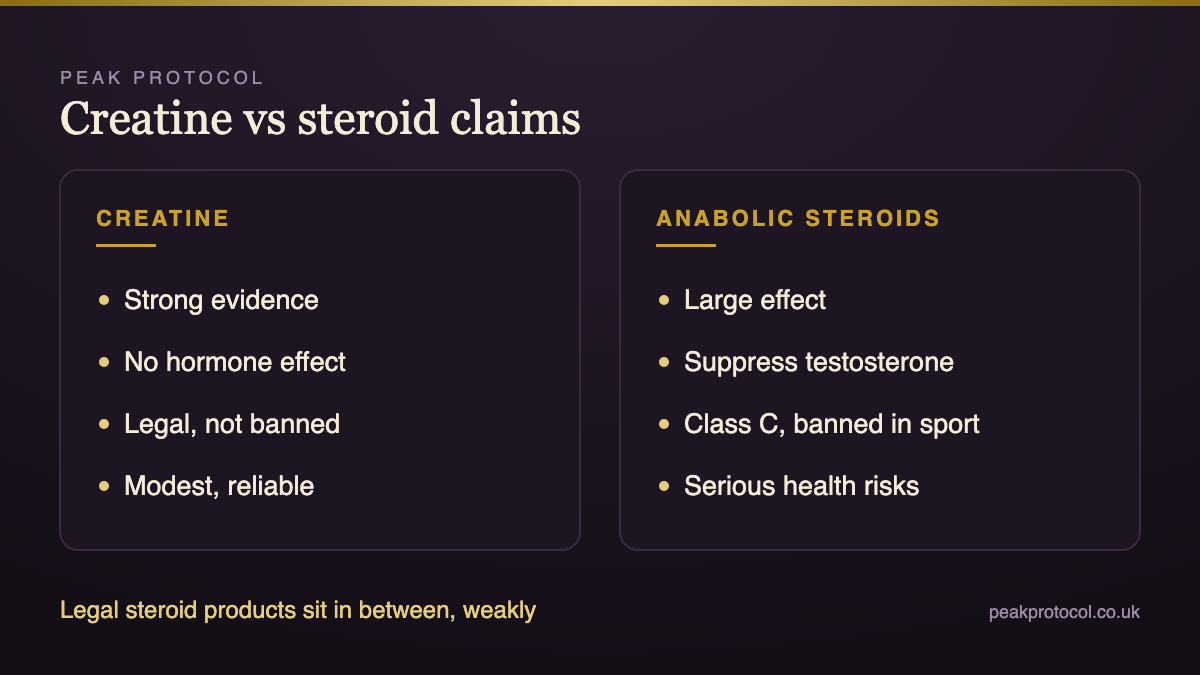
Creatine is often lumped in with products sold as legal steroids, and it is the one ingredient in that world with strong evidence. The difference is that creatine is honest about what it does: a modest, reliable improvement in repeated high intensity work. Most products marketed as legal steroids rely on herbal extracts with weak evidence and claims no GB regulator has authorised, as our legal steroids UK guide explains.
Anabolic steroids are a different category entirely. They are hormones, they suppress your own testosterone, they carry serious risks to the heart and fertility, and supplying them is a criminal offence. Creatine does none of that. Our steroids in the UK hub explains the law and the risks, and anti-doping explains why creatine is permitted in tested sport.
Who creatine suits, and who it does not
Creatine suits adults who do strength training, sprint sports or any training with repeated hard efforts, and is especially worth trying for vegetarians and vegans. It is less useful for pure endurance training, where short bursts matter less, and the added water weight can be a small disadvantage in weight class or running sports.
Some people see little change, usually because their stores were already high from a meat rich diet. A month of consistent use is a fair trial.
Five common creatine mistakes
- Stopping on rest days. Stores only stay full with daily use.
- Judging it after a week without loading. It takes three to four weeks to fill stores at 3 to 5 g.
- Paying extra for a form with no better evidence.
- Not mentioning it before a blood test. Raised creatinine can be misread.
- Expecting steroid like results. The effect is real and modest.
Where creatine fits in the rest of your nutrition
Creatine works alongside, not instead of, enough protein across the day. Our protein guide explains how much you need and when. How we assess every ingredient we sell, including where evidence is weak, is set out on our supplement evidence page.
How to choose a creatine product
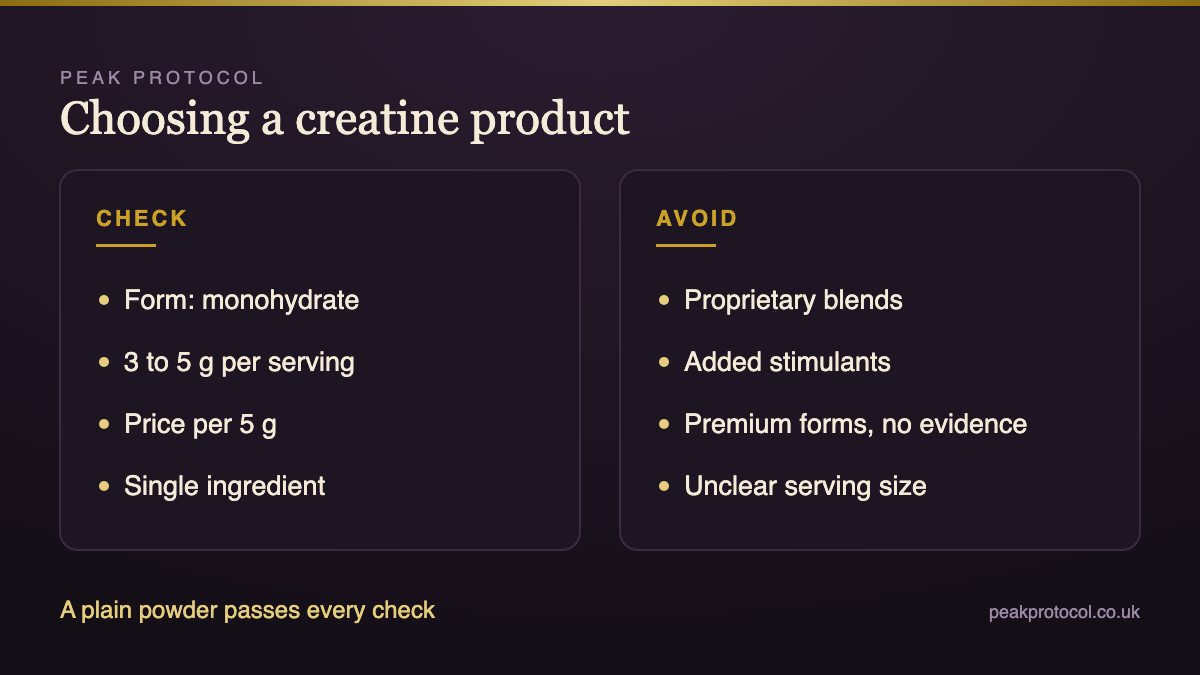
Four checks cover almost everything. First, the form: monohydrate unless you have a reason to prefer another. Second, the amount per serving: you want 3 to 5 g of creatine, and with capsules that can mean several at a time. Third, the price per 5 g serving, which is the fair comparison across tub sizes. Fourth, what else is in it: creatine blended with stimulants, sugar or a proprietary mix costs more and makes it harder to know what you are taking.
A plain powder that lists one ingredient passes all four. Every product in our creatine range states the creatine per serving so the comparison is easy.
Creatine for women and older adults
Most early research was in young men, but studies in women show similar benefits for high intensity performance, and women often start with lower creatine stores. In older adults, creatine combined with resistance training has been studied as a way to support strength and lean mass, and results are generally positive, although the effect depends on the training. The authorised GB claim covers adults, and anyone with a medical condition or taking regular medicines should check with a pharmacist or GP first.
What to expect, week by week
Without loading, the first week usually brings little change beyond slight water weight. By weeks three to four, stores are full and many people notice an extra repetition on hard sets or better repeat sprint performance. Over the following months, that extra training volume is what turns into strength and muscle, provided training and diet are in place. If after six weeks of daily use you notice nothing, you may simply be a low responder, often because your diet already filled your stores.
Creatine: common questions
What does creatine do?
It tops up the phosphocreatine stored in muscle, which supports repeated short bursts of high intensity exercise. The authorised GB claim is that creatine increases physical performance in successive bursts of short term, high intensity exercise, based on 3 g a day.
How much creatine should I take?
Most adults take 3 to 5 g a day. An optional loading phase of about 20 g a day in split doses for 5 to 7 days fills stores faster.
When is the best time to take creatine?
Any time you will remember every day. Consistency matters far more than timing.
Is creatine safe?
In healthy adults, long term studies have not found harm to the kidneys or liver at normal doses. People with kidney disease, and anyone pregnant or breastfeeding, should ask a doctor first.
Is creatine a steroid?
No. Creatine is a compound found in meat and fish. It does not act on hormones, and it is not banned in sport.
Does creatine cause weight gain?
Usually one to two kilograms in the first weeks, mostly water held in muscle rather than fat.
Which type of creatine is best?
Creatine monohydrate has by far the most evidence. Other forms have not been shown to work better.
Sources and review status
This guide draws on the International Society of Sports Nutrition position stand on creatine, the European Food Safety Authority opinion on creatine and the GB nutrition and health claims register. Product claims on this site are limited to those authorised in Great Britain.
Written by the Peak Protocol editorial team. This page has not been reviewed by a medical or legal professional. It is information, not medical or legal advice, and it is not an encouragement to use any drug. Peak Protocol sells legal sports supplements and does not sell anabolic steroids, SARMs or prescription medicines. How we research and correct content is set out in our editorial policy.