
Information and harm reduction only, never medical advice. Sourced from the NHS, TALK TO FRANK, the MHRA and peer reviewed research, and written to say plainly where the evidence runs out rather than filling the gap. Always speak to a qualified clinician before changing anything. See our editorial policy.
Low testosterone is real, it is treatable, and it is also the most over diagnosed condition on the internet. Both of those are true at once, which is what makes this hard to write about honestly.
This page sets out the symptoms, then does the more useful thing: explains which of them actually point at testosterone rather than at the half dozen more common conditions that produce an identical list.
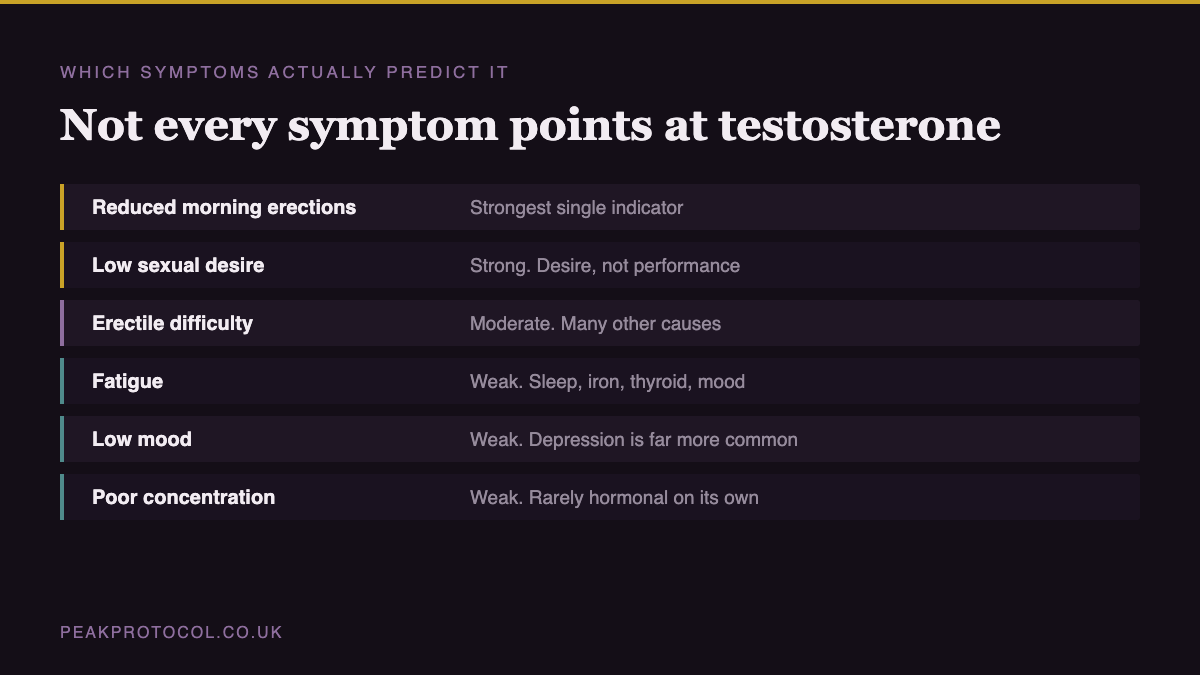
Symptoms ranked by how much they point at testosterone
The commonly listed symptoms are persistent fatigue, low libido, erectile difficulty, low mood or irritability, poor concentration, loss of muscle mass, increased body fat particularly around the middle, reduced body hair, hot flushes, and disturbed sleep.
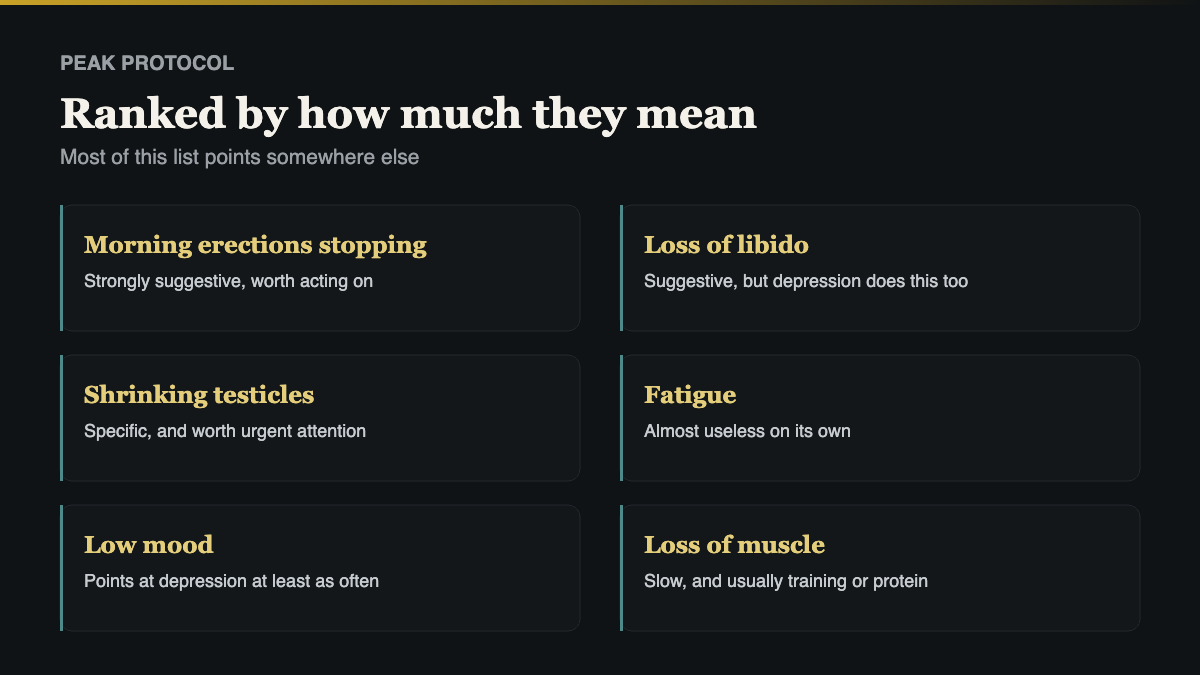
That list appears on every page about this subject, and on its own it is close to useless, because almost none of those symptoms are specific. Fatigue and low mood in a man in his thirties are far more likely to be sleep, stress or depression than hypogonadism.
The list is worth having, but ranking it matters more than reciting it.
The three symptoms that actually discriminate
Clinical research on which symptoms best predict genuinely low testosterone consistently lands on the sexual ones rather than the general ones.
Reduced morning erections. The single most useful indicator. Their frequency tracks testosterone more closely than almost anything else, and it is a change most men notice but few mention because it feels awkward to raise.
Low sexual thoughts and desire. Not performance, desire. A man with normal libido and a performance problem usually has a vascular, psychological or medication related cause rather than a hormonal one.
Erectile difficulty, though this one has many causes and is the weakest of the three on its own.
If none of those three apply, low testosterone becomes considerably less likely regardless of how tired you are. If all three apply, it is worth testing properly.
What else causes the same symptoms
This is the section most sites skip, because it does not sell anything.

Poor sleep. Most testosterone is produced during sleep. Chronic short sleep suppresses it measurably, and a week of restricted sleep is enough to drop levels significantly in healthy young men. Sleep apnoea does it worse and is badly underdiagnosed.
Excess body fat. Fat tissue converts testosterone to oestradiol through aromatase, so higher body fat means lower testosterone and higher oestrogen, which then further encourages fat storage. It is genuinely a loop, and it is reversible.
Depression. The symptom overlap is nearly total: fatigue, low libido, poor concentration, low mood, disturbed sleep. Depression is far more common than hypogonadism, and treating a normal testosterone level does nothing for it.
Thyroid dysfunction. An underactive thyroid produces fatigue, weight gain, low mood and low libido. It is a simple blood test and it is frequently not ordered.
Iron deficiency or anaemia. Common, easily missed in men because it is thought of as a women’s problem, and it produces exactly the exhaustion people attribute to testosterone.
Alcohol. Regular heavy drinking suppresses testosterone directly and wrecks sleep quality on top.
Medication. Opioids are the big one and suppress testosterone substantially. Some antidepressants affect libido directly. Finasteride affects a subset of men.
A proper workup checks these. A clinic that goes straight to testosterone without touching any of them is not investigating, it is selling.
Age, and the decline everyone quotes
Testosterone does fall with age, at somewhere around one percent a year from the late thirties. That figure gets quoted constantly and usually misapplied.
One percent a year is slow. It means a man in his fifties has meaningfully less than he did at twenty five, and it does not mean he is hypogonadal or that he needs treatment. Most men decline within the normal range and never develop symptoms attributable to it.
The more interesting finding from population research is that a substantial part of the decline attributed to age tracks with health rather than years: weight gain, reduced activity, worse sleep, more medication. Men who stay lean and active decline considerably more slowly. Age is not entirely destiny here.
The four reversible causes
If you are symptomatic, these four are worth attacking properly for three months before concluding anything, because they are free, they work, and they fix the underlying problem rather than masking it.
Sleep. Seven hours minimum, consistently. If you snore heavily or wake unrefreshed, ask about sleep apnoea specifically.
Body fat. Losing meaningful fat raises testosterone in men carrying excess, and the effect is not small.
Alcohol. Reducing heavy intake helps directly and through sleep.
Resistance training. Modest direct effect on testosterone, larger effect on body composition, insulin sensitivity and mood, all of which feed back.
None of that is a fobbing off. It is the first line of treatment in every clinical guideline, and for a meaningful number of men it resolves the problem entirely.
Symptoms that mean something else is wrong
A few things alongside low testosterone symptoms warrant prompt medical attention rather than a supplement or a private clinic.
- Headaches with visual disturbance, particularly loss of peripheral vision. That combination with low testosterone can indicate a pituitary tumour, which is uncommon but important and treatable.
- Milky nipple discharge. Suggests raised prolactin, which has its own causes and its own treatment.
- Very rapid onset. Testosterone decline is gradual. A sudden change over weeks points elsewhere, including testicular injury or infection.
- Testicular lump, pain or swelling. Needs seeing quickly regardless of hormones.
Symptoms under thirty five
Genuinely low testosterone in a young man is uncommon, and when it is present it usually has a specific cause worth finding rather than simply replacing.
Causes include pituitary problems, raised prolactin, Klinefelter syndrome, undescended testes in childhood, previous chemotherapy, opioid use, significant obesity, and prior anabolic steroid use, which is now a meaningful proportion of young men presenting with this.
The reason it matters is that starting replacement in your twenties is close to a lifelong commitment and it suppresses fertility during the years you are most likely to want it. Finding and treating the cause is a materially better outcome than replacing the hormone and leaving the cause in place. A clinician who investigates rather than prescribes immediately is doing you a favour.
What partners notice first
A recurring pattern in men who eventually get diagnosed is that somebody else spotted it first. Worth knowing, because the symptoms that are hardest to self assess are the ones that change slowly.
The changes partners most often describe are a shorter temper over small things, withdrawal from conversation rather than active irritability, falling asleep early and still waking exhausted, and a loss of interest that reads as being about the relationship when it is not. That last one causes a great deal of unnecessary damage, because the obvious interpretation is rarely the correct one.
If someone close to you has raised any of this, treat it as information rather than criticism. Gradual change is genuinely difficult to see from inside.
Track your symptoms before you go
Ten minutes of preparation makes a GP appointment considerably more productive, and the difference between being taken seriously and being dismissed is often just specificity.
For two or three weeks before you go, note morning erections as present or absent, sleep hours and quality, energy on a simple scale, and mood. Add the things a clinician will ask about and you will not remember accurately: alcohol units per week, current medications including anything bought over the counter, and any previous anabolic steroid use.
Turning up with three weeks of notes rather than a vague description of feeling tired changes the consultation. It also gives you a baseline to compare against later, whether or not treatment follows, which is worth having regardless of what the tests show.
When to get tested
Test if you have the sexual symptoms above, particularly reduced morning erections and low desire, and especially if you also have any of the risk factors: significant obesity, opioid use, previous anabolic steroid use, chemotherapy, or a known pituitary or testicular problem.
Test in the morning, before 11am, fasted, and twice on separate days. Ask for SHBG, LH and FSH alongside total testosterone, because total alone cannot answer the question. Full detail in testosterone blood tests.
Why online questionnaires are useless
Search this topic and you will be offered a symptom quiz within about two clicks. They are worth understanding, because they are designed to produce one answer.
The best known screening questionnaire in this area was developed as a research tool and performs reasonably at catching men who might have low testosterone. What it is very poor at is ruling it out in men who do not, because the questions are broad enough that almost any tired adult scores positive. Sensitivity is decent, specificity is weak.
Used clinically, alongside bloods, that is fine. Used as a lead capture tool by a clinic that sells the treatment, it is close to a machine for manufacturing customers, because virtually everyone who takes it is told they may be affected.
If a provider offers you a prescription on the strength of a questionnaire and no morning blood test, you have learned everything you need to know about that provider.
What low testosterone is not
It is not the explanation for every symptom of being tired, stressed and in your forties, though it is marketed that way relentlessly.
It is not diagnosable from a symptom questionnaire. Any provider prescribing on a questionnaire alone is not diagnosing.
And it is not something a supplement fixes. No legal supplement raises testosterone in a man whose level is already normal. Zinc, magnesium and vitamin D matter if you are deficient in them, and that is a different claim entirely: zinc contributes to the maintenance of normal testosterone levels in the blood, which means preventing a deficiency related fall rather than raising a normal level. Our shop sells those and the product pages say exactly that.
Getting assessed
Get a morning blood test with the full panel. Fix sleep, body fat and alcohol properly in parallel, because you should be doing it anyway and it costs nothing.
If treatment looks likely, NHS vs private TRT explains the two routes.
If levels come back genuinely low, see TRT in the UK for how treatment actually works and how to tell a proper clinic from one selling testosterone. If they come back normal, the cause is still out there and still findable, and that is better news than it feels like.
What is not a solution is buying testosterone online. That is a supply offence for whoever sells it, it is unmonitored, and it makes the underlying question permanently harder to answer.
Five things people get wrong
Five misreadings send most people either to the wrong clinic or to no clinic at all.
One, treating fatigue as the headline. Tiredness is the symptom people lead with and the least useful one in the whole list. The low testosterone symptoms that actually discriminate are the loss of morning erections, a genuine collapse in libido, and shrinking testicles.
Two, trusting an online questionnaire. The screening questionnaires are so broad that most middle aged men score positive on them. They are marketing instruments for clinics, not diagnostic tools, and a positive score tells you nothing.
Three, skipping the alternatives. Sleep apnoea, depression, thyroid disease and iron deficiency all produce the same low testosterone symptoms, and every one of them is commoner than low testosterone in men under fifty.
Four, assuming age explains it. Testosterone does decline with age, by roughly one percent a year after about thirty, which is far too slow to explain symptoms that appeared over six months. A sharp change is a reason to look for a cause, not to accept it.
Five, going straight to a private clinic. A clinic that sells treatment is not the right place to establish whether you need it. Get the bloods first, from anywhere, and take the numbers with you.
A step by step plan

If the symptoms are real, there is a cheap order of operations that saves a great deal of money and gets a better answer.
Track it before you act on it. A month of dated notes on the specific low testosterone symptoms, their severity and what else was happening, is worth more in a ten minute GP appointment than any amount of describing how you feel today.
Deal with the reversible causes. Sleep, weight, alcohol and training load are not a consolation prize; they are the actual cause in a large share of cases, and fixing them resolves the symptoms outright. If you snore heavily, get screened for sleep apnoea before anything else.
Then get properly tested. Two morning samples with SHBG, LH and FSH alongside total testosterone. Testosterone blood test UK covers what to ask for and why the timing decides the result.
And only then think about treatment. If the numbers and the low testosterone symptoms agree, how to get TRT in the UK sets out the lawful route and TRT cost and clinics covers what it actually costs over a year. If they disagree, the answer is somewhere else and treatment will not find it.
Low testosterone symptoms: common questions
What are the first signs of low testosterone?
Reduced morning erections and reduced sexual desire are the most predictive early signs. Fatigue and low mood are commonly listed but point at testosterone far less reliably.
Can low testosterone be cured naturally?
Where the cause is poor sleep, excess body fat, heavy alcohol use or inactivity, addressing those often restores levels. Where the cause is testicular or pituitary, it does not.
At what age does testosterone drop?
It declines gradually from the late thirties, at roughly one percent a year. Most men remain within the normal range and never develop symptoms from it.
Can low testosterone cause depression?
The symptoms overlap heavily and the relationship runs both ways. Depression is much more common, so it should be considered first rather than last.
Do testosterone booster supplements work?
Not in men with normal levels. Correcting a genuine zinc or vitamin D deficiency can help, which is not the same as raising testosterone above normal.
What are the most reliable low testosterone symptoms?
Loss of morning erections, a genuine collapse in libido rather than reduced opportunity, and reduced testicular size. These three point at testosterone far more specifically than fatigue, low mood or loss of muscle, all of which have commoner explanations.
Can low testosterone symptoms be caused by something else?
Very often, yes. Obstructive sleep apnoea, depression, thyroid disease, iron deficiency and poorly controlled diabetes all produce almost the same list, and each is more common than low testosterone in men under fifty.
Do online low testosterone symptoms questionnaires work?
No. They are deliberately broad, most middle aged men score positive, and they exist mainly to generate consultations. A blood test taken before 11am on two separate days is the only thing that answers the question.