
Information and harm reduction only, never medical advice. Sourced from the NHS, TALK TO FRANK, the MHRA and peer reviewed research, and written to say plainly where the evidence runs out rather than filling the gap. Always speak to a qualified clinician before changing anything. See our editorial policy.
If you are using anabolic steroids, regular bloodwork is the single highest value harm reduction step available to you. It is more useful than any supplement, any protocol and any forum consensus, because it is the only way to see the effects that produce no symptoms until they are advanced.
This page sets out what to test, why each marker matters and how often. It is harm reduction, not encouragement. If you have decided to use, this is how you reduce the chance of it costing you something permanent.
Why blood tests matter more than how you feel
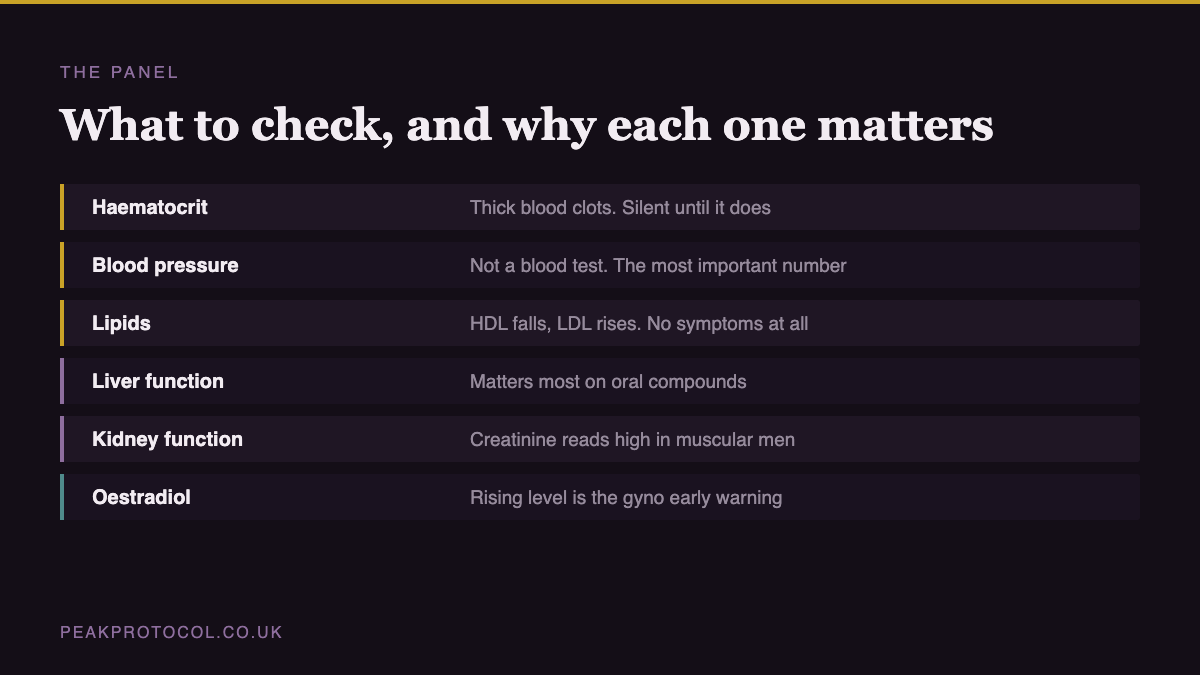
The effects most likely to shorten a life are silent. Raised blood pressure has no symptoms. Falling HDL cholesterol has no symptoms. Rising haematocrit has no symptoms until a clot forms. Liver strain frequently has none until it is significant.
Meanwhile the things you do feel, pumps, strength, appetite, mood, tell you almost nothing about any of them. People routinely report feeling excellent on bloodwork that would concern any clinician who saw it.
That gap between how you feel and what is happening is the entire argument for testing.
The baseline is the most valuable test of all
A full panel taken before you start is worth more than any single test afterwards, because it tells you what normal looks like for you rather than for a population.
Reference ranges are broad. A result at the bottom of the range means something completely different in a man whose baseline was at the top than in one who always sat low. Without a baseline you cannot tell a meaningful change from ordinary variation.
If you have already started and did not take one, take the earliest panel you can and treat it as your reference point. It is imperfect and it is far better than nothing.
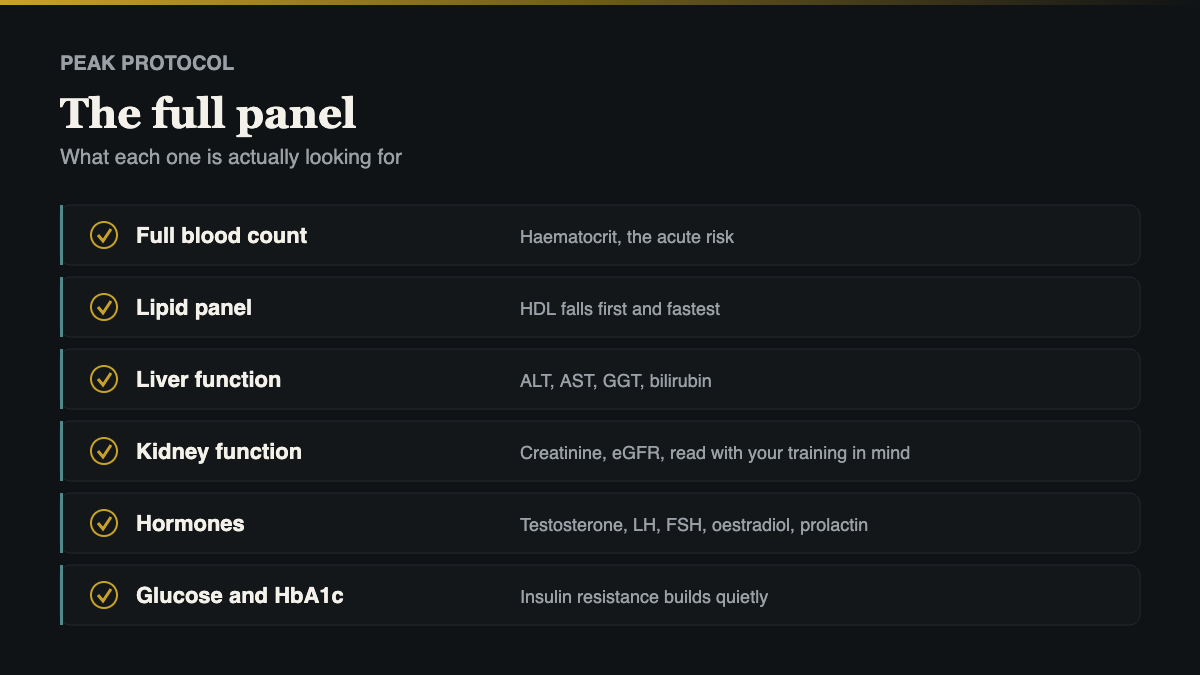
Full blood count and haematocrit
This is the marker most likely to need action and the easiest to check.
Testosterone stimulates red blood cell production. Some increase is expected and part of the performance effect. Too much raises haematocrit, the proportion of blood volume made up of red cells, and thicker blood clots more readily. Raised haematocrit is a recognised cause of stroke and clotting events in users.
It appears on a standard full blood count, which costs very little and is available anywhere. If it is climbing, that is information you can act on, and the actions are straightforward once you know.
Lipids, the first thing the tests catch
A lipid panel covers total cholesterol, LDL, HDL and triglycerides.
What lipid and blood pressure changes mean for the heart is covered in steroids and heart health.
Anabolic steroids reliably lower HDL, the protective fraction, and raise LDL. Oral compounds do this more aggressively than injectables. The change can be substantial and it happens within weeks rather than years.
This is the mechanism behind the long term cardiovascular risk, and it is completely invisible without testing. It also improves after stopping, which is a reason to know where you are rather than to avoid finding out.
Liver function
ALT, AST, GGT, ALP and bilirubin.
Oral 17 alpha alkylated compounds are hepatotoxic, and enzyme rises are common on them. One caveat worth knowing: heavy resistance training alone raises ALT and AST, because they are released from muscle as well as liver. A rise in those two alongside normal GGT and bilirubin is frequently training rather than liver strain, and this causes a great deal of unnecessary alarm.
If you are taking oral compounds, test more often, not less. If liver markers rise substantially, or bilirubin rises, that is a doctor rather than a forum.
Kidney function
Creatinine, urea and eGFR.
Another caveat with the same shape: creatinine is produced by muscle, so a man carrying a great deal of it can have raised creatinine and a low calculated eGFR with entirely normal kidneys. Creatine supplementation nudges it too. Cystatin C is a better marker in this population and is worth asking for if creatinine comes back high.
That said, kidney damage in long term high dose users is documented, so this belongs on the panel rather than being assumed away.
The hormone panel
Total testosterone, free testosterone, SHBG, LH, FSH, oestradiol and prolactin.
For fertility specific tests such as semen analysis, see steroids and fertility.
While using, LH and FSH will be suppressed and that is expected rather than alarming. Their value is after stopping, where a rise in LH is the first sign the system is restarting. Oestradiol matters because aromatisation drives gynaecomastia, and a rising level is the early warning for the one side effect that does not reverse.
See testosterone blood tests for how these are interpreted, and coming off steroids for what recovery looks like on paper.
PSA
Relevant mainly in men over forty, and worth a baseline at any age if you intend to use long term. Testosterone does not appear to cause prostate cancer, but it can accelerate an existing one, which is why PSA is monitored in prescribed TRT.
Glucose and HbA1c
Frequently omitted and worth including. Some compounds affect insulin sensitivity, and HbA1c gives a three month average rather than a single moment, which makes it more useful than a fasting glucose taken on a day you happened to eat well.
Blood pressure, which is not a blood test
Included here because it is the most important number on this page and the one people skip.
A home monitor costs very little and takes a minute. Blood pressure rises on almost every compound, it is the effect most likely to cause harm over years, and it is completely symptomless until it is not. Measure it weekly, at the same time of day, sitting and rested.
If it is consistently high, that is worth acting on regardless of anything else on your panel.
When to test
A baseline before starting anything. Then during use, mid way through and at the end, with more frequent testing on oral compounds because liver markers move faster.
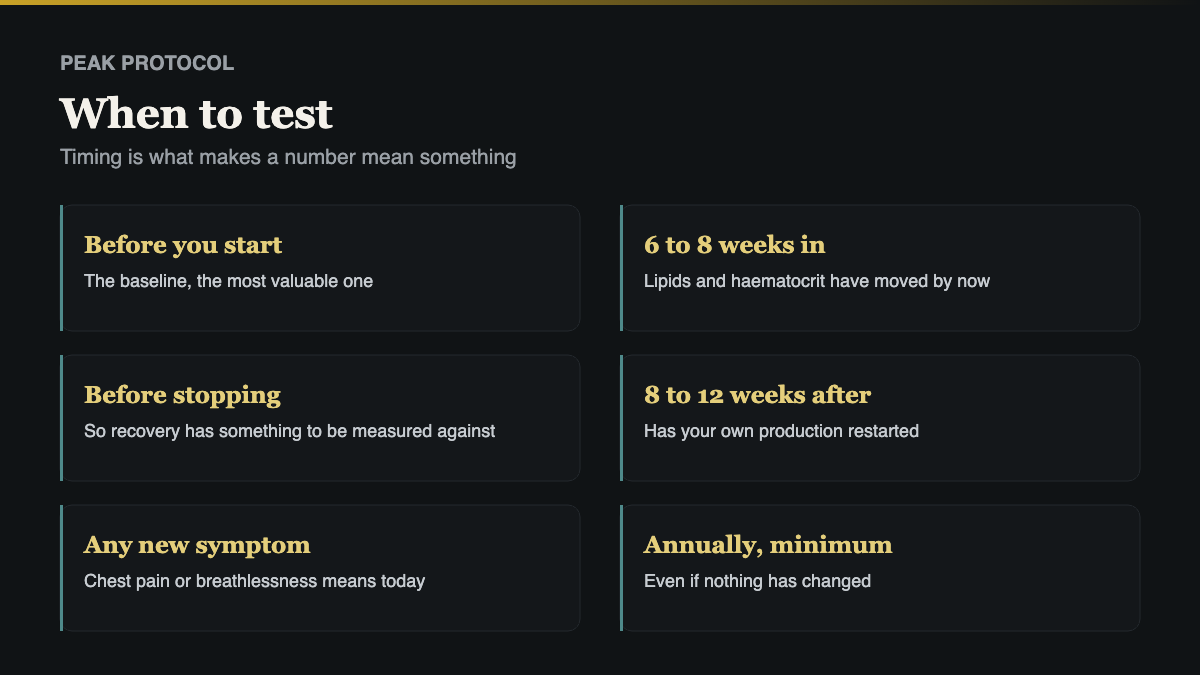
After stopping, test at intervals to track recovery: LH, FSH and testosterone are what tell you whether the system is restarting or stalled. Then annually as a general health baseline whether or not you are using.
Test in the morning, fasted, and ideally not the day after a very heavy training session, since that skews liver and kidney markers.
Where to get tested
Your GP. Free. You do not have to disclose everything to get a full blood count, lipids, liver and kidney function, and being honest gets you better interpretation. GPs are not going to report you.
Private finger prick panels by post. Convenient and increasingly comprehensive. Check the laboratory is UKAS accredited and that the panel covers what you need rather than a headline marker.
Private venous draws. More markers, more accurate for some, and more expensive.
Keep every result with its date and reference ranges. Trends matter far more than single readings, and you cannot see a trend you did not record.
Being honest with whoever reads your results
This is worth stating plainly. A clinician interpreting your bloods without knowing what you have taken is working blind, and may investigate you for a condition you do not have while missing the actual cause.
Doctors in the UK are not reporting you to anybody. Possession is not an offence, and clinical confidentiality applies regardless. The number of men who receive worse care because they will not say what they are taking is genuinely significant, and it is an avoidable problem.
Reading results without panicking
Two rules make results useful rather than alarming.
First, one out of range marker in isolation usually means very little. Ranges are set so that a proportion of healthy people fall outside them, and a single value slightly out is common. Patterns across related markers matter, single values rarely do.
Second, compare to your own baseline rather than to the range. A value that has moved substantially within the range can be more informative than one sitting just outside it.
And get a clinician to interpret them. Not a forum, not us. We can tell you what to measure and why. What your particular numbers mean, in your particular context, is a medical question.
Keeping the cost down
A full private panel with every marker on this page is expensive, and most people do not need all of it every time. Splitting it sensibly costs far less.
The markers worth checking most often are haematocrit, lipids and liver function, all of which sit on cheap standard panels and all of which move fastest. Your GP will usually run those without difficulty as part of a general health check.
The hormone panel is the expensive part, and it is the one you need least frequently while actually using, since the results are predictable: suppressed LH and FSH, testosterone reflecting whatever you are taking. It becomes important at baseline and after stopping, which is where the money is better spent.
PSA, HbA1c and cystatin C are situational: over forty, if glucose control is a concern, or if creatinine came back high respectively.
Spending on frequent cheap panels plus occasional comprehensive ones beats one expensive panel a year, because trends are what tell you anything.
Keep the numbers, not just the verdict
Providers often summarise results as normal or abnormal and leave it there. That summary is close to useless six months later.
Ask for the actual figures with their reference ranges and the laboratory name. Ranges differ between labs because assays differ, so a number without its range cannot be compared to anything.
Put them in a spreadsheet as you go. It takes two minutes per panel and it turns a series of isolated snapshots into a trend line, which is the only form in which this data is genuinely useful. It is also what a doctor will want if something ever does need investigating.
On blood donation
Donating blood is frequently suggested in forums as a way of managing raised haematocrit, and it needs stating carefully.
It does lower haematocrit, which is why the suggestion exists. The problem is that UK donation exists to supply patients, not to treat donors, and the screening questions protect recipients. Donating while concealing relevant information is not a harm reduction strategy, it is a transfer of your problem to somebody receiving a transfusion.
The legitimate route for genuinely raised haematocrit is therapeutic venesection arranged through a doctor, which does the same thing for the right reason and is recorded in your notes. If your haematocrit is high enough to need managing, it is high enough to need a clinician looking at it rather than a workaround.
Five mistakes that waste a blood test
Five mistakes turn a useful set of steroid blood tests into an expensive set of numbers nobody can interpret.
One, never getting a baseline. Almost everything that matters here is a change rather than an absolute. A haematocrit of 52 percent means one thing in a man who started at 44 and another in a man who has always run high, and without the first reading nobody can tell which you are.
Two, ordering total cholesterol instead of a full lipid panel. The damage concentrates in HDL, and a total figure can look perfectly acceptable while HDL is on the floor. This is the commonest way steroid blood tests miss the thing they were ordered to find.
Three, not saying that you lift. Heavy resistance training raises ALT, AST and creatinine on its own. A doctor who does not know that may investigate a liver or kidney result that has an obvious explanation, and you will have wasted everyone’s time.
Four, testing at the wrong point. Steroid blood tests taken the day after a heavy session, or the week after starting something new, produce numbers that are real and misleading. Consistency of timing matters more than the exact day.
Five, keeping the verdict instead of the numbers. Normal is not a result. Get the actual figures and keep them, because the trend across three sets of steroid blood tests tells you far more than any single one.
A budget panel, step by step
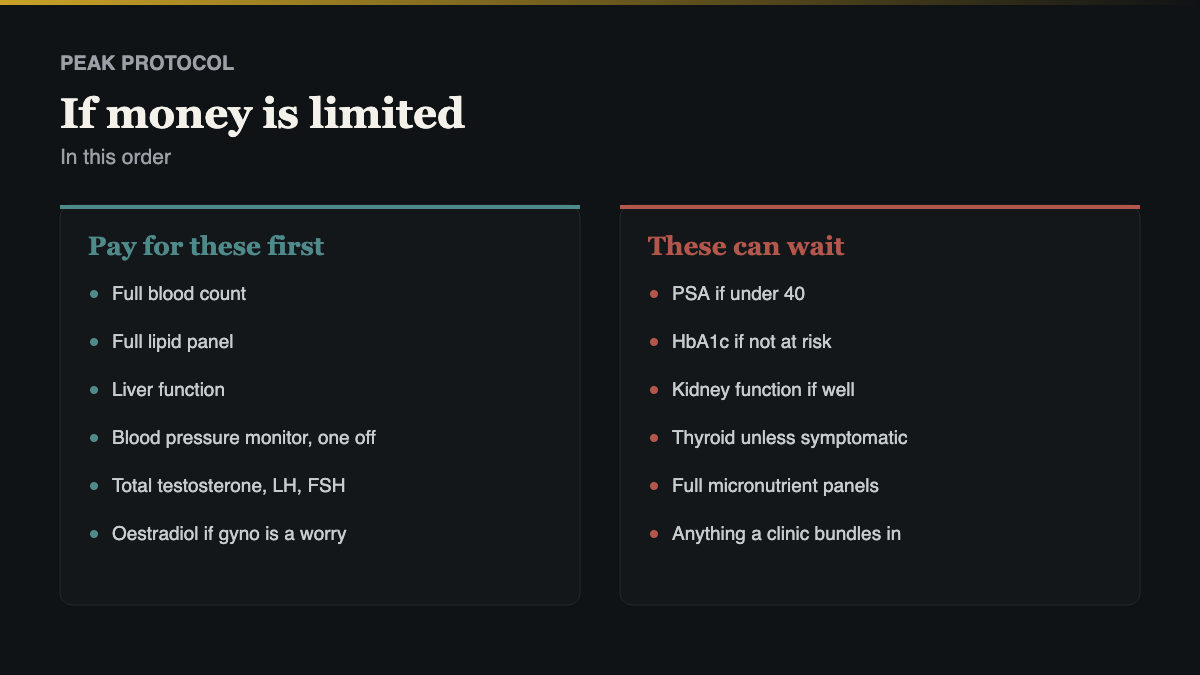
You do not need to buy everything at once. There is a sensible order that gets most of the value for a fraction of the price.
Start with three tests and a blood pressure monitor. A full blood count, a full lipid panel and liver function cover the great majority of what steroid blood tests exist to catch, and an upper arm monitor costs less than a single private consultation and gives you better data than any clinic reading.
Add the hormone panel when you are thinking about stopping. Total testosterone with LH and FSH tells you how far suppression has gone, which is the only way to know what recovery looks like. Coming off steroids explains why that matters more than how you feel.
Add the specific ones when there is a specific worry. Oestradiol on a sensitive assay if breast tissue is a concern, covered in gynaecomastia and steroids. Prolactin if you are using nandrolone or trenbolone, for the reasons set out on the nandrolone page.
And use the NHS where you can. A GP will not report you, and being straight about what you are taking is what makes steroid blood tests interpretable at all. Steroid side effects covers what the numbers are looking for.
Steroid blood tests: common questions
What blood tests should I get if I am using steroids?
Full blood count including haematocrit, lipids, liver function, kidney function, a hormone panel with LH, FSH, SHBG and oestradiol, plus glucose or HbA1c, and PSA over forty. Blood pressure at home alongside.
How often should I test?
A baseline before starting, mid cycle and at the end, more often on oral compounds, then at intervals afterwards to track recovery. Annually thereafter as general health monitoring.
Can I get these tests from my GP?
Yes, and it is free. Being honest about what you are taking gets you better interpretation, and doctors are not reporting you to anyone.
Why are my liver enzymes high if I am only using injectables?
Heavy resistance training raises ALT and AST because they are released from muscle as well as liver. Raised ALT and AST with normal GGT and bilirubin is often training rather than liver strain.
What is the most important marker?
Haematocrit and blood pressure, because both are silent, both carry serious risk, and both are easy to check and act on.
What steroid blood tests should I get?
At minimum a full blood count for haematocrit, a full lipid panel, and liver function. Add total testosterone with LH and FSH to see how far suppression has gone, and oestradiol on a sensitive assay if breast tissue is a concern. Blood pressure at home belongs alongside them.
How often should I run steroid blood tests?
A baseline before starting, again six to eight weeks in, before stopping, and eight to twelve weeks after stopping. If nothing changes, at least annually. Any chest pain or unexplained breathlessness means seeking help the same day rather than booking a test.
Will my GP judge me for asking for steroid blood tests?
Clinicians who see this regularly have heard all of it and are not going to report you to anyone. Withholding the history is the single commonest reason monitoring catches nothing, because results in this population are close to uninterpretable without knowing what is on board.