
Information and harm reduction only, never medical advice. Sourced from the NHS, TALK TO FRANK, the MHRA and peer reviewed research, and written to say plainly where the evidence runs out rather than filling the gap. Always speak to a qualified clinician before changing anything. See our editorial policy.
Search for legal steroids in the UK and you will find dozens of products with names engineered to sound like anabolic compounds, sold with before and after photographs and language about rapid transformation.
The distinction that matters is legal rather than marketing. Actual anabolic steroids are Class C controlled drugs, and where that sits in the wider classification of drugs in the UK decides what is an offence and what is not. Everything described on this page is a food supplement, which is a different legal category entirely.
This page explains what those products actually are, which ingredients inside them have real evidence, which do not, and what the UK rules say about how any of it can be advertised. We sell legal supplements ourselves, which makes this awkward to write honestly. We are going to write it honestly anyway.
What legal steroid products actually are
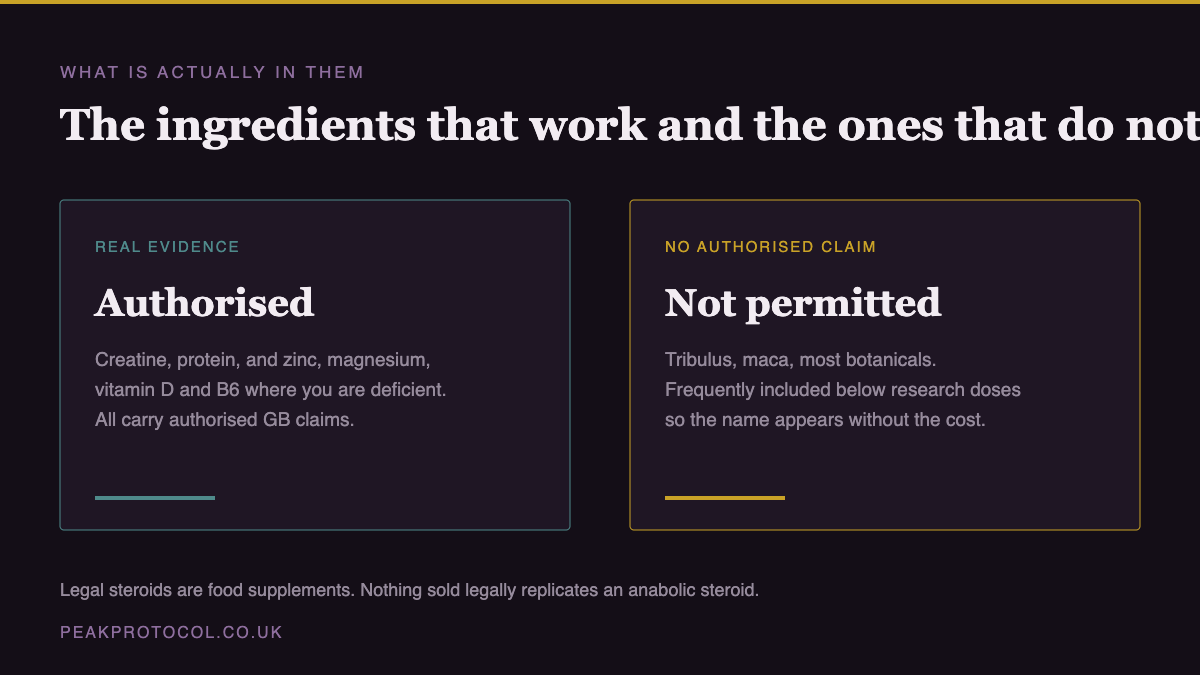
They are food supplements. Not medicines, not hormones, not anabolic compounds of any kind. Legally and chemically they sit in the same category as a protein powder or a multivitamin.
The phrase legal steroids is a marketing description rather than a chemical one. It tells you what the product is positioned against, not what it contains.
That matters because the positioning creates an expectation the contents cannot meet. Nothing sold legally over the counter in the UK replicates the effect of an anabolic steroid, and any product implying otherwise is describing a hope rather than a mechanism.
Why the name exists at all
Because it converts. A supplement named after a controlled compound borrows every association that compound carries, and the buyer arrives already believing the product does something dramatic.
The convention is decades old and predates most current advertising regulation, which is why products with names echoing Dianabol, Trenbolone, Anadrol and Winstrol are still on sale. The names are usually just similar enough to trigger the association and different enough to avoid a trademark problem.
Once you notice the pattern it is difficult to unsee, and it is a reasonable first filter: a product whose name is doing that much work is telling you where its budget went.
What is actually inside them
Turn the tub around and the ingredient lists across this whole category are remarkably similar. Typically some combination of amino acids, plant extracts such as tribulus, fenugreek, ashwagandha or maca, vitamins and minerals particularly zinc, magnesium and vitamin D, creatine in some products, and occasionally caffeine.
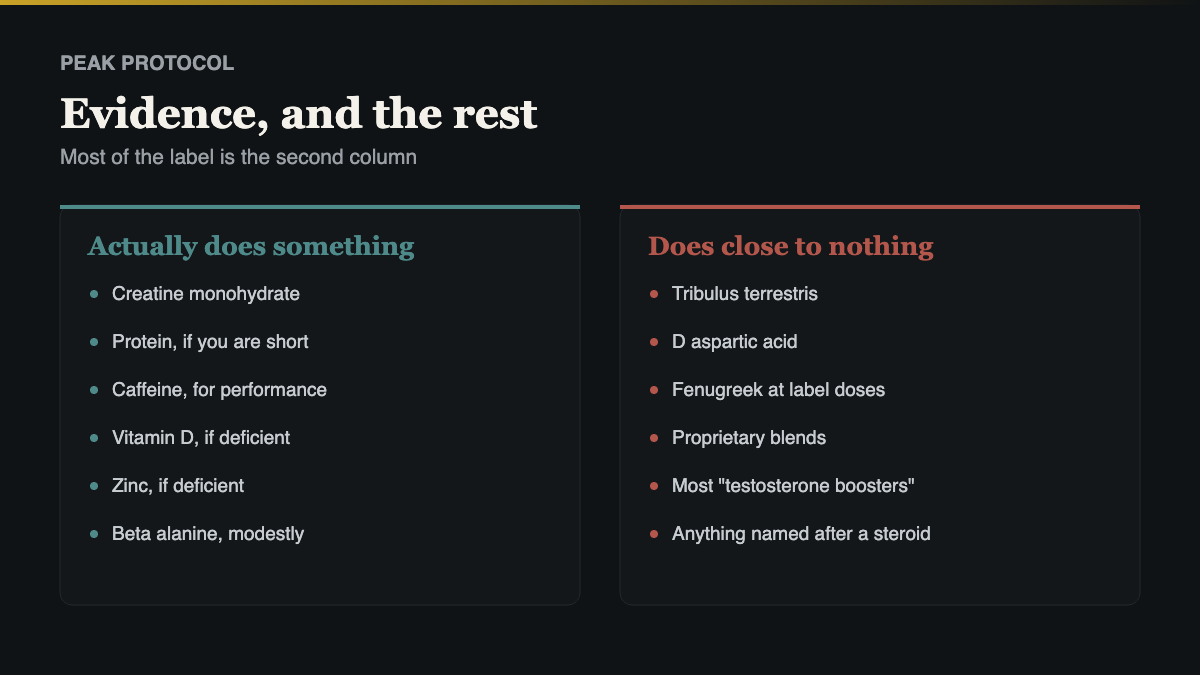
There is nothing wrong with any of those. Several are worth taking. The issue is not the contents, it is the gap between the contents and the marketing wrapped around them.
The ingredients that do something
Creatine monohydrate. The genuinely effective one. Creatine increases physical performance in successive bursts of short term, high intensity exercise, on a daily intake of 3g. That is an authorised claim in Great Britain because the evidence supports it. If a legal steroid product contains a real dose of creatine, it works to the extent that creatine works, and you could buy creatine on its own for a fraction of the price.
Protein, where included in meaningful quantity. Protein contributes to a growth in muscle mass and to the maintenance of muscle mass.
Zinc, magnesium, vitamin D and vitamin B6, if you are deficient. Zinc contributes to the maintenance of normal testosterone levels in the blood. That claim is authorised, and it is worth reading precisely: maintenance, not increase. Correcting a deficiency prevents a fall. It does not lift a normal level above normal, and the difference between those two statements is the whole argument on this page.
Caffeine. Helps to increase alertness and improve concentration, at 75mg per serving. Real, authorised, and available in coffee.
The ingredients that do not
Tribulus terrestris is the most common inclusion in this category and the evidence for it raising testosterone in humans is poor. Fenugreek, maca and most of the other botanicals hold no authorised health claims in Great Britain, which is a formal way of saying the evidence did not meet the threshold.
That does not mean they do nothing at all in any context. It means nobody has demonstrated the effect being implied, and a seller is not permitted to claim it.
The other common problem is dosing. A product can list an impressive ingredient at a quantity far below anything used in research, which lets the label carry the name without the cost. This is why the dose next to each ingredient matters more than the list of ingredients.
What UK rules say about the claims
Two systems apply, and both are stricter than the marketing suggests.
Health claims on food supplements are only permitted if they appear on the GB Nutrition and Health Claims Register, in wording close to the register text. Anything outside that register cannot be claimed, however true a seller believes it to be.
Separately, the Advertising Standards Authority has repeatedly ruled against supplement advertising that implies steroid like effects, and against before and after imagery presented as typical results.
A product marketed as building muscle like an anabolic steroid is therefore making a claim that is not authorised. That is not a technicality, it is the basis on which these adverts get pulled.
The marketing pattern to recognise
Once you know what to look for, the category identifies itself.
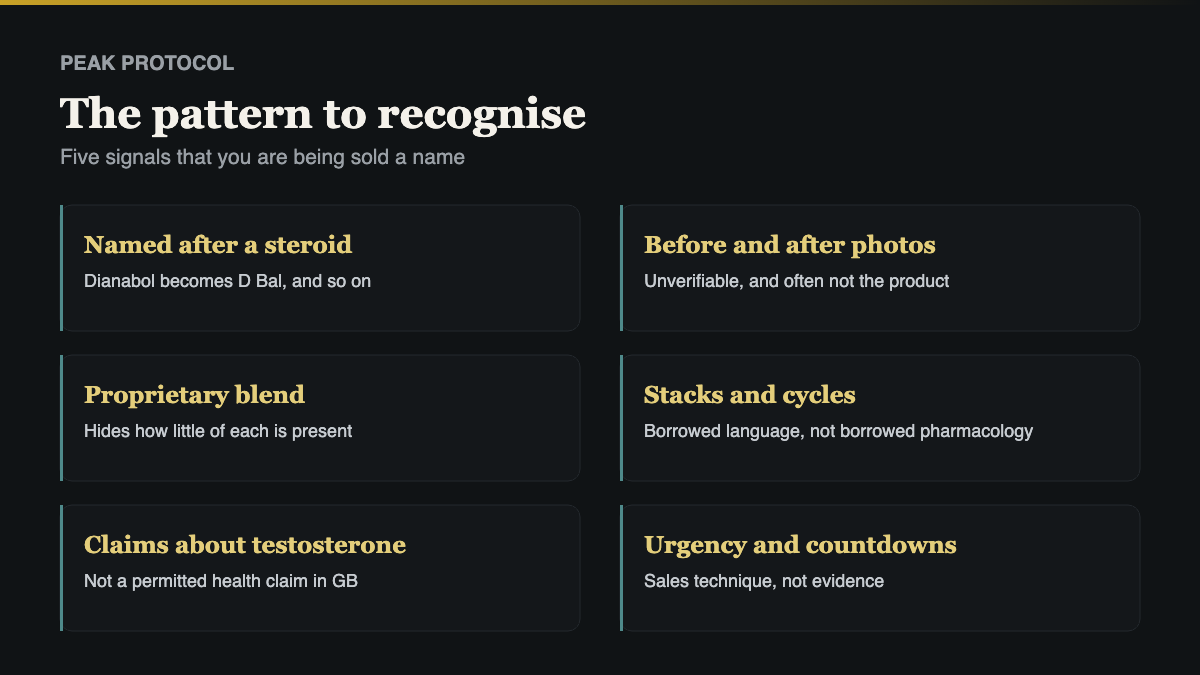
A name echoing a controlled compound. Before and after photographs. Language about cycles and stacks borrowed wholesale from steroid use. Proprietary blends that give a total weight without disclosing individual doses. Urgency pricing and permanent sales. And claims phrased just vaguely enough to avoid the register while creating a definite impression.
None of those tells you the product is harmful. Most of these products are harmless. It tells you the money went into the positioning rather than into the formulation.
SARMs are not a legal alternative
SARMs come up constantly in this context and they belong in a different category entirely.
They are not controlled under the Misuse of Drugs Act, which is where the idea that they are legal comes from. They are also not licensed medicines, and selling them for human consumption is not permitted in the UK. Sellers get around this by labelling them research chemicals not for human consumption, which is a legal fiction rather than a legal position.
They are not supplements, they are unapproved drugs with real effects and an incomplete safety picture. Treating them as a safer middle ground is the single most common mistake in this area.
Nor are prohormones
Prohormones are compounds the body converts into active hormones. Several have been controlled outright, and DHEA is a prescription only medicine in the UK, which surprises people because it sits on shelves freely in the United States.
Anything sold as a prohormone is either controlled, prescription only, or a supplement that does not do what the name implies. None of those is the legal loophole it is presented as.
How to read the label properly
Three checks, in order.
Is every ingredient listed with its individual dose? A proprietary blend that gives only a total is concealing the split, and the expensive ingredient is invariably the one at the bottom.
Is the dose comparable to the research? Ashwagandha at 600mg of a standardised extract is the trial dose. Ashwagandha at 50mg in a blend is a name on a label.
Are the claims authorised? If a benefit is stated that does not appear on the GB register, the seller either does not know the rules or does not care, and neither is reassuring.
The contamination problem nobody mentions
There is one genuine safety issue in this category, and it is not the ingredients on the label.
For tested athletes this matters twice over, as our anti-doping guide explains.
Testing programmes across several countries have repeatedly found bodybuilding supplements containing substances that were not declared: unapproved stimulants, prohormones, and in some cases actual anabolic agents. The products most likely to be adulterated are precisely the ones promising the most dramatic results, because a product that does nothing generates refund requests and a product that quietly contains something active does not.
Two practical consequences. If you are drug tested in any sport, an undeclared ingredient ends your season regardless of whether you knew, which is why tested athletes use products screened under programmes like Informed Sport or listed on the Cologne List. And if a supplement produces an effect that seems disproportionate to its ingredients, that is a reason for suspicion rather than satisfaction.
Buying from established brands through established retailers is most of the protection available here.
Where the money actually goes
It is worth understanding the economics, because they explain the marketing.
The raw materials in a typical product in this category cost a small fraction of the retail price. Creatine and the common vitamins and minerals are commodities. Botanical extracts cost more, which is exactly why they tend to appear at token doses.
The rest of the price covers marketing, affiliate commission and margin. Affiliate commission is the part most people never consider: a substantial share of the review sites ranking for these products earn a percentage of every sale they refer, which is why the reviews are uniformly positive and why the same handful of products appear on every list.
Look for a disclosure on any review page you read. If it is absent, that tells you something. If it is present, at least you know what you are reading.
What actually works instead
The honest list is short, unexciting and cheap.
The two with the strongest evidence each have their own guide, creatine and protein, and how we rate the rest is on our supplement evidence page.
Creatine monohydrate. Enough total protein. Sleep. Progressive training over years rather than months. Correcting an actual deficiency if you have one, which a blood test will tell you and a supplement label will not.
That is most of it. Anyone selling you something more exciting is selling the excitement.
If low testosterone is your genuine concern rather than an assumption, the answer is a blood test followed by a proper assessment, not a supplement named after a steroid.
Why we sell supplements and still say this
We stock creatine, protein, amino acids and vitamins in our shop, so we have an obvious interest in you buying supplements.
What we do not do is name them after controlled compounds, imply they replicate anabolic effects, or use claims outside the authorised register. Several of our product pages tell you the product will do very little for you if you are already hitting your protein target, which is a strange thing for a shop to write and entirely deliberate.
The category described on this page is profitable precisely because it is dishonest. We would rather sell less and be worth reading, because in a niche where everyone exaggerates, the only durable position is being the one that does not.
Five claims to distrust
Five claims turn up on almost every product in this category, and none of them survive contact with the evidence.
One, that it is a legal version of a specific steroid. It is not. Legal steroids UK products named to echo Dianabol or Anavar contain no steroid and share no mechanism with one. The name is the product.
Two, that a proprietary blend protects a formula. A proprietary blend hides the amount of each ingredient, which is convenient when several are present at doses far below anything used in a trial.
Three, that it raises testosterone. Raising testosterone is not a permitted health claim on a food supplement in Great Britain. Zinc contributes to the maintenance of normal testosterone levels in the blood, which is a much narrower statement and applies mainly if you are deficient.
Four, that before and after photographs mean anything. They are unverifiable, frequently unrelated to the product, and the transformation shown usually reflects a training programme and a diet rather than a capsule.
Five, that legal steroids UK products are automatically safe because they are legal. Legal means it can be sold, not that it has been tested. Contamination of sports supplements with undeclared substances is a documented and recurring problem.
What to buy instead
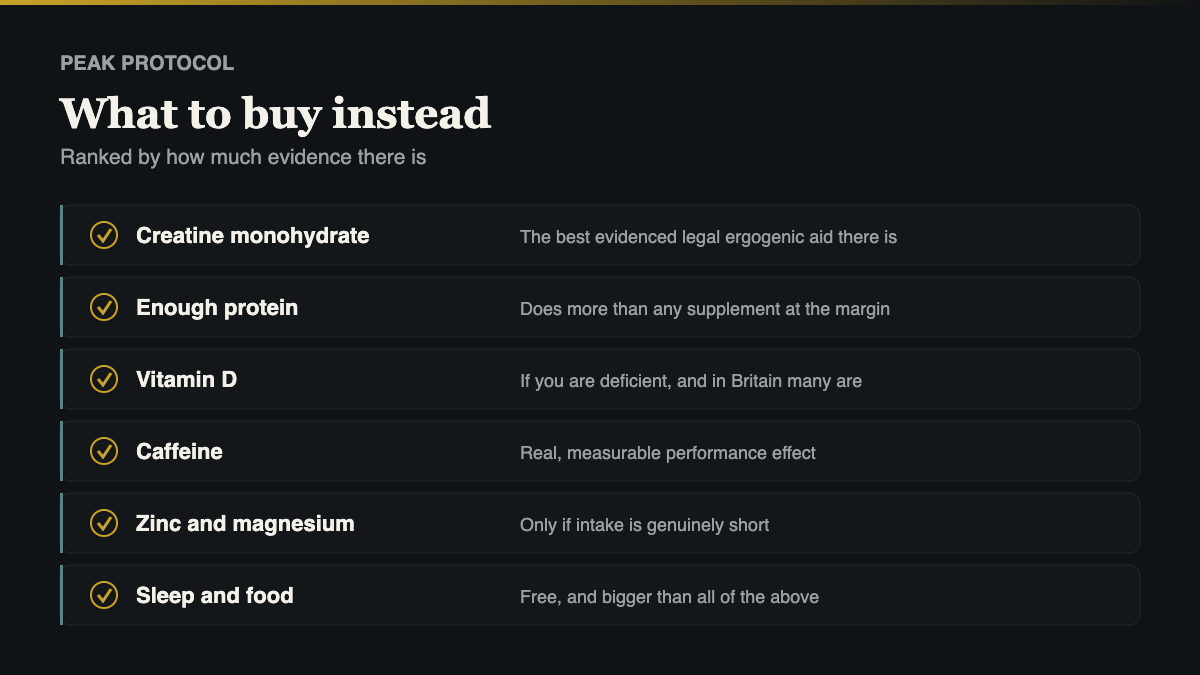
We sell supplements, so take this in the spirit it is meant: the honest list of things worth buying is short, cheap, and mostly boring.
Creatine monohydrate. The single best evidenced legal ergogenic aid there is, effective at a few grams a day, and cheap. It does not need a brand, a blend or a name borrowed from a controlled drug. Anyone selling legal steroids UK products at five times the price of creatine is selling packaging.
Enough protein. Hitting a sensible daily target does more for body composition than any supplement decision at the margin. If food gets you there, you do not need powder at all.
Vitamin D, and zinc or magnesium only if you are short. These are deficiency corrections rather than performance drugs. Vitamin D contributes to normal muscle function and magnesium contributes to the reduction of tiredness and fatigue, which is the whole of the permitted claim.
And be clear about what the category cannot do. No legal steroids UK product replicates an anabolic steroid, and nobody honest will tell you otherwise. If you are weighing up the real thing, read anabolic steroids in the UK and steroid side effects first. If the underlying issue is genuinely low testosterone, that is a medical question with a lawful answer in how to get TRT in the UK, and SARMs are not the middle path they are sold as.
Legal steroids: common questions
Do legal steroids work?
They are food supplements. Some ingredients inside them work, creatine most obviously, and none of them replicate an anabolic steroid. A product implying otherwise is making a claim that is not authorised in Great Britain.
Are legal steroids safe?
Most are harmless because most contain ordinary supplement ingredients. The risk is wasted money and, occasionally, undeclared ingredients in products bought from unregulated sellers.
What is the strongest legal steroid?
There is no such thing, because none of them are steroids. The supplement with the strongest evidence for training performance is creatine monohydrate, and it is also one of the cheapest.
Are SARMs legal in the UK?
They are not controlled drugs, and they are also not licensed medicines, and selling them for human consumption is not permitted. Research chemical labelling is a workaround rather than a legal basis.
Can any supplement raise testosterone?
Correcting a genuine zinc or vitamin D deficiency can restore levels that had fallen because of it. Nothing available legally raises testosterone above normal in a man who is not deficient.
Do legal steroids UK products actually work?
Not in the way the name implies. They contain no steroid and share no mechanism with one. Some individual ingredients, creatine especially, have genuine evidence behind them, but you can buy those directly for a fraction of the price of a branded blend.
Are legal steroids UK products safe?
Legal means saleable, not tested. Most are harmless and simply ineffective, but contamination of sports supplements with undeclared substances is a documented and recurring problem, which matters particularly for anyone subject to drug testing at work or in sport.
What is the best legal alternative to steroids?
Creatine monohydrate, adequate protein and enough sleep, in that order. None of them replicate anabolic steroids and nobody honest will claim they do, but they are the interventions with real evidence behind them and they cost very little.