Legal steroids UK: what they actually are and what works
What products marketed as legal steroids actually contain, which ingredients have evidence, and what UK advertising rules permit anyone to claim.

This is the awkward category, because we sell supplements and are about to tell you that most of them do very little. Both of those things are true at once, and a site unwilling to say the second is not worth reading on the first.
The guides here cover what the evidence actually supports, what may lawfully be claimed in Great Britain, and why the phrase legal steroid is meaningless. Nothing in this category is written to move stock.
On this page

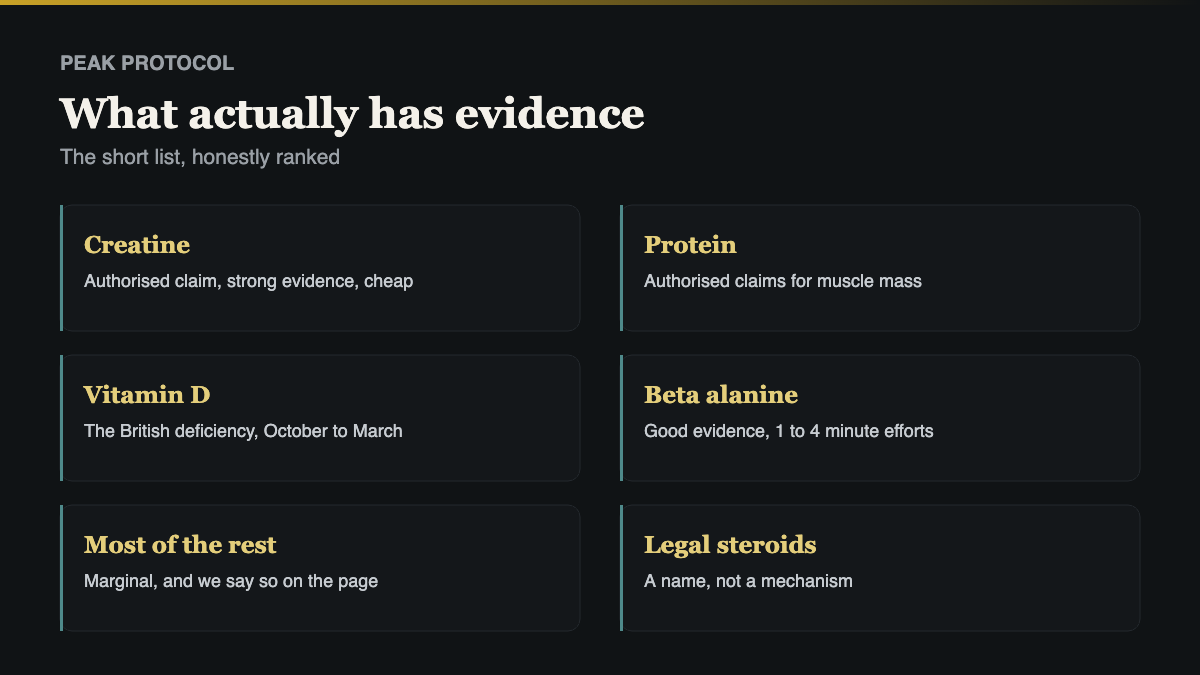
Four or five supplements have evidence strong enough to be worth the money for most people who train. A slightly longer list has a modest case in specific circumstances. Everything else is either unproven, underdosed, or correcting a shortfall you do not have.
Nothing in any of those groups competes with training, food and sleep, and nothing in them is remotely comparable to the compounds covered elsewhere on this site. Anyone telling you otherwise is selling something.
Legal steroids UK is the main guide here and it is largely a demolition of the phrase. It covers what those products actually contain, what the ingredients do at the doses supplied, and why the category exists at all.
The product pages across our range carry the same treatment applied individually: the dose, the cost per serving, the evidence, and a plain statement where the evidence is thin. Several of them tell you the product will do very little for you.
This list is short, and it has been short for twenty years.
| Supplement | What the evidence supports |
|---|---|
| Creatine monohydrate | Strength and power output, well replicated over decades |
| Protein powder | Convenience, where total daily protein is otherwise short |
| Caffeine | Endurance and perceived exertion, reliably |
| Vitamin D | Correcting a deficit, which is common in the UK in winter |
| Omega 3 | Cardiovascular markers, with a modest effect size |
| Beta alanine | High intensity work in the 60 to 240 second range |
Creatine is the only one in that list that behaves like the marketing for the whole category suggests, and it costs almost nothing. Protein powder is food rather than a supplement, and its value is convenience rather than any property of the powder.
A second tier has some support in specific situations and should not be oversold.
Citrulline malate for training volume. Ashwagandha for stress markers, with reasonable trials and an unclear effect size. Magnesium and zinc where intake is genuinely short, which is common enough to be worth checking. Electrolytes where sweat losses are large. Beetroot and nitrate for endurance.
What these supplements share is that the effect is real, small, and conditional on the situation applying to you. None of them changes an outcome on its own.
We stock some of these, which makes this list uncomfortable to publish and more useful because of it.
BCAAs, where the evidence has moved against them. Testosterone boosters, where the effect in men with normal levels is essentially zero. Fat burners, which are caffeine plus a premium. Most proprietary blends, where the amounts are hidden precisely because they are small. Glutamine outside clinical settings. Deer antler velvet and the rest of that family.
Our product pages say this individually rather than only here. The BCAA range pages state that complete protein is the better purchase, which costs us sales and is the correct thing to print.
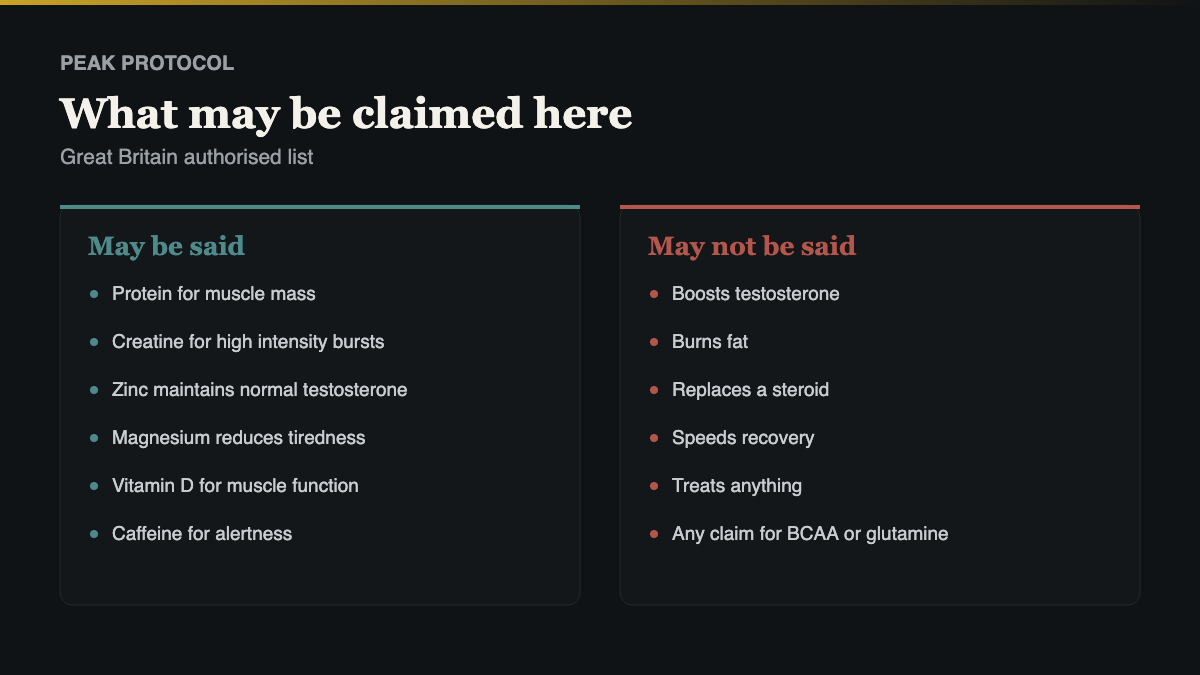
Supplement claims in Great Britain are not a matter of opinion. Only wording on the Great Britain nutrition and health claims register may be used, and only where the product delivers the required amount of the nutrient.
That is why authorised claims sound so stilted: contributes to the maintenance of normal muscle function is approved wording, and builds muscle is not. A product page using the second is breaking the rules, whatever it believes about the ingredient.
The Food Standards Agency regulates supplements as food rather than as medicine, and the Advertising Standards Authority polices how they are advertised. Both are worth knowing about before trusting any claim on any site.
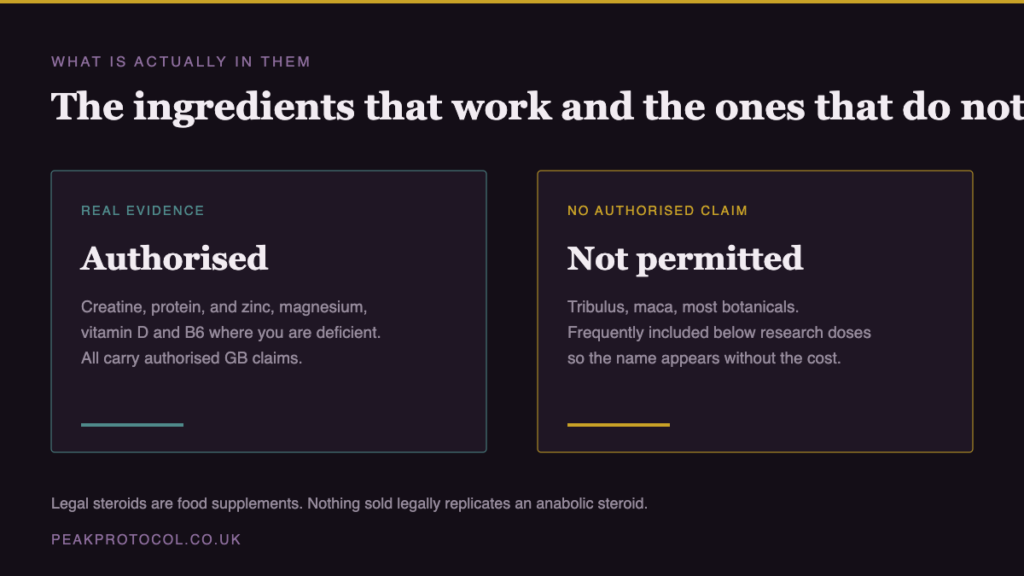
There is no such thing. A steroid is a class of compound; legal steroid is a marketing phrase attached to products that contain none of them.
What is usually in the tub is a blend of the second tier ingredients above, at doses that range from reasonable to token, sold at several times the price of buying them separately. The phrase exists to borrow credibility from something these supplements have no relationship with.
It is also outside UK advertising rules, which is why you will not find it anywhere on this site except in a sentence explaining why we do not use it. Our guide to the category goes through what those products contain in detail.
Most of the nonsense in this category survives because study quality is invisible in a headline.
Four questions settle most of it. Was it in humans, or in cells or rodents? How many participants, and was there a control group? Was the dose the same as the dose in the tub, which is where most ingredient stories collapse? And who funded it, since manufacturer funded trials on their own ingredients are common and rarely negative.
Effect size matters as much as significance. A statistically significant one percent improvement is real and irrelevant, and that distinction is the one marketing depends on.
Formulations converge in this industry. What genuinely differs is whether the tub contains what the label says, and analytical surveys of retail supplements have repeatedly found gaps between the two.
For anyone tested in sport or at work, that is not an academic problem. A clean formulation is not a clean batch, and under strict liability the responsibility is yours. UK Anti-Doping publishes guidance and batch testing is the only real assurance.
In order, for almost everybody: sleep, total food, training consistency, then creatine, then protein if hitting the target is difficult, then vitamin D in a British winter. That list is dull and it is also accurate.
A hundred pounds spent on supplements beyond that produces less than the same hundred pounds spent on food, and considerably less than an extra hour of sleep a night that costs nothing at all.
Where you have decided to buy, the categories worth starting with are creatine and protein, which carry the strongest evidence of anything we sell. Vitamins and minerals matter where there is a genuine shortfall, and testosterone support is mostly those same nutrients under a more exciting name.
Every product page prints the dose, the cost per serving and the alternatives on our own shelves, including where a cheaper product is the better buy.
A large part of supplement culture is devoted to questions that do not matter, and timing is the clearest example.
The anabolic window turned out to be hours rather than minutes, and total daily protein matters far more than when any of it arrived. Creatine does not need loading, does not need cycling, and works on saturation over weeks rather than on timing. Taking supplements only on training days makes sense for caffeine and for almost nothing else.
What does matter is consistency, which is unglamorous and difficult to sell. A cheap product taken every day beats an expensive one taken when you remember.
Most of what separates good supplements from poor ones is on the back of the tub in small type.
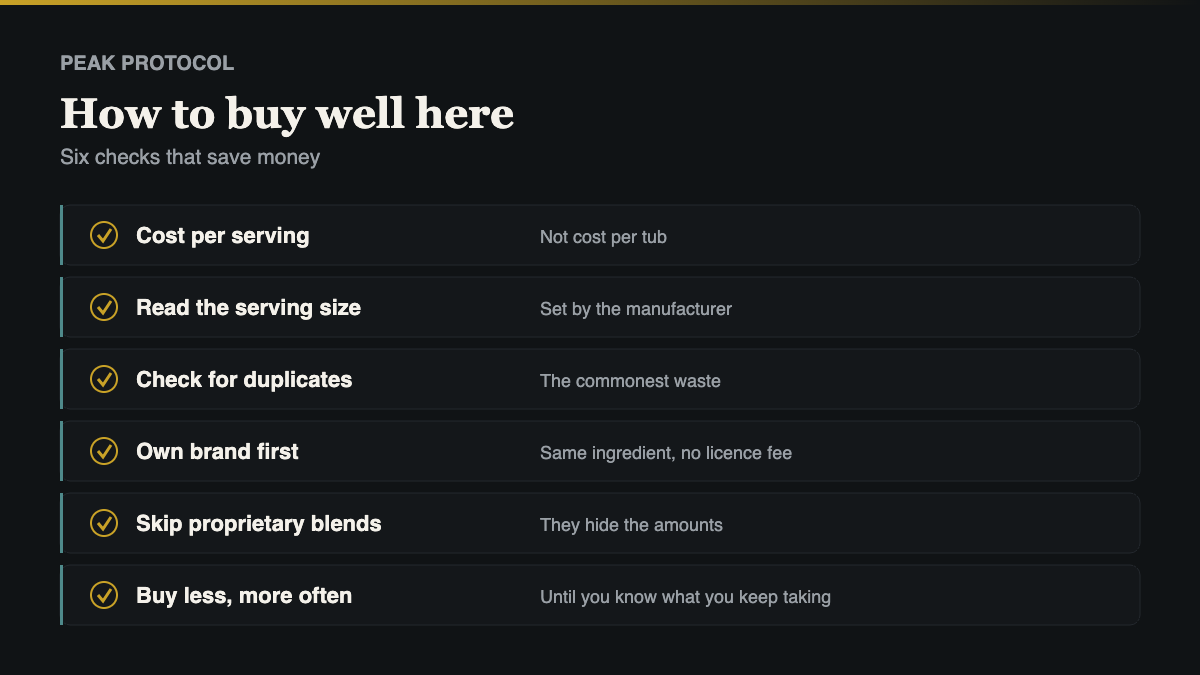
Read the amount per serving rather than the percentage of reference intake, because the percentage describes a population and not you. Check the ingredient order, since everything after the sweeteners and anti caking agents is present in token quantities. Treat a proprietary blend as a refusal to tell you the doses, because that is what it is.
Then divide the price by the number of servings you will actually get. That single number sorts this category faster than any review, and it is the comparison we print on every product page for exactly that reason.
Telling people that most supplements do very little is an odd commercial strategy, and it is a deliberate one.
The alternative is joining an industry that sells hope by the kilogram, and competing on advertising spend against companies far better funded than we are. A shop that will say which of its own products are not worth buying is at least worth believing when it says one is.
It also costs less than it looks. The people who buy supplements after reading pages like this one tend to buy the right thing, keep taking it, and come back. Overselling produces one sale and a return.
Creatine monohydrate for almost anyone who trains, protein powder if hitting your target is otherwise hard, and vitamin D through a British winter. The list is genuinely that short.
In men with normal levels, essentially not at all. Where they help it is by correcting a vitamin D, zinc or magnesium shortfall, which you could do far more cheaply.
No. The phrase is marketing and the products contain none. It is also outside UK advertising rules, which is why you will not see it used here.
Rarely past a basic quality threshold. You are usually paying for brand and flavour rather than for a better active, so compare on cost per serving.
Most people do not. They close a gap where one exists and do very little where it does not, which is the honest position even though we sell them.
No, and nothing that could would be a legal supplement. Every authorised claim is conditional on supporting a normal function rather than replacing the work.
Our editorial policy explains how these claims are checked, and the authorised claims register is the independent version of what may lawfully be said about any of this.
What products marketed as legal steroids actually contain, which ingredients have evidence, and what UK advertising rules permit anyone to claim.