
Information and harm reduction only, never medical advice. Sourced from the NHS, TALK TO FRANK, the MHRA and peer reviewed research, and written to say plainly where the evidence runs out rather than filling the gap. Always speak to a qualified clinician before changing anything. See our editorial policy.
Hair loss is one of the two side effects that most reliably makes people stop, and it is also the one most consistently misunderstood.
Anabolic steroids do not give anyone male pattern baldness who was not going to get it. What they do is compress a process that might have taken fifteen years into one or two, which in practice is a distinction without much comfort if it happens to you.
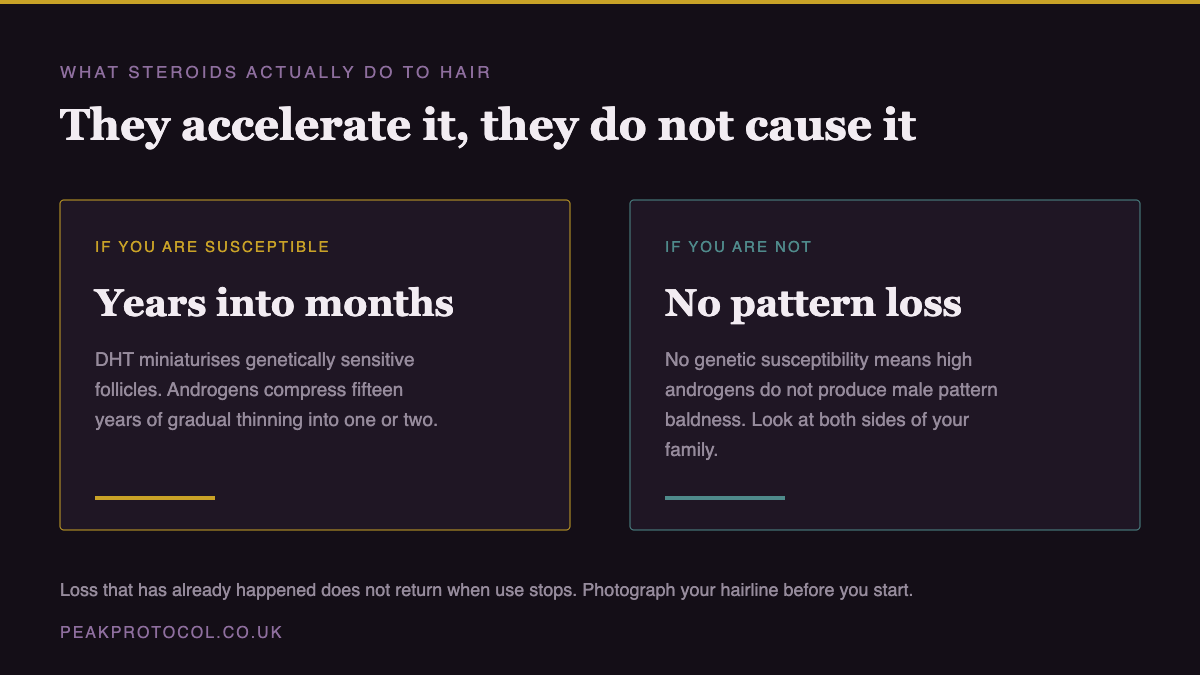
Acceleration, not causation
Male pattern baldness, properly androgenetic alopecia, is genetically determined. Some follicles on the scalp are sensitive to androgens and some are not, and which ones you have is set before you are born.
If you have no genetic susceptibility, high androgen levels do not produce pattern baldness. If you do, raising androgens dramatically accelerates what those follicles were already going to do.
This is why two men on identical compounds can have completely different outcomes, and why the forum question of whether a particular compound causes hair loss has no general answer.
What DHT does
Testosterone converts to dihydrotestosterone through the enzyme 5 alpha reductase. DHT is a considerably more potent androgen at the hair follicle.
In susceptible follicles, DHT drives miniaturisation: each growth cycle produces a slightly finer, shorter, less pigmented hair, until the follicle produces something barely visible and eventually nothing. The follicle does not disappear immediately, which is the basis for treatment working at all, but once it has been dormant long enough it does not come back.
That progression is why timing matters more than intensity. Catching it while follicles are miniaturised is a completely different proposition to catching it after they are gone.
Which compounds are worst for hair
Compounds vary in how much they contribute, and the pattern is broadly predictable.
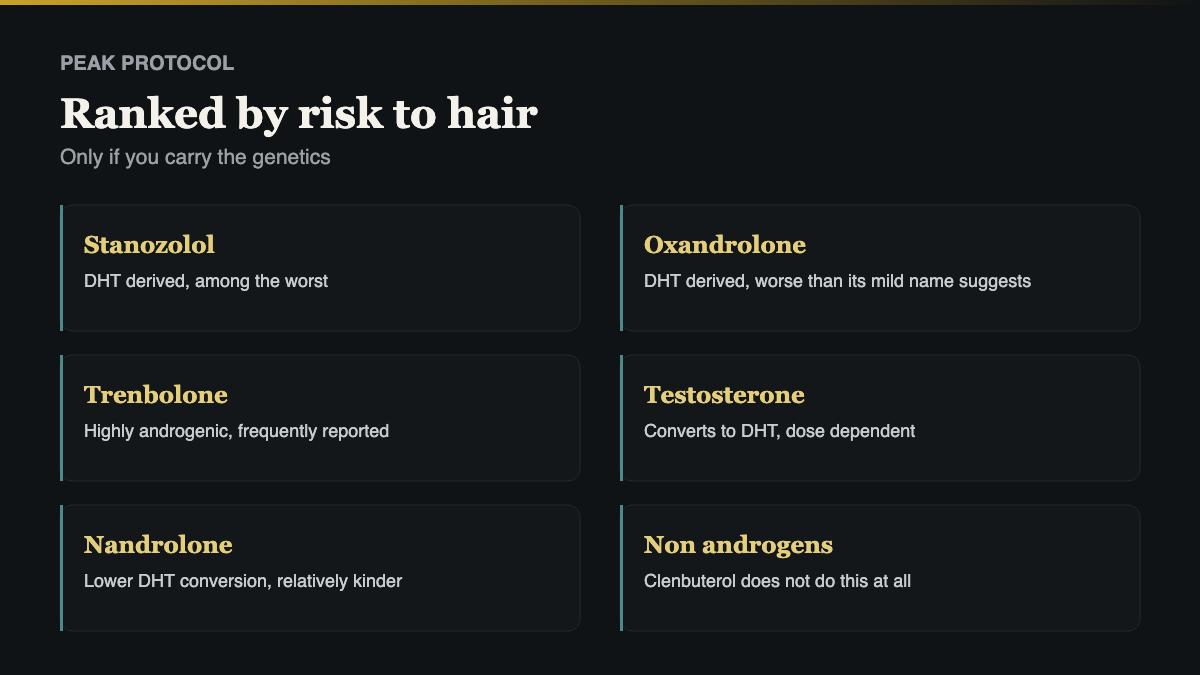
Anything that converts readily to DHT, or that is itself a DHT derivative, tends to be worse. Testosterone converts, so it contributes. Several oral compounds are DHT derivatives and are commonly reported as aggressive in this respect.
Compounds that do not follow that pathway are generally reported as milder for hair specifically, though they carry their own issues elsewhere. Nandrolone is the usual example, and it is associated with other problems that make it a poor trade rather than a clever workaround.
There is no compound that is safe for hair in a susceptible man at meaningfully supraphysiological doses. Choosing differently changes the rate, not the direction.
Genetics decide your risk
Look at your family, and look at both sides. The idea that baldness comes exclusively from the mother’s father is a persistent myth. There is a significant X linked component, which is where the myth comes from, and multiple other genes are involved, so paternal history matters too.
Hair loss is one of several androgenic effects; the full picture is in steroid side effects.
If your father, grandfathers and uncles kept their hair into their sixties, your risk is lower. If several of them thinned early, assume you are susceptible and that androgens will bring it forward.
Also look at yourself honestly. Slight recession at the temples in your twenties is the early stage of the process, not a mature hairline that will hold.
How fast it progresses
This is what separates it from ordinary pattern baldness, and it is the part people are unprepared for.
Natural progression is gradual enough that most men adjust as they go. Androgen accelerated loss can be dramatic over months, with noticeable thinning at the temples and crown inside a single period of use.
Because it is fast, it is also frequently the first side effect anyone notices, and it arrives before most of the benefits have fully materialised.
Shedding is not the same as loss
An important distinction that saves a lot of unnecessary panic.
Telogen effluvium is a temporary increase in shedding triggered by a physiological stressor, and it can follow starting or stopping compounds, illness, crash dieting or significant stress. It presents as diffuse shedding across the whole scalp rather than in a pattern, and it typically resolves within months with full regrowth.
Androgenetic loss is patterned, temples and crown, and it does not resolve.
If hair is coming out everywhere evenly, that is more likely to be shedding. If the hairline is receding at the temples specifically, that is the other thing.
Is any of it reversible
Partly, and only early.
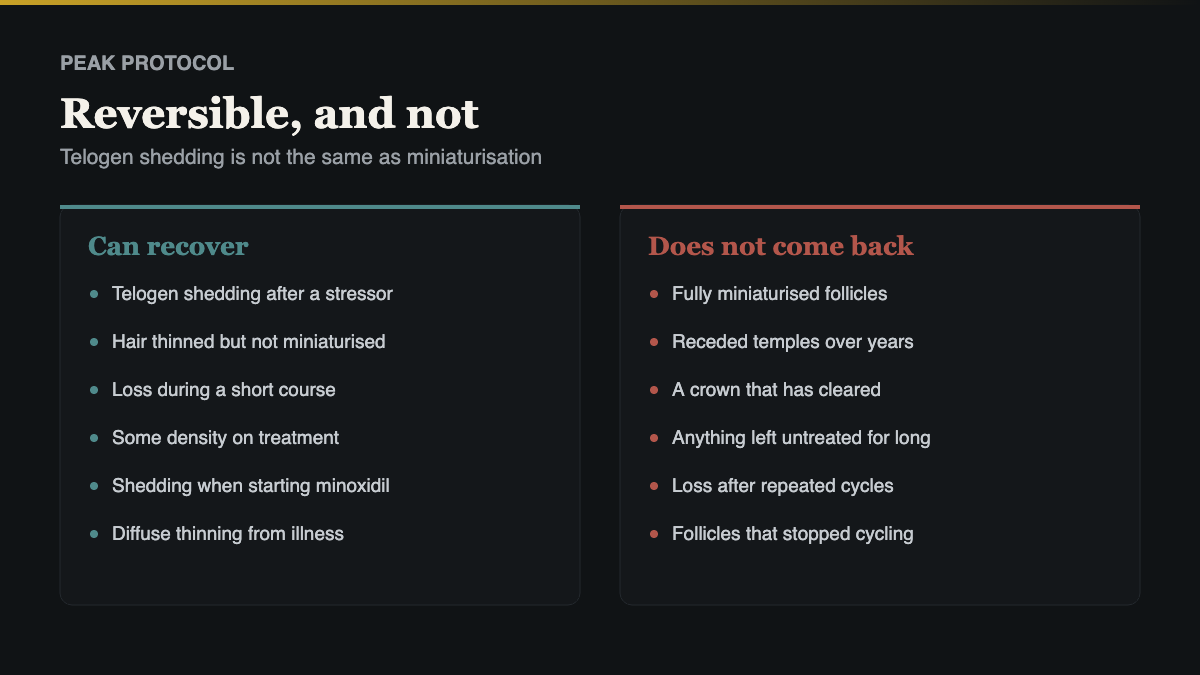
Follicles that have miniaturised but are still producing hair can recover to some extent if the driver is removed or treated. Follicles that have been dormant for years do not.
Stopping the compound removes the acceleration. It does not restore what has gone, and the underlying genetic process continues at its normal pace afterwards.
The honest summary is that you keep whatever is still alive when you intervene, and lose what has already gone.
On finasteride
Finasteride inhibits 5 alpha reductase, reducing conversion of testosterone to DHT. It is the most effective widely available treatment for androgenetic alopecia and it is the one most commonly used alongside androgen use.
In the UK, finasteride 1mg for male pattern baldness is a pharmacy medicine, meaning it is obtained after a consultation with a pharmacist or prescriber rather than off the shelf. That consultation exists for a reason, and it is worth having properly rather than ordering from an unregulated source.
Two things worth understanding. It works by prevention rather than restoration, so it protects what you have far better than it recovers what has gone. And at the androgen levels involved in steroid use, its effect is partial at best, because it reduces conversion rather than eliminating the androgen load driving the process.
The finasteride side effect question
This deserves a straight answer because the internet gives two extreme ones.
A minority of men report sexual side effects including reduced libido and erectile difficulty. In controlled trials the rates are low and close to placebo, and there is a genuine, unresolved debate about persistent symptoms in a small subset after stopping.
What is not honest is either dismissing the reports entirely or presenting them as the likely outcome. The reasonable position is that most men take it without difficulty, a minority do not, and it is worth discussing with the pharmacist or doctor rather than deciding from forum posts in either direction.
Being straightforward about your androgen use in that conversation changes the advice you get.
Minoxidil
Topical minoxidil is a pharmacy medicine in the UK and works through a different mechanism, prolonging the growth phase and improving follicular blood supply rather than affecting DHT.
It is frequently used alongside finasteride because the mechanisms are complementary. It requires indefinite continued use, since stopping returns the scalp to where it would have been, and initial shedding in the first weeks is common and expected rather than a sign it is failing.
Transplants
Transplantation moves follicles from the back and sides, which are typically not androgen sensitive, to the areas that are.
It works and it is permanent for the transplanted hair. The complication in this context is that native hair around the transplant continues to be lost, which can produce an odd result over time unless the underlying loss is also being managed. Most surgeons will want that addressed before operating.
Doing it while continuing high androgen use is generally a poor investment for the same reason.
How to actually track it
People are unreliable narrators about their own hairline, in both directions. Some panic over normal shedding, others fail to notice steady loss until it is well advanced. Photographs solve both problems.
Take four: hairline straight on, both temples, and the crown from above, in the same lighting with dry hair, and repeat every three months. Nothing else gives you a comparison worth having, because day to day impressions depend on lighting, hair length and how it dried.
The other useful check is the hair itself rather than the count. Miniaturisation shows up as hairs becoming finer and shorter in one area while remaining normal elsewhere. That difference in texture across the scalp is often visible before any thinning is.
If you are going to use, take the photographs before you start. That baseline is worth more than any amount of later argument with yourself about whether it has changed.
The cost of treating it
Worth pricing in before you start rather than discovering afterwards, because both effective treatments require indefinite continuation.
Finasteride and topical minoxidil are both ongoing costs for as long as you want the effect, and stopping either returns the scalp toward where it would otherwise have been. That is not a course of treatment, it is a subscription, and over decades it adds up.
Transplantation is a large one off cost and usually still requires ongoing medication to protect the native hair around it.
None of that is an argument against treating it. It is an argument for knowing the commitment before you accelerate a process that creates the need.
What does not work
Shampoos marketed for hair loss. Supplements sold for hair growth, unless you have a genuine deficiency, and biotin only carries an authorised claim for the maintenance of normal hair, which is not the same as regrowing lost hair. Scalp massage devices. Laser combs, on any evidence worth the price.
We sell supplements and we are not going to sell you one for this. Nothing in that category reverses androgenetic alopecia, and anything implying otherwise is making a claim that is not authorised in Great Britain.
Deciding before you start
If you are susceptible and you use, you will very likely lose hair faster. That is the trade, and it is worth making consciously rather than discovering.
Some men decide it is worth it. Some decide it is not, and it is the single most common reason people stop. Both are reasonable, and the worst outcome is the one where nobody thought about it until the temples had already gone.
See also steroid side effects for what else is on the list, and gynaecomastia, which is the other one that does not reverse.
Five things people get wrong
Five misunderstandings run through almost every conversation about this, and the first one reframes the whole question.
One, thinking steroids cause baldness. They do not. Steroids and hair loss are connected because androgens accelerate a process that your genetics already decided. A man with no genetic predisposition can run high androgens and keep his hair. A man who was going to lose it at forty may lose it at twenty six instead.
Two, treating shedding as loss. A temporary increase in shedding after starting or stopping something is often telogen effluvium and recovers. Miniaturisation, where follicles produce progressively finer hair, is the one that does not.
Three, assuming mild compounds are kind to hair. Oxandrolone and stanozolol are DHT derived and are among the worst for this, which surprises people who chose them for their gentle reputation.
Four, starting finasteride without understanding it. It works for many men and the side effect debate is genuine rather than invented. That is a decision to make deliberately, not reactively at the point where steroids and hair loss have already become visible.
Five, acting only once it shows. By the time loss is obvious in a mirror, a substantial share of follicles have already miniaturised. Photographs taken monthly catch it far earlier than memory does.
A decision framework, step by step
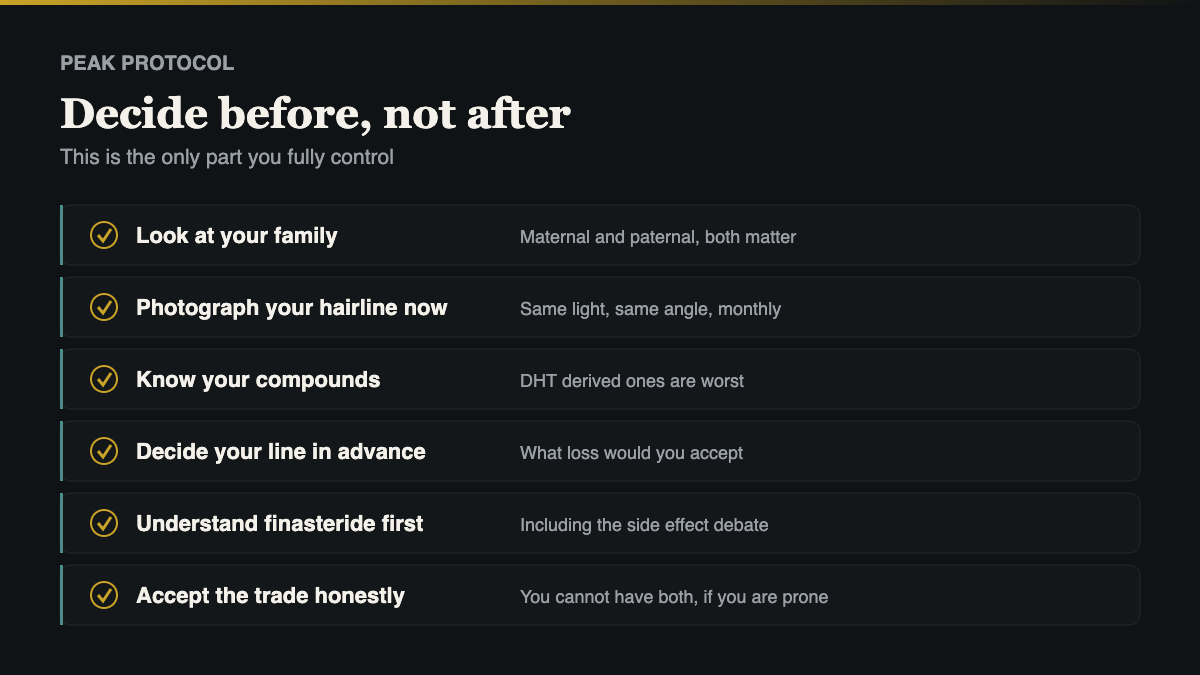
This is the one steroid side effect you can genuinely decide about in advance, and almost nobody does.
Look honestly at your family. Both sides, not just your mother’s father. If the men in your family kept their hair into their sixties, your risk from steroids and hair loss is low. If they did not, androgens will bring your timeline forward and no compound choice makes that untrue.
Photograph it now. Same light, same angle, monthly. This costs nothing and it is the only way to distinguish normal variation from real progression early enough to act.
Decide your line before you need it. The genuinely difficult question is what you would accept, and answering it while nothing is happening produces a better decision than answering it in a panic six months in. Compound choice shifts the odds a little; nandrolone converts to DHT less readily than stanozolol or oxandrolone, but none of it is protective.
And be clear that steroids and hair loss is a trade, not a problem to solve. If you are predisposed and you use androgens, you are choosing to spend hair for muscle. That is a legitimate choice to make knowingly, and a miserable one to discover by accident. Steroid side effects covers what else does and does not reverse.
Steroids and hair loss: common questions
Do steroids cause hair loss?
They accelerate male pattern baldness in men who are genetically susceptible. In men who are not susceptible, they do not cause pattern baldness.
Will my hair grow back if I stop?
Follicles that have miniaturised but are still producing hair may partly recover. Follicles dormant for years do not. Stopping removes the acceleration rather than reversing what has gone.
Which steroids are worst for hair?
Those that convert readily to DHT or are DHT derivatives. No compound is safe for hair in a susceptible man at high doses, so the choice changes the rate rather than the direction.
Does finasteride prevent steroid related hair loss?
It reduces conversion of testosterone to DHT and helps, though its effect is partial at the androgen levels involved. In the UK it is a pharmacy medicine obtained after a consultation.
Is my hair falling out everywhere or just at the temples?
Diffuse shedding across the whole scalp is usually telogen effluvium, which is temporary. Recession at the temples and crown is androgenetic and is not.
Do steroids cause hair loss?
They accelerate it rather than cause it. Androgens speed up male pattern baldness in men who are genetically predisposed, and have no effect on hair in men who are not. The genetics decide whether it happens; the compounds decide how quickly.
Which steroids are worst for hair loss?
DHT derived compounds, particularly stanozolol and oxandrolone, along with trenbolone which is highly androgenic. Nandrolone converts to DHT less readily and is generally considered kinder to hair, though nothing in the class is protective.
Will hair grow back if I stop?
Temporary shedding often recovers, but follicles that have fully miniaturised do not come back. That is why acting early matters, and why monthly photographs are more useful than waiting until the change is obvious in the mirror.