
Counterfeit steroids are not a fringe problem in the UK. They are most of the market. Because anabolic steroids cannot be sold legally without a prescription, the products in circulation are made in unregulated labs with no oversight of what goes in, how clean it is or whether the label is true. This guide explains what testing typically finds, why the usual signs of quality mean nothing and what that means for anyone who already has a product. It is part of our steroids in the UK hub, and it contains no advice on buying or sourcing any drug.
Counterfeit steroids: the short version
- Almost all anabolic steroids outside prescriptions come from underground labs with no regulatory control.
- Analyses of seized and purchased products repeatedly find the wrong drug, the wrong dose, no active drug at all, or contamination.
- Pharmaceutical style packaging, holograms, batch numbers and online “lab tests” are easy to fake and prove nothing.
- Non sterile injectables can cause abscesses and serious infections regardless of what the active drug is.
- In Wales, WEDINOS tests submitted samples anonymously and publishes the results.
- Suspected fake medicines can be reported to the MHRA Yellow Card scheme.
Why counterfeits dominate
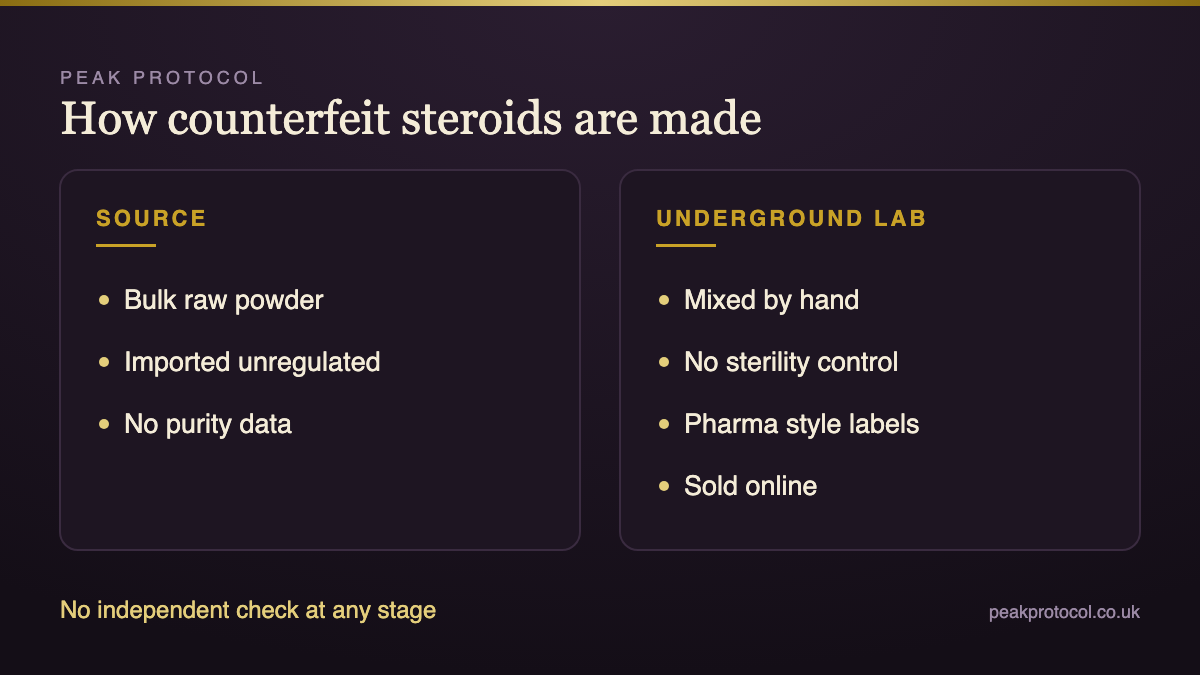
Genuine pharmaceutical steroids are made by licensed manufacturers, checked by regulators and supplied through pharmacies on prescription. Very little of that supply leaks into the unregulated market. What fills the gap is product made from raw powder, usually imported in bulk, dissolved or pressed by underground labs and packaged to look as if it came from a pharmaceutical company.
Many of these operations invent brand names that sound like drug companies and build websites, logos and “certificates” to match. Others copy the packaging of real manufacturers. Either way, nobody independent checks the contents, and the seller has no legal accountability. The Medicines and Healthcare products Regulatory Agency regularly seizes large volumes of illegal medicines, and its warnings about fake medicines apply directly to this market.
That is also why UK steroid law treats postal importation and supply so seriously: the supply chain is criminal from end to end.
What testing finds inside
Studies and testing services that have analysed steroid products bought or seized in the UK and Europe report the same problems again and again.
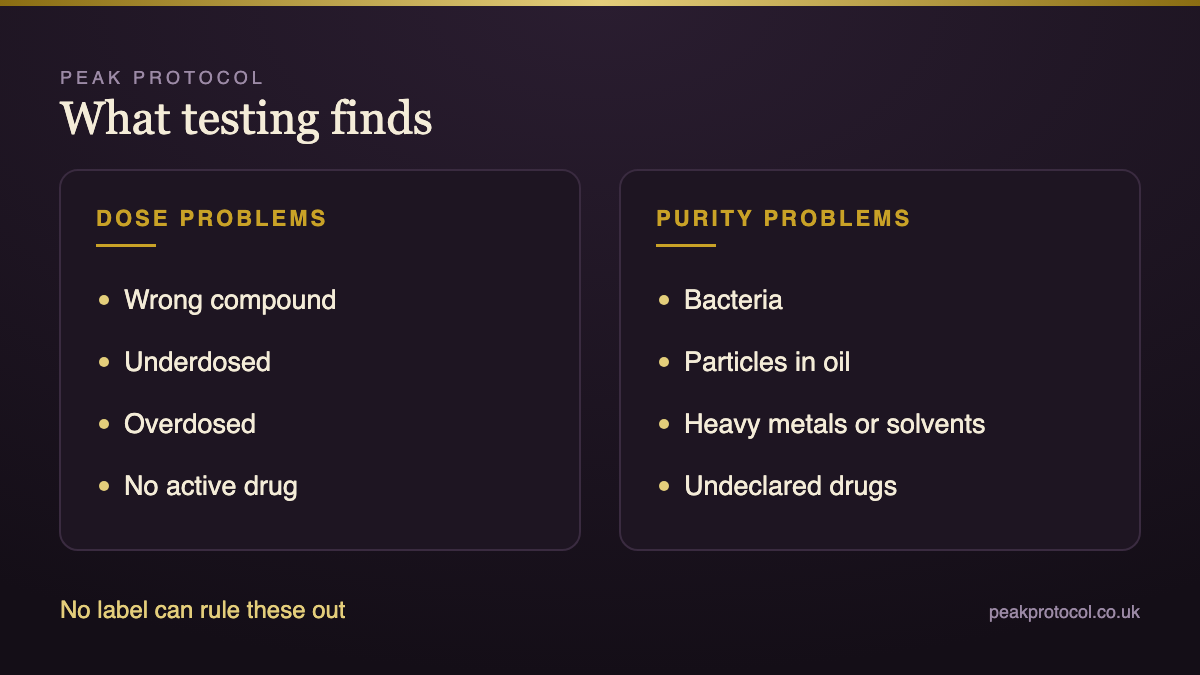
| Problem | What it means | Why it matters |
|---|---|---|
| Wrong compound | A different steroid from the one on the label | Different side effects, different detection times in sport |
| Underdosed | Less active drug than stated | People increase the dose or add more drugs |
| Overdosed | More active drug than stated | Greater side effects than expected |
| No active drug | Oil or filler only | Money wasted, injection risks remain |
| Contamination | Bacteria, particles, heavy metals or solvents | Infections, abscesses, unknown toxicity |
| Undeclared extras | Added drugs not on the label | Unexpected reactions and interactions |
These problems are not confined to cheap or obscure products. Well known underground brands are counterfeited in turn, so even a buyer who thinks they know the maker cannot be sure the product came from them.
Sterility: the risk nobody can see
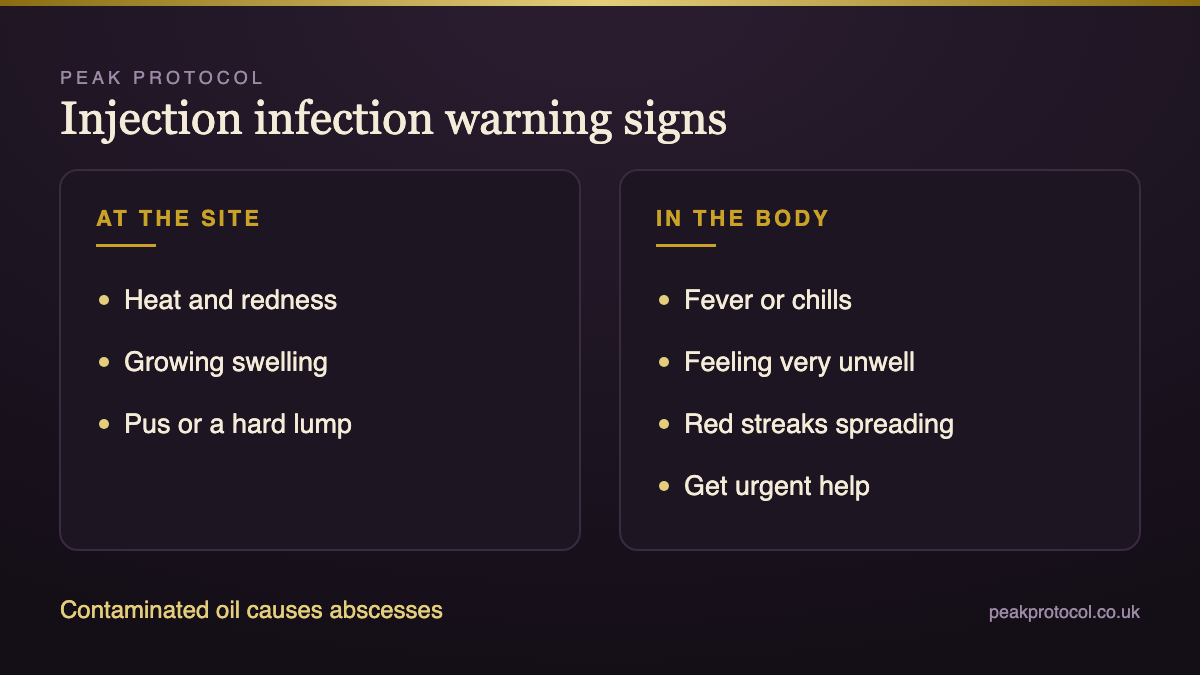
Injectable products must be sterile, and pharmaceutical manufacturers achieve that with controlled clean rooms, validated filtration and testing. Underground labs rarely have any of this. Bacterial contamination, fungal contamination and particles in oil have all been found in tested products.
Contaminated injections can cause abscesses that need surgical drainage, cellulitis, and in the worst cases infections that spread to the blood or heart valves. Our steroid injection safety guide explains the warning signs. A hot, red, swollen injection site, especially with fever, needs urgent medical attention.
Why the usual quality signs mean nothing
People often rely on signals that feel reassuring but cannot be verified.
- Packaging and holograms. Printing and hologram stickers are cheap and widely available.
- Batch numbers and verification codes. A code that checks out on the seller’s own website verifies nothing, because the seller controls the website.
- “Lab tested” certificates. Certificates posted online are easy to fabricate or reuse, and a test of one sample says nothing about the next batch.
- Reviews and forum reputation. Reviews are easily faked and cannot tell you what is in a vial.
- Feeling an effect. Feeling something tells you a drug is present, not which one or how much.
There is no way to make an unregulated product safe by choosing it carefully. That is the honest conclusion, and it applies equally to SARMs and to products sold as legal steroids, some of which have been found to contain undeclared drugs.
Substance testing services
WEDINOS, run by Public Health Wales, accepts drug samples by post from anywhere in the UK, tests them free of charge and publishes the result against an anonymous reference number. It is the main service of its kind in Britain and can identify what a product actually contains. It cannot tell you whether a product is safe to use, and it does not test sterility.
Some drug services also offer testing or can advise on local options. TALK TO FRANK can point you to services near you.
Reporting fake medicines
If you have had a reaction you think was caused by a fake or contaminated medicine, see a doctor first, then report it to the MHRA Yellow Card scheme. Reports help the MHRA identify dangerous products. You can report without incriminating yourself, and the aim of the scheme is safety, not prosecution.
If you already have a product
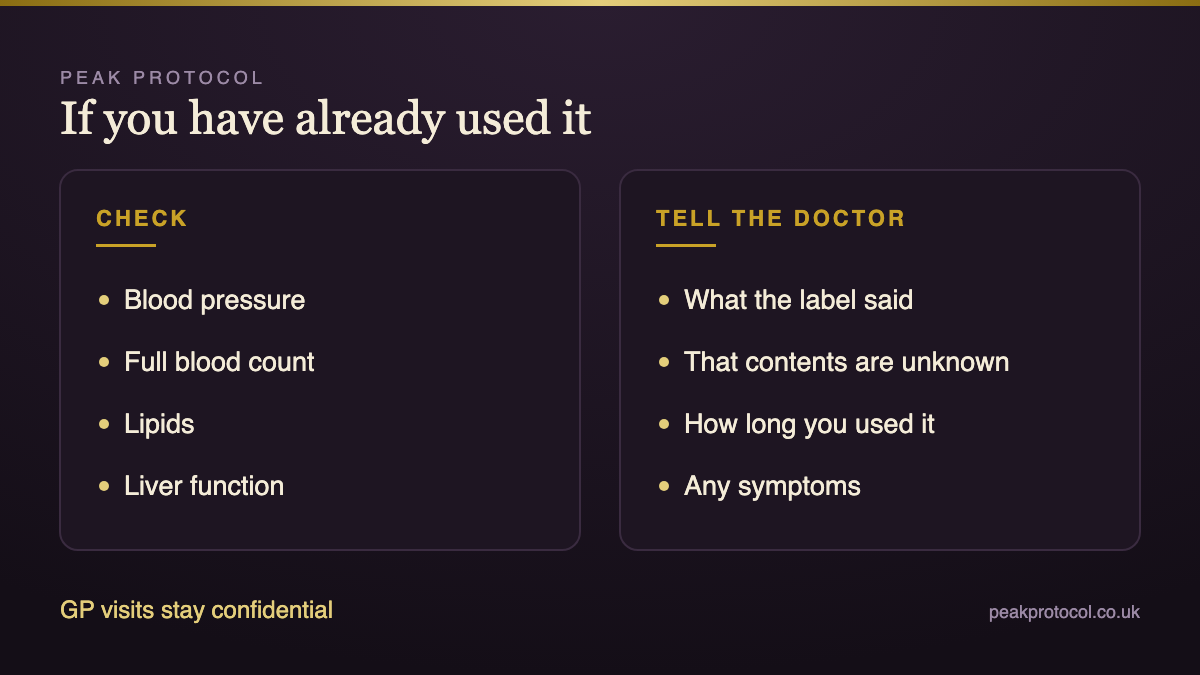
The safest option is not to use it. If you have used it, get the health checks that apply to any steroid use: blood pressure, a full blood count, lipids and liver function, as explained in our steroid blood tests guide. Tell the doctor what the label said and that you cannot be sure what it contained. If you inject, use sterile equipment from a needle and syringe programme and never share vials.
If you are an athlete, remember that a mislabelled product can contain a substance with a far longer detection time than the one you thought you were taking. Our anti-doping guide covers strict liability.
The same problem, on a smaller scale, with supplements
Contamination is not only a steroid problem. Some sports supplements, particularly products marketed as “legal steroids”, fat burners and pre workouts with exotic stimulants, have been found to contain undeclared or banned substances. For tested athletes, batch testing schemes such as Informed Sport reduce that risk. We explain how we choose and describe the supplements we sell in our editorial policy.
Fake online pharmacies and TRT
Counterfeiting reaches beyond underground steroid brands. Websites styled as pharmacies offer testosterone, anti oestrogens and fertility drugs without a prescription. A legitimate UK online pharmacy must be registered, and you can check it on the General Pharmaceutical Council register. Any site that sells prescription only medicines without a genuine prescription is operating illegally, whatever its design suggests.
If you need testosterone for a medical reason, the safe routes are set out in NHS vs private TRT. Products from those routes are licensed, traceable and dispensed by a registered pharmacy.
Why price, reputation and experience do not help
People often assume that paying more buys a better product, or that a seller with a long history must be reliable. Neither holds. Price in an unregulated market reflects what buyers will pay and the risk the seller takes, not what is in the vial. A seller can have a long history and still change their source at any point without telling anyone. Experienced users are not immune either: several analyses of seized products have found mislabelled items attributed to brands with strong reputations among users.
The only products whose contents are verified are licensed medicines supplied through the regulated system. That is not a moral point, it is simply where testing and accountability exist.
Five misunderstandings about counterfeit steroids
- “Pharma grade means genuine.” Pharma grade is a marketing phrase with no regulatory meaning.
- “It worked last time.” The next batch may contain something different.
- “Oil is always sterile.” Contaminated oils have been found repeatedly.
- “A lab report proves it.” Reports can be forged or reused and cover one sample at most.
- “Buying from a friend is safer.” It is the same supply chain, and passing steroids between friends is itself supply.
Counterfeit steroids: common questions
How common are counterfeit steroids in the UK?
Outside prescriptions, almost all steroids come from unregulated labs. Testing of seized and purchased products regularly finds wrong compounds, wrong doses or contamination, so any unregulated product should be assumed unreliable.
Can you tell if a steroid is fake by the packaging?
No. Packaging, holograms, batch numbers and verification codes are easy to copy or invent and prove nothing about what is inside.
What are the dangers of counterfeit steroids?
The wrong drug or dose, contamination with bacteria or particles leading to abscesses and infections, and undeclared substances that cause unexpected reactions.
Can I get a steroid tested in the UK?
WEDINOS, run by Public Health Wales, tests submitted samples anonymously and free of charge and publishes the result. It identifies contents but does not test sterility or confirm safety.
How do I report a fake medicine?
Report suspected fake or contaminated medicines and any side effects to the MHRA Yellow Card scheme. See a doctor first if you are unwell.
Are legal steroid supplements ever contaminated?
Some products marketed as legal steroids or fat burners have been found to contain undeclared drugs. Batch tested supplements reduce the risk for athletes.
Sources and review status
This guide draws on guidance from the Medicines and Healthcare products Regulatory Agency, the MHRA Yellow Card scheme, the NHS guidance on anabolic steroid misuse, WEDINOS and Informed Sport.
Written by the Peak Protocol editorial team. This page has not been reviewed by a medical or legal professional. It is information, not medical or legal advice, and it is not an encouragement to use any drug. Peak Protocol sells legal sports supplements and does not sell anabolic steroids, SARMs or prescription medicines. How we research and correct content is set out in our editorial policy.