
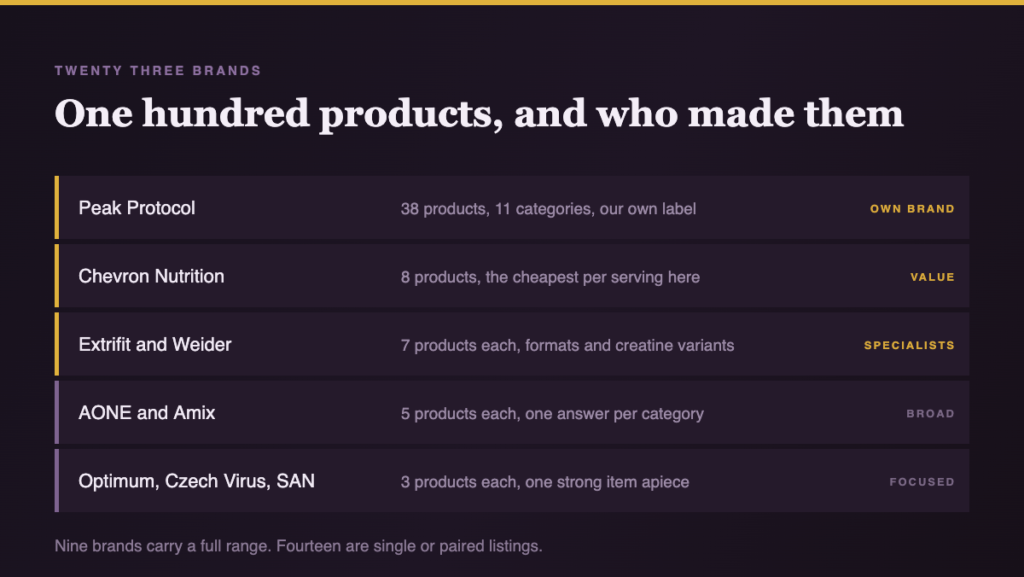
Peak Protocol carries one hundred and five products from twenty three supplement brands. Thirty eight of those are our own label and the other sixty seven come from companies we do not own, do not control and are perfectly willing to criticise on their own product pages. This page explains what each of those brands is for, which of them we think is worth your money, and where a familiar name is doing more work than the powder inside the tub.
Eleven of the twenty three supplement brands have enough depth here to be worth browsing as a range. The other twelve are one or two product listings, and we have said so plainly rather than dressing a single protein tub up as a collection.
On this page
- All 23 supplement brands we stock
- Why we sell other companies’ supplement brands
- How supplement brands earn shelf space here
- The own label, and what it changes
- Where each brand is genuinely the best answer
- What a brand name does not tell you
- What each shelf looks like across the brands
- How to compare prices across supplement brands
- Supplement brands we do not stock
- Buying imported supplement brands in the UK
- Common questions about our supplement brands
All 23 supplement brands we stock
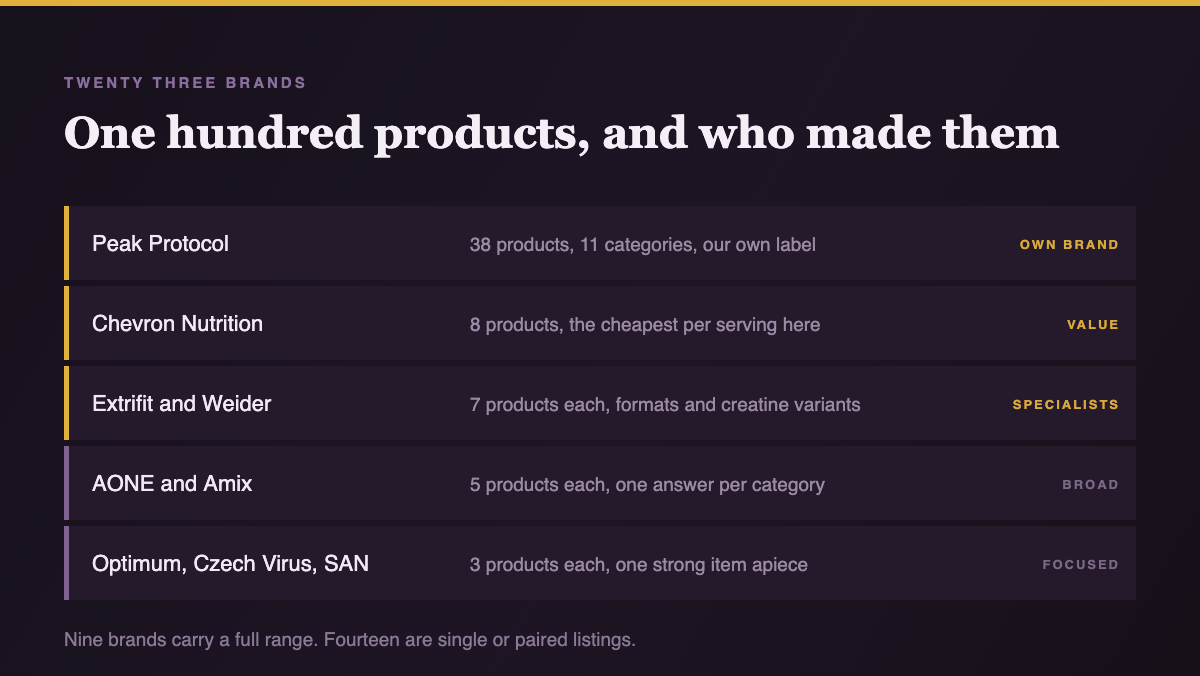
Eleven supplement brands here carry three or more products, which is enough for the range to have a shape worth describing. Each one has a full write up behind the link.
| Brand | Products | Categories | Price range | What it is for |
|---|---|---|---|---|
| Peak Protocol | 38 | amino acids, bundles, creatine, estrogen support, glutamine, L carnitine, recovery support, pre workout, protein, testosterone support, vitamins | £13.99 to £74.99 | Our own label. Single ingredients at researched doses, every amount printed |
| Chevron Nutrition | 9 | amino acids, creatine, protein | £15.00 to £44.00 | The value option. Cheapest creatine and glutamine on the site |
| Extrifit | 7 | amino acids, protein | £20.00 to £61.00 | Format specialists. Four BCAA formats and a hydrolysed isolate |
| Weider | 7 | amino acids, creatine | £24.00 to £51.00 | The oldest name here. Four creatine variants at premium prices |
| Amix Nutrition | 6 | amino acids, creatine, protein | £12.00 to £36.00 | Amino acid range, including a 4:1:1 BCAA that is hard to find in the UK |
| AONE Nutrition | 5 | amino acids, creatine, electrolytes, protein | £18.00 to £34.00 | One product per category. The only electrolyte formula we carry |
| Nutrend | 4 | amino acids, creatine, electrolytes | £7.00 to £24.00 | The lowest prices on the site. Creatine, two BCAA formats and an isotonic concentrate |
| Czech Virus | 3 | creatine, protein | £20.00 to £57.00 | Creapure creatine at a generic price, plus two bulk protein blends |
| Optimum Nutrition | 3 | protein, vitamins | £32.00 to £89.00 | The protein benchmark. The 4.54 kg tub is the cheapest per serving |
| Reflex Nutrition | 3 | amino acids, protein, vitamins | £7.00 to £54.00 | The only British manufacturer here, making in its own facility |
| SAN Nutrition | 3 | amino acids, creatine | £17.00 to £42.00 | American brand built on modified creatine forms |
The remaining twelve brands are single listings or pairs. They are real products from real companies and several are good buys, but a one product archive is not a range, so we have not pretended otherwise by writing two thousand words about each of them.
| Brand | Products | Categories | Price range | What it is for |
|---|---|---|---|---|
| BSN | 2 | amino acids, protein | £32.00 to £52.00 | Protein and an amino acid formula |
| Kevin Levrone | 2 | protein | £36.00 to £56.00 | Two protein products |
| MuscleTech | 2 | protein, vitamins | £15.00 to £41.00 | Whey and a multivitamin |
| Prom In | 2 | creatine, protein | £12.00 to £26.00 | Czech brand, protein and creatine |
| PVL | 2 | protein | £36.00 to £38.00 | Two protein products |
| DG Nutrition | 1 | protein | £51.00 | One protein |
| MB Nutrition | 1 | protein | £20.00 | One protein |
| Musclebody | 1 | accessories | £4.99 | A shaker |
| NOW Foods | 1 | vitamins | £26.00 | A single vitamin product |
| Peak | 1 | creatine | £52.00 | One creatine formula |
| Scitec Nutrition | 1 | amino acids | £36.00 | One amino acid product |
| Yamamoto | 1 | amino acids | £20.00 | One amino acid product |
Why we sell other companies’ supplement brands
A shop with an own label and nothing else has an obvious problem: every recommendation it makes is a recommendation to buy from itself. That is not advice, it is a catalogue with opinions attached, and readers work it out quickly.
Stocking sixty seven products we did not formulate solves that. When our page on creatine says the Creapure sourced monohydrate from Czech Virus at twenty pounds is the best value creatine in the catalogue, that is a statement against our own margin, and it is true. When the protein page points at the four and a half kilogram Optimum Nutrition tub as the cheapest protein per serving on the site, the same applies.
There is a commercial logic underneath the principle. People who trust a shop’s advice come back to it. People who work out that every answer leads to the house brand do not.
How supplement brands earn shelf space here
We apply five tests before any of the supplement brands here goes on the site, and they are all things you could check yourself if you had the tubs in front of you.
The label declares amounts, not just ingredients. A proprietary blend is a way of listing eleven impressive sounding ingredients while hiding how little of each is present. If a brand’s flagship product hides its doses, it does not get listed.
The doses relate to the research. Not every product needs to hit a study dose, but a product built around an ingredient should contain a working amount of it. A pre workout with three hundred milligrams of citrulline is decorating a label, because the research used six to eight grams.
UK compliant labelling. Anything sold here has to carry an ingredient list in weight order, a nutrition declaration and an allergen statement that meet the government rules on food labelling. European or American packaging that has not been brought into line does not qualify.
Honest claims. Great Britain permits only the wording on the nutrition and health claims register, and a brand that routinely writes past it is telling you how it treats evidence generally.
Price that survives arithmetic. Cost per serving, or per gram of the active, not cost per tub. A cheap tub with a small scoop is not cheap.
The own label, and what it changes
Peak Protocol is thirty eight products across eleven categories, and it exists because there were gaps we could not fill from other people’s ranges at a price we thought was fair. Single ingredient powders at researched doses are unglamorous, low margin and easy to compare on price, which is exactly why fewer brands make them than you would expect.
Selling our own label alongside other supplement brands creates an obvious conflict, and the way we handle it is to publish the comparison rather than avoid it. Every own label product page names the competing product on this site where one is a better buy. Every brand page in the table above has a comparison section that includes us, and in several of them we come second.
The categories where our own range genuinely is the strongest answer are the ones nobody else here covers: testosterone support, estrogen support, recovery support and vitamins and minerals. On protein and creatine we are competitive rather than dominant, and the tables say so.
Where each brand is genuinely the best answer
Eleven ranges, eleven different jobs. This is the short version of what each brand page argues at length.
| If you want | Buy from | Why |
|---|---|---|
| The cheapest creatine that works | Chevron Nutrition | Plain monohydrate at twenty pounds for five hundred grams, no exotic form, no premium |
| Creatine with documented purity | Czech Virus | Creapure sourced monohydrate priced level with generic material |
| Protein in bulk, cheapest per serving | Optimum Nutrition | The 4540 gram Gold Standard tub works out at around sixty one pence a serving |
| A hydrolysed isolate for lactose trouble | Extrifit | Hydro Isolate 90, plus four BCAA formats if you want one |
| An electrolyte formula for long sessions | AONE Nutrition | Stamimax is the only product of its kind in the catalogue |
| A 4:1:1 BCAA, specifically | Amix Nutrition | A leucine weighted tablet that is hard to find in the UK |
| An alternative creatine after stomach trouble | SAN Nutrition | Buffered and modified forms, useful for tolerance rather than for performance |
| Creatine in tablets from a heritage name | Weider | Krea Genic in tablet form, at the highest creatine prices here |
| Single ingredients with every dose printed | Peak Protocol | Twenty four of the thirty eight own label products contain one active |
| The lowest price in a category | Nutrend | Cheapest item on the site in two of the three categories it enters |
| Something made in Britain | Reflex Nutrition | The only brand here manufacturing in its own facility rather than by contract |
What each shelf looks like across the brands
The twenty three supplement brands are not spread evenly. Protein is contested by fifteen of them and amino acids by twelve, which is why those two categories carry the widest price spread on the site and the most duplication. Creatine has nine brands competing, and because creatine monohydrate is a commodity, that competition shows up almost entirely in the price rather than in the powder.
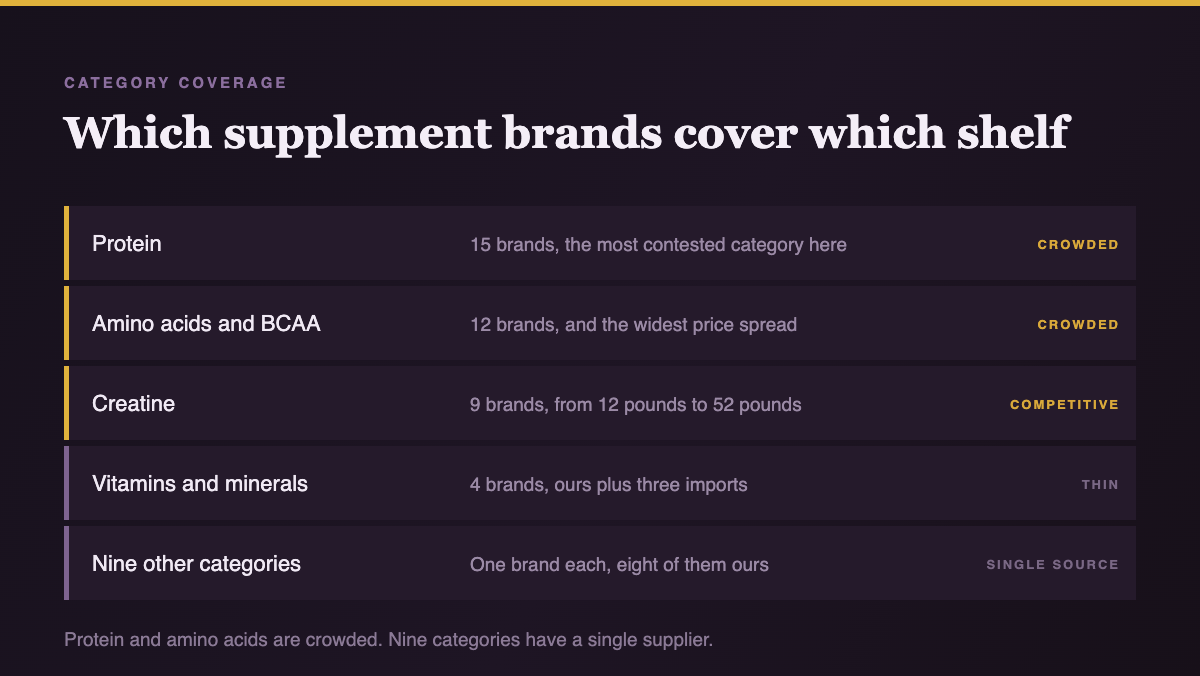
At the other end, nine categories have exactly one supplier, and in eight of those it is our own label. Testosterone support, estrogen support, pre workout, glutamine and L carnitine have no imported competitor here at all. That is not a claim to superiority, it is simply where the ranges we can buy do not reach.
How to compare prices across supplement brands
Every price comparison between supplement brands goes wrong in the same place: the tub. Serving sizes are set by whoever made the product, so a cheap tub with a small scoop and an expensive tub with a large one can cost exactly the same per serving. Divide the price by the number of servings on the label before you decide anything.
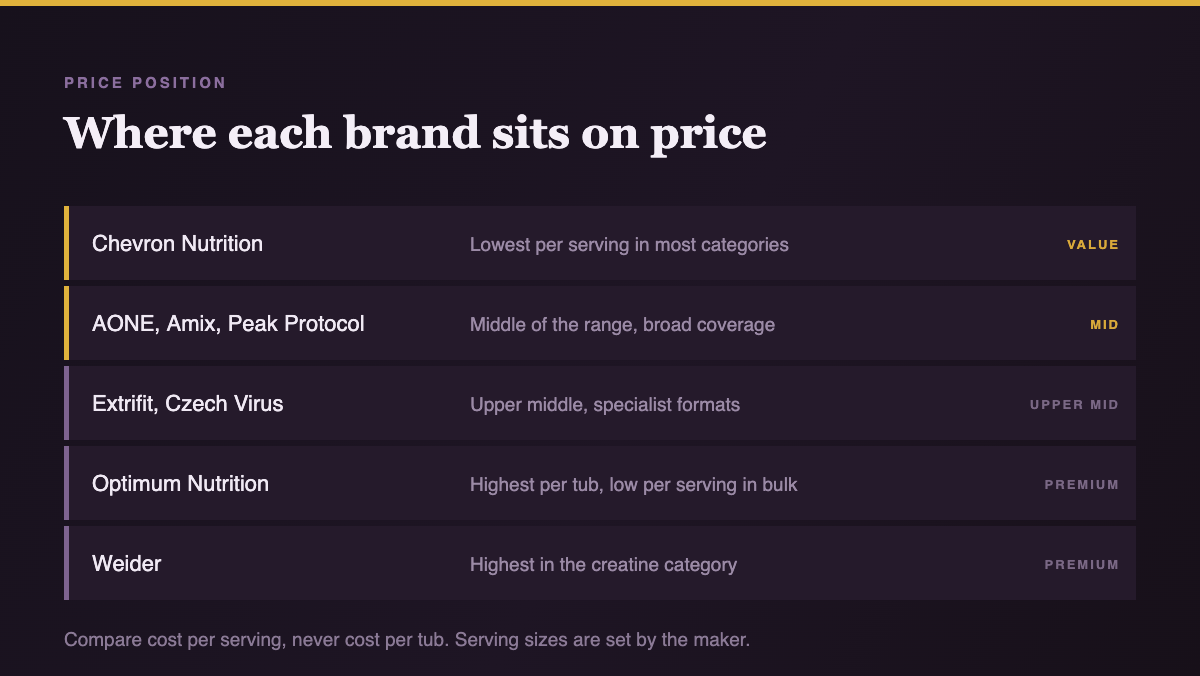
Comparing supplement brands on a single ingredient means going one step further and pricing the active. Compare cost per gram of it. A creatine at twenty pounds for five hundred grams and one at fifty pounds for two hundred grams are not close, whatever the front of the tub says. The same test applied to protein means cost per gram of protein rather than per kilogram of powder, which is where a flavour led product with a lower protein percentage quietly loses.
Across supplement brands, two things are worth paying more for and neither is the logo: a documented raw material where purity has actually been tested, and batch testing if you compete under anti doping rules. Everything else you are paying for is packaging, flavour and marketing, and those are preferences rather than performance.
What a brand name does not tell you
Three things get attributed to supplement brands that no brand can actually deliver, and it is worth being explicit about all three.
A brand cannot make an ingredient work better. Creatine monohydrate from a famous company and creatine monohydrate from an unknown one are the same molecule at the same dose. What differs is purity documentation, mixing quality, flavour and consistency between batches. Those are real and worth paying something for. They are not pharmacology.
A clean formula is not a clean batch. Supplement contamination is a documented problem and it happens at the manufacturing level, which means it is a question about a specific batch rather than about a logo. If you compete under anti doping rules, read the UK Anti-Doping guidance on supplements and buy from batch tested programmes such as Informed Sport. Trusting a brand name instead of a batch certificate is how people lose careers.
Regulatory status travels with the country, not the company. A claim printed legally on an American label may be unlawful in Great Britain, because the two systems substantiate claims differently. The Food Supplements (England) Regulations 2003 and the GB claims register decide what may be said here, whoever made the product.
Supplement brands we do not stock
We turn down more supplement brands than we take, and the reasons cluster into three groups.
Anything sold as a legal alternative to an anabolic steroid. There is an entire category of products named to resemble controlled substances, and none of them behave like one. Our guide to what legal supplements actually do covers why the resemblance stops at the name, and our page on where UK law sits covers the real thing.
Proprietary blend ranges. If the amounts are hidden, we cannot tell you whether the product works, which makes writing an honest product page impossible.
Anything requiring a prescription, or sitting near that line. Everything on this site is a food supplement. Where a reader’s question is actually a medical one, the answer is a doctor and a blood test, which is why we publish the TRT guide and the blood testing guide rather than selling something against them.
Buying imported supplement brands in the UK
Most of the imported supplement brands here come from central European manufacturers, and buying them through a UK shop rather than direct changes three practical things.
The first is cost certainty. Stock held in the UK ships domestically, so there is no customs charge arriving after the fact and no handling fee from a courier. Ordering the same tub from a European site can add both.
The second is labelling. Products brought into Great Britain properly carry compliant ingredient, nutrition and allergen information, and a UK responsible business behind them. Grey imports frequently do not, which matters most for anyone with an allergy.
The third is recourse. If a tub arrives damaged, or is not what the listing described, the position is set out on shipping and returns and it is enforceable. Payment options are on how to pay.
Counterfeiting is a genuine problem for the best known names in this industry, and the pattern is consistent: the most heavily counterfeited products are the most famous ones, sold through marketplaces at prices that do not make sense. If a four and a half kilogram tub of a flagship whey is advertised at half the going rate, the arithmetic is telling you something.
Common questions about our supplement brands
How many supplement brands do you stock?
Twenty three supplement brands, covering one hundred and five products. Thirty eight are our own Peak Protocol label and sixty seven come from other companies. Eleven of the brands carry three or more products and have a full range page; the other twelve are single or paired listings.
Do you recommend your own brand over the others?
Not automatically, and the comparison tables on every brand page are the evidence. Chevron Nutrition beats us on creatine price, Czech Virus beats us on documented creatine value, Optimum Nutrition beats us on cost per protein serving in bulk, and Extrifit has a hydrolysed isolate we do not make.
Why do some brands only have one product?
Because that one product was worth listing and the rest of the range was not, or because stock is limited. We have set those archives to stay out of search results rather than pad them with copy, since a single listing is not a range.
Are the imported brands genuine?
Yes. Everything here is sourced through UK supply and held in UK stock, with compliant labelling. The counterfeiting problem in this industry lives mostly on open marketplaces where anyone can list a tub, and the tell is nearly always a price that does not add up.
Is a more expensive brand a better product?
Sometimes, and not for the reason people assume. Higher prices buy purity documentation, mixing quality, flavour consistency and batch to batch reliability. They do not buy a different effect from the same ingredient at the same dose.
Which brand should I start with?
Whichever one is cheapest for the two things that matter most: protein and creatine. That usually means Chevron Nutrition or Czech Virus for creatine and Optimum Nutrition or our own range for protein. Everything beyond those two is optional.
Do you stock new supplement brands as they launch?
Rarely. A new brand has no batch history and no track record on label accuracy, and we would rather watch for a while than list something we cannot yet write about honestly.
Read next
- What actually has evidenceWhich legal supplements earn their place and which are sold on marketing alone.
- The full catalogueAll one hundred products, filterable by category and price.
- The guide libraryLong form guides on UK law, TRT, blood work and recovery.
- Who we areHow the shop is run and why the editorial line is what it is.
Editorial standards are set out in our editorial policy.